
Overview
Lithium Batteries for Golf Carts
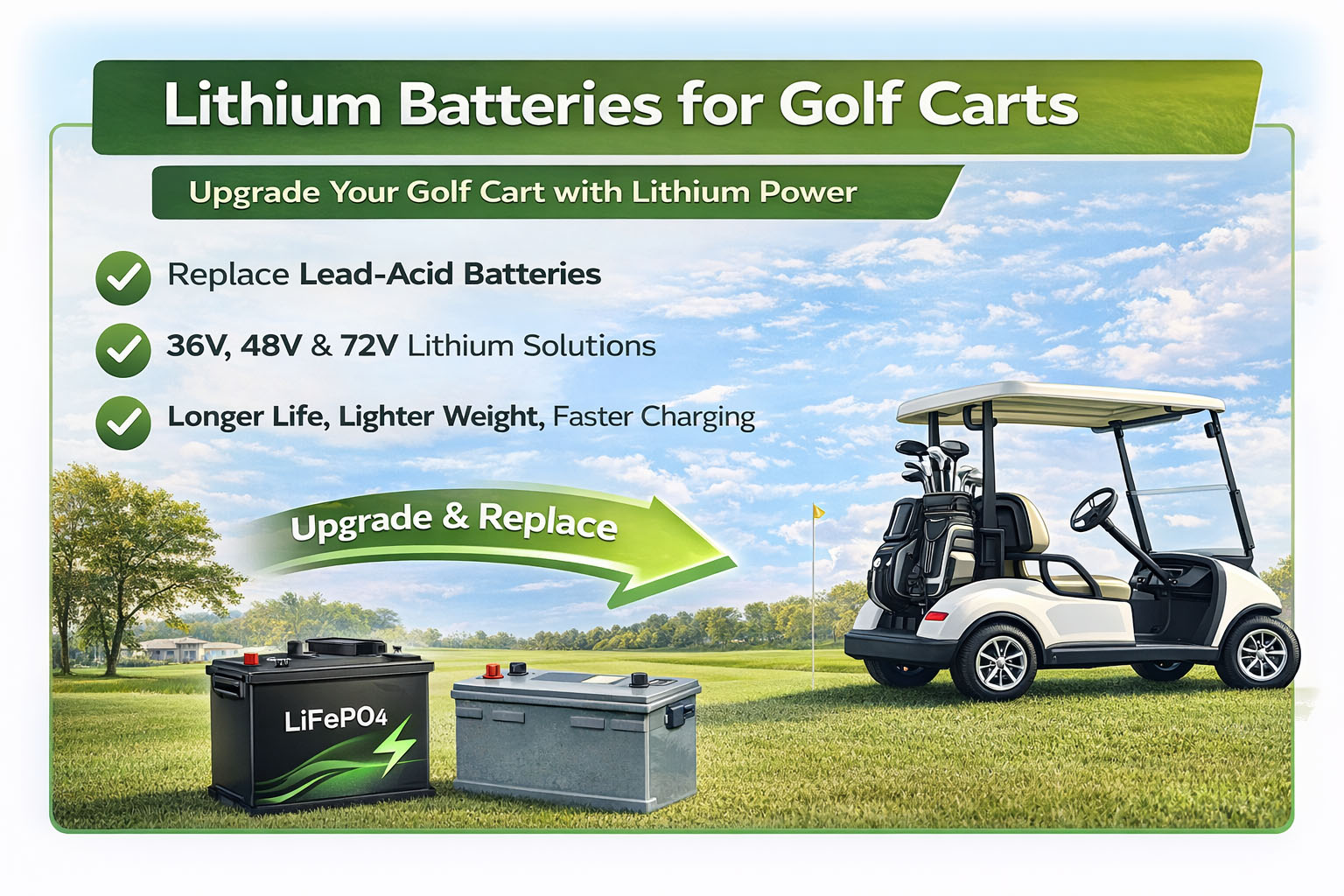
If you are trying to decide whether lithium batteries are the right choice for your golf cart, this page helps you get a clear answer faster. You can quickly understand what a lithium upgrade means, why many users replace lead-acid systems, and what you should check before you choose a battery solution for your cart.
Instead of making you search through scattered product pages and mixed advice, this guide brings the key questions together in one place. You can review voltage options, battery size, runtime expectations, charging requirements, and conversion basics before you move on to detailed product selection.
Why Choose Lithium Batteries for Golf Carts
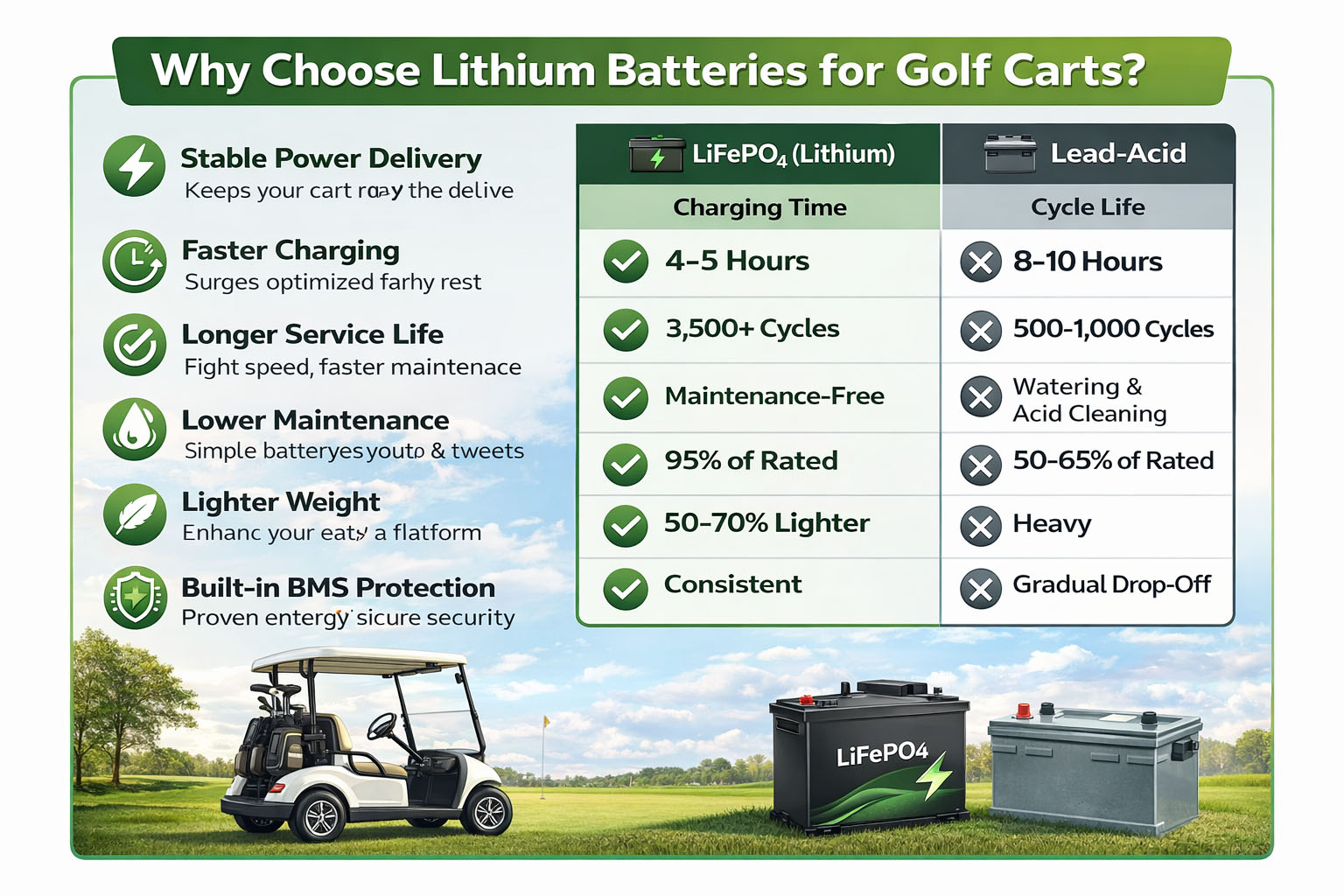
If you are comparing lead-acid and lithium for your golf cart, the biggest difference is not just battery chemistry. It is how your cart feels in daily use, how often you need to charge, how much maintenance you want to deal with, and how reliably the power system performs when you actually need it. That is why many users see lithium golf cart battery benefits as more than a simple battery upgrade.
Stable Power Delivery
If you use your cart on slopes, around larger properties, or for longer drives, stable output matters. A lithium setup can help your cart feel more consistent during acceleration and repeated use, instead of feeling weaker as the battery charge drops. That makes everyday driving feel more predictable, especially when you want dependable performance instead of noticeable power fade.
Faster Charging
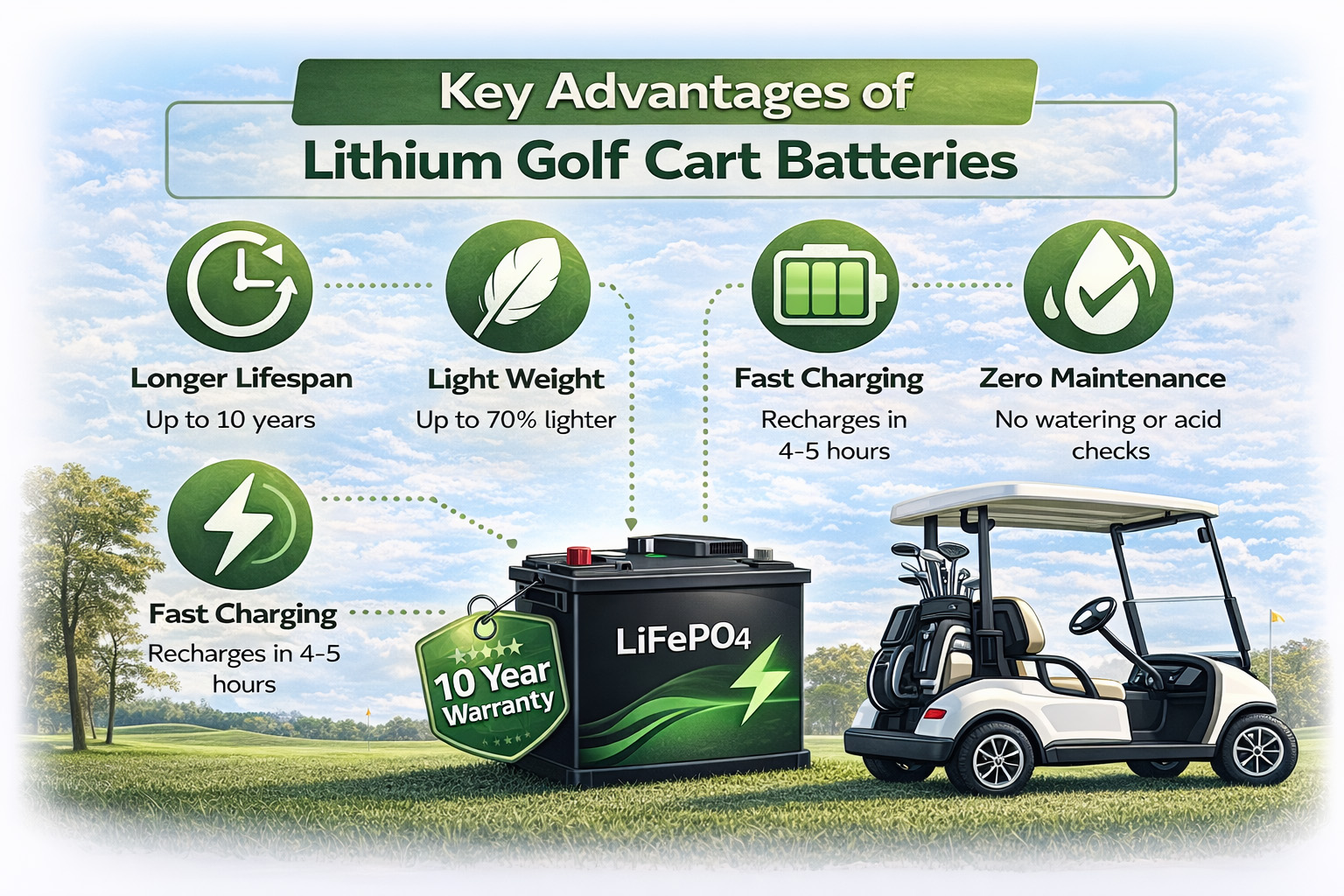
Faster charging can make a real difference if you use your cart often and do not want long downtime between trips. Instead of waiting as long for the battery system to recover, you can get back to using the cart sooner. If your routine includes frequent stops, short breaks, or back-to-back use, this is one reason many users feel lithium is worth it for golf carts.
Longer Service Life
If you want a battery system that can support more charge and discharge cycles over time, lithium is often considered a stronger long-term option than traditional lead-acid. This does not just mean longer life on paper. It can also mean fewer replacement cycles, less interruption, and a better fit if you plan to keep your golf cart in service for years rather than treat the battery as a short-term part.
Lower Maintenance
One reason people look for a maintenance-free golf cart battery is simple: they want less routine work. Compared with lead-acid systems that may require more ongoing attention, lithium can reduce the amount of regular battery care you need to think about. If convenience matters to you, this becomes a practical daily-use advantage, not just a technical feature on a spec sheet.
Lighter Weight
A lighter battery system can help reduce overall cart weight, and that may improve efficiency and make the cart feel more responsive in normal use. If you are carrying passengers, tools, or other loads, reducing battery weight can also give you more flexibility elsewhere in the cart. For many users, this is one of the most noticeable lead-acid vs lithium golf cart battery differences.
Built-In BMS Protection
Many lithium systems include built-in battery management features designed to help monitor and protect the battery during use and charging. That does not mean you should ignore system matching or charging requirements, but it does add a layer of control that many users appreciate. If you want a more modern golf cart battery setup, BMS protection is one of the features worth paying attention to.
What You May Notice in Daily Use: Lead-Acid vs Lithium
| What You Compare | Traditional Lead-Acid | Lithium Setup |
|---|---|---|
| Charging Time | Usually longer, with more downtime between uses | Typically faster charging, which can help reduce waiting time |
| Cycle Life | May need replacement sooner with repeated use | Often supports more use cycles over a longer period |
| Maintenance | Usually needs more routine battery care | Lower-maintenance use is one reason many users switch |
| Usable Capacity | Power drop can feel more noticeable as charge falls | More stable usable performance in normal operation |
| Weight | Heavier battery system | Lighter overall setup, which can help efficiency and handling |
| Voltage Stability | Performance may fade more obviously during use | More consistent power delivery for repeated driving |
How to Choose the Best Lithium Battery for a Golf Cart
If you are searching for the best lithium battery for a golf cart, it helps to start with the right questions instead of looking for one universal answer. The best option depends on your cart voltage, how long you use the cart each time, the terrain you drive on, the weight you carry, the installation space available, and whether you need a battery-only replacement or a more complete conversion kit.
Check Your Cart Voltage First
Before you compare anything else, you should confirm whether your golf cart system is 36V, 48V, or 72V. This is the first filter because the battery setup needs to match the cart system requirements. If you skip this step, it is easy to spend time looking at options that are simply not right for your cart from the start.
Estimate Your Runtime Needs
Think about how you actually use the cart. Short neighborhood trips, course use, property transportation, and longer utility-style runs can create very different runtime expectations. If you drive often, carry passengers or equipment, or use the cart over longer distances, you will usually need to look more carefully at capacity rather than just choosing the first battery that matches the voltage.
Choose the Right Capacity
Capacity is where many buying decisions become more practical. If you are comparing 100Ah, 150Ah, or larger options, the right choice depends on how much runtime you want between charges. If your goal is light and occasional use, your needs may be different from someone who wants longer operating time, heavier-duty use, or fewer charging interruptions during the week.
Confirm Installation Space
The battery solution still has to fit your cart properly. If you are upgrading an older cart or changing from a multi-battery lead-acid layout to a different lithium structure, you should check tray space, cable routing, and overall installation layout in advance. This helps avoid choosing a battery system that looks good on paper but is harder to fit in real use.
Review Charger Compatibility
A battery is only part of the upgrade decision. You should also check whether your current charger setup is suitable for the lithium system you want to use. In many cases, charger compatibility becomes one of the most important buying checks, especially if you are moving from an older lead-acid system and want a smoother transition without guessing.
Look for BMS and Safety Features
If you are comparing golf cart battery options seriously, built-in battery management and protection features deserve attention. These features can support safer system control and better battery monitoring during use and charging. They are not a substitute for correct setup, but they are part of what can make one lithium solution a better fit than another for real-world golf cart use.
Start with Voltage
Ask yourself what voltage system your cart uses now. This helps narrow your choices immediately and keeps you focused on compatible options first.
Then Think About Use
Ask how often you use the cart, how long each trip usually lasts, and whether the cart is used on hills, with passengers, or with extra load.
Match Capacity to Need
Once voltage and usage are clear, it becomes easier to decide which capacity range makes more sense for your golf cart instead of guessing.
Before You Choose, Check These Practical Points
36V vs 48V vs 72V Golf Cart Lithium Batteries
If you are trying to figure out what voltage battery your golf cart needs, this is the first place to slow down and check the basics. A 36V lithium battery for a golf cart, a 48V lithium battery for a golf cart, and a 72V golf cart lithium battery are not interchangeable choices. The right option depends on the system your cart was built to use, how you drive it, and how much runtime you expect from the battery upgrade.
36V Lithium Batteries for Golf Carts
If your cart uses a 36V system, a 36V lithium battery for a golf cart is the voltage range you should focus on first. This type of setup is commonly considered for carts that are used for neighborhood driving, lighter daily movement, or general property transportation where the goal is to replace an older lead-acid system with a more modern lithium solution.
- Common fit for golf carts built around a 36V battery system
- Often considered for lighter daily use and straightforward battery replacement
- Typical capacity choices may start around 60Ah and move upward depending on use needs
48V Lithium Batteries for Golf Carts
If your cart is built around a 48V system, this is often where your research should stay. A 48V lithium battery for a golf cart is one of the most searched voltage options because many users want a balance of strong everyday performance, practical runtime, and a cleaner upgrade path from aging lead-acid batteries.
- Common choice for carts designed around a 48V platform
- Often suitable for regular driving, larger properties, and more frequent weekly use
- Typical capacity ranges may include 80Ah, 100Ah, 105Ah, 150Ah, and beyond
72V Lithium Batteries for Golf Carts
If your cart operates on a 72V system, you should stay within that voltage requirement and choose a 72V golf cart lithium battery that matches the original setup. This voltage class is usually more relevant when the cart is designed for higher-voltage operation and the battery replacement needs to preserve the original electrical platform rather than change it.
- Intended for golf carts built for a 72V system
- More relevant when maintaining a higher-voltage platform is part of the upgrade goal
- Capacity choices vary, but runtime planning still depends on usage, terrain, and load
Golf Cart Lithium Battery Conversion & Compatibility
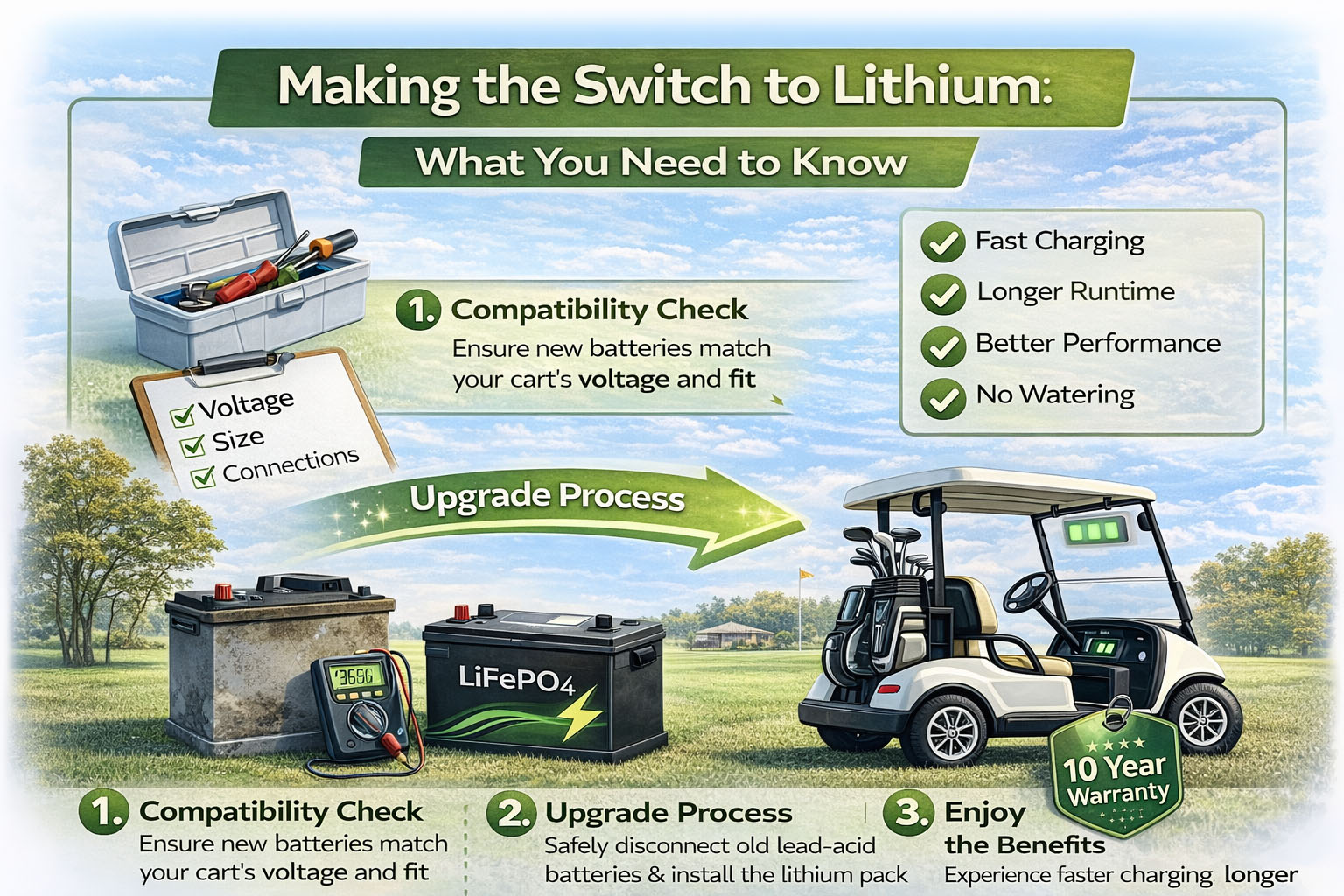
If you are asking whether you can convert your golf cart to lithium batteries, the answer is often more detailed than simply replacing one battery with another. A golf cart lithium battery conversion can involve the battery itself, the charger, cables, brackets, monitors, and other parts depending on your cart design and how complete the upgrade needs to be. That is why it helps to understand the conversion path before choosing a battery-only option or a full conversion kit.
Can Most Golf Carts Be Converted to Lithium?
In many cases, a golf cart can be converted to lithium, but the right answer depends on the original voltage system, battery tray space, cable layout, charger situation, and the overall condition of the cart. If your cart is older, it is even more important to check the whole setup before assuming the upgrade will be as simple as a direct battery swap.
What Is Included in a Conversion Kit?
A golf cart lithium battery conversion kit may include more than the battery pack itself. Depending on the system, it can also involve a lithium-compatible charger, cables, mounting brackets, a monitor or display, and optional accessories designed to support the installation. If you are trying to avoid guesswork, a more complete kit may feel easier to evaluate than sourcing parts one by one.
Is It a Drop-In Replacement?
Some lithium upgrades are closer to a drop-in golf cart battery replacement, while others are better treated as a fuller system conversion. If your cart layout, charger setup, or mounting configuration does not line up cleanly with the new battery design, the upgrade may require extra planning rather than a simple swap. This is one reason conversion research matters before purchase.
Do You Need a New Charger?
In many upgrade situations, you should not assume the old charger is automatically the right match for a new lithium system. Charger compatibility is often one of the most important parts of a lithium golf cart battery conversion. If the charger is not suitable for the battery system, the upgrade process can become more complicated than expected.
What Should You Check Before Converting?
Before you switch to lithium batteries in your golf cart, you should confirm the cart voltage, available installation space, current battery layout, charger plan, cable condition, and whether you need a battery-only replacement or a broader conversion package. A little checking up front can save you from choosing a setup that does not fit your cart as well as it should.
What Size Lithium Battery Do I Need?
If you are trying to decide what size lithium battery you need for a 48V golf cart or wondering whether 100Ah is enough for your golf cart, the answer depends on how you actually use the cart. Battery size affects runtime, but Ah does not decide everything by itself. Voltage, terrain, passenger load, driving habits, and how often you use the cart all matter when you choose the right golf cart battery size.
What Battery Capacity Means for Golf Carts
Battery capacity, usually shown in Ah, helps describe how much energy the battery can support over time. In simple terms, a larger capacity can help support longer use between charges, but it should always be viewed together with your cart voltage and the way the cart is driven. If you are using your cart lightly, you may not need the same capacity as someone who drives longer routes, carries more load, or uses the cart frequently throughout the week.
Is 100Ah Enough for a Golf Cart?
For many users, 100Ah can be a practical starting point, especially if the cart is used for normal neighborhood driving, course movement, or lighter daily transportation. If your use is moderate and your routes are not especially long or demanding, a 100Ah lithium setup may feel like a balanced option. If your cart is used harder, longer, or on more challenging terrain, it may make sense to look beyond 100Ah.
When to Consider 150Ah or 200Ah
If your golf cart is used more often, carries passengers or tools, travels over larger properties, or spends more time on slopes and longer routes, a higher-capacity battery may be the better match. A 150Ah or 200Ah class option can make more sense when you want longer runtime, fewer charging interruptions, and a setup that fits heavier weekly use rather than occasional trips.
Single Large Pack vs Multiple Batteries
If you are comparing 2 x 100Ah vs 1 x 200Ah, the better choice is not only about total capacity. It also depends on system design, available space, wiring layout, mounting structure, and the battery configuration your cart is meant to use. That is why how many batteries you need for a golf cart lithium setup should be decided based on fitment and system planning, not just the total Ah number.
A Simple Way to Think About Capacity
100Ah Range
If you mainly use your cart for shorter daily trips, neighborhood driving, or lighter general use, this capacity range is often the first place many users start looking.
- Good for lighter weekly use
- Often easier to match for everyday driving needs
- Worth considering if you want a balanced starting point
150Ah Range
If your cart is used more regularly, covers longer routes, or carries more people and gear, moving into a higher capacity range can make daily use feel more comfortable.
- Useful for more frequent weekly driving
- Helps if you want longer runtime between charges
- Often a better fit for mixed personal and utility use
200Ah and Up
If your cart works harder, runs longer, or needs to reduce charging interruptions as much as possible, higher capacity becomes more relevant.
- Better for longer routes and heavier use
- Worth reviewing for frequent cargo or passenger demand
- Helps when runtime matters more than minimum battery size
Before You Choose a Battery Size, Keep These Points in Mind
Capacity affects runtime, but not by itself
A bigger Ah number usually supports longer use, but runtime still depends on your voltage, the terrain you drive on, how much weight the cart carries, and how you use the throttle in real conditions.
Your setup matters as much as the number
If you are comparing one large pack with multiple batteries, the real answer depends on system design, available space, and how your golf cart is meant to be configured.
How Long Will a 100Ah Lithium Battery Last in a Golf Cart?
If you are trying to estimate 100Ah lithium golf cart runtime or wondering how many miles a 48 volt golf cart can go on a full charge, the honest answer is that runtime depends on several conditions working together. A 100Ah battery can be enough for many users, but the actual driving time or range you experience will still depend on voltage, terrain, speed, weight, temperature, and how the cart is used from trip to trip.
What Affects Golf Cart Battery Runtime?
Runtime is shaped by more than just battery capacity. Your cart voltage, how quickly you accelerate, how far you normally drive, and whether the route is flat or hilly will all affect how long the battery feels in everyday use. This is why two golf carts using the same 100Ah battery may still deliver a different experience.
Typical Use Scenarios for 100Ah
A 100Ah setup is often viewed as a practical choice for users who want a balanced solution for ordinary golf cart driving rather than the longest possible runtime. If your cart use is moderate, your routes are reasonable, and your load is not especially heavy, this size can often feel like a sensible middle ground.
Why Terrain, Load, and Speed Matter
If you drive uphill often, carry extra passengers, haul tools, or run the cart at higher speed for longer periods, the battery will be asked to do more work. In practice, that means a 100Ah battery may feel very different in light use compared with heavier real-world use over the same voltage system.
What Usually Changes Golf Cart Battery Runtime
How to Think About 100Ah Runtime More Clearly
| What You Are Asking | What Really Changes the Answer | What It Means for You |
|---|---|---|
| How long will a 100Ah lithium battery last? | Voltage, speed, terrain, load, and trip pattern | A 100Ah battery may feel enough for moderate use, but real runtime depends on how the cart is driven |
| How many miles will a 48V golf cart go? | Route length, hills, passengers, and driving style | Range is not one fixed number, so it is better to think in terms of light, medium, or heavy use |
| Why does one cart last longer than another? | Cart setup, usage conditions, and system efficiency | Even with the same battery size, two carts may not deliver the same daily result |
Cost to Convert a Golf Cart to Lithium
If you are trying to work out the cost to convert a golf cart to lithium, it helps to look at the whole upgrade instead of focusing on just one battery price. The real golf cart lithium upgrade cost can depend on the battery itself, charger compatibility, added accessories, installation work, and whether you are doing a simple battery replacement or a more complete conversion. If you are asking whether it is worth converting to lithium, the better question is not only what you pay up front, but also what you gain over time.
What Affects Total Conversion Cost?
The total cost of a lithium upgrade usually depends on more than one part. The battery is a major part of the budget, but you may also need to consider the charger, wiring or cable adjustments, mounting parts, monitoring accessories, and installation support. If your cart is older or your setup needs more planning, the cost of the full upgrade can look different from a simple replacement project.
Battery Only vs Full Conversion Kit
If your cart already has a layout that works well with the lithium system you want, a battery-only replacement may be enough. If not, a full conversion kit can make more sense because it may include other parts that support the upgrade more smoothly. This is why the cost of a lithium battery for a golf cart can look very different from the cost of a full conversion path.
DIY vs Professional Installation
Some users prefer to handle the installation themselves, while others would rather pay for a more complete setup process. If your cart is straightforward and you already understand the system, DIY may reduce part of the cost. If you want more confidence in system fitment, charger matching, and final setup, professional installation may be worth considering as part of the full project budget.
Why Long-Term Cost Matters
A lithium upgrade should not be judged by first cost alone. If your goal is lower maintenance, fewer replacement cycles, less downtime, and a more convenient charging experience, the long-term view matters. That is often why users who compare lead-acid replacement cycles with lithium begin to see the upgrade as a bigger ownership decision rather than just a one-time purchase.
What You May Be Paying For in a Lithium Upgrade
Battery
The battery is usually the first and biggest part of the budget, but it should be evaluated together with the rest of the upgrade.
Charger
If your current charger is not suitable, charger replacement can become an important part of the total conversion cost.
Accessories
Cables, brackets, monitor tools, and other setup parts may be needed depending on the design of your cart and battery system.
Installation
If you want installation support, labor and setup work may need to be included in the full upgrade plan.
Why Some Users Still Feel Lithium Is Worth It
| What You May Notice | Short-Term View | Long-Term View |
|---|---|---|
| Initial Purchase | The up-front battery cost may look higher | This is only one part of the full ownership picture |
| Maintenance | You may focus only on replacement price | Lower routine maintenance can change how the value feels over time |
| Replacement Cycle | The first purchase may feel expensive | Fewer replacement cycles may make long-term planning easier |
| Downtime | Charging and battery handling may be seen as normal | Less interruption and easier daily use can add practical value |
Charger Compatibility, Charging Habits & Daily Use
If you are asking whether a regular golf cart charger can charge a lithium battery, how often you should charge a lithium battery in a golf cart, or whether it is okay to leave the system plugged in overnight, these are all practical questions that matter. Charging is not just about plugging in the cart. It is about using the right golf cart lithium battery charger, following sensible daily habits, and understanding how storage and charging conditions affect the battery system over time.
Do You Need a Lithium-Compatible Charger?
In most cases, you should not assume a regular charger for a lithium golf cart battery will automatically be the right match. Charger compatibility depends on the battery system you are using, and using the wrong charger can create unnecessary risk or poor charging performance. If you are upgrading from lead-acid, checking the charger plan is one of the first steps that should happen alongside the battery decision.
How Often Should You Charge a Golf Cart Lithium Battery?
The right charging frequency depends on how often and how hard you use the cart. If your golf cart is used lightly, your charging pattern may look different from a cart that is driven every day, over long distances, or with heavier load. Daily charging for a lithium golf cart is not automatically required in every situation, so it makes sense to match the charging habit to real use instead of following one rule for everyone.
Can You Leave It Plugged In Overnight?
Whether overnight charging makes sense depends on the charger logic and the battery system design. Some users prefer the convenience of plugging in after use, but the best approach should still follow the charging guidance for the specific system. If you are wondering whether you should leave your lithium golf cart plugged in all the time, it is better to think in terms of charger compatibility and system design rather than assuming longer connection is always better.
Daily Charging and Storage Tips
If your golf cart will sit for a while, storage habits matter too. It helps to think about how the cart is charged before storage, what the temperature conditions are like, and whether the battery system will be left in a suitable state for the next use. Good daily charging and sensible storage habits can make the whole lithium upgrade feel easier and more predictable in normal life.
What You Should Do
- Use a compatible charger that matches the lithium battery system you choose
- Follow the charging guidance for your battery setup instead of guessing from old lead-acid habits
- Charge based on how the cart is actually used, rather than forcing the same routine every time
- Think about storage conditions if the cart will sit for longer periods
- Review charger fit, battery fit, and daily use together as one system decision
What You Should Avoid
- Do not assume an old or regular charger is automatically correct for a lithium system
- Do not ignore temperature conditions if the cart is stored or charged in less stable environments
- Do not leave a poor or mismatched charging setup unattended and assume it is fine
- Do not copy charging habits from other battery types without checking system requirements
- Do not treat charger choice as an afterthought once the battery is already selected
How to Think About These Common Charging Questions
| Your Question | What Usually Matters Most | Better Way to Think About It |
|---|---|---|
| Will a regular golf cart charger charge a lithium battery? | Charger compatibility and battery system requirements | Do not assume yes; check for a lithium-compatible charger first |
| How often should I charge it? | How often, how far, and how hard the cart is used | Charge based on real use, not a one-size-fits-all rule |
| Can I leave it plugged in overnight? | Charger logic and system design | Convenience is fine only when the charging setup is appropriate for the system |
| What about storage? | How the cart is left before long idle periods and the surrounding temperature | Good storage habits are part of battery care, not something to think about later |
Common Problems, Disadvantages & When Lithium May Not Be Ideal
If you are looking up the problems with lithium batteries in golf carts, the downside of lithium golf cart batteries, or the disadvantages of LiFePO4 golf cart batteries, it helps to look at the topic honestly. Lithium can offer real benefits, but it is not the perfect answer for every cart, every budget, or every use pattern. If you are comparing options seriously, this is the stage where practical limits matter just as much as headline benefits.
Higher Upfront Cost
One of the first things many users notice is that the initial price can be higher than a traditional lead-acid replacement. If your main goal is the lowest possible first cost, lithium may not feel like the easiest choice at the start. This does not automatically mean it is the wrong choice, but it does mean the budget conversation needs to be realistic instead of based only on performance claims.
Charger and Voltage Compatibility Issues
Compatibility is one of the most common golf cart battery conversion issues. The battery voltage still has to match the cart system, and the charger setup still needs to make sense for the lithium battery you choose. If these checks are skipped, the upgrade can become more frustrating than expected. This is one of the reasons some users run into problems after focusing only on battery size or price.
Cold-Weather Charging Limitations
Temperature conditions matter more than some buyers expect. Cold-weather charging needs to be considered carefully, especially if the cart is stored outdoors or used in colder seasons. This does not mean lithium is unusable, but it does mean the battery system and charging habits should match the environment rather than being treated like a one-condition-fits-all solution.
Installation Planning Still Matters
Even if a lithium upgrade looks simple from the outside, installation planning still matters. Fitment, cable condition, charger matching, and cart layout all need to be checked, especially on older carts or modified systems. If you skip these details, the upgrade may feel more complicated than a standard replacement, which is why planning is part of the real decision.
When Lithium May Not Be the Best Fit
If your golf cart is only used lightly once in a while, if you are not ready to think through charger compatibility, or if your first priority is simply the lowest immediate replacement cost, lithium may not be the first option you focus on. In some cases, the best fit depends less on what is technically better and more on how often you use the cart, how much convenience matters to you, and how ready you are for a proper upgrade rather than a simple swap.
How to Look at Lithium More Realistically
Why Users Still Choose Lithium
- More modern battery experience for many golf cart owners
- Lower daily maintenance is attractive to users who want convenience
- Weight reduction and easier charging can improve daily use
- Longer-term ownership value matters to many buyers
What You Still Need to Think About
- Higher initial cost may not fit every budget
- Battery voltage and charger matching cannot be guessed
- Old carts and modified carts may need more setup review
- Cold-weather charging and storage conditions still matter
Older Golf Carts, Winter Use & Storage
If you are wondering whether you can put lithium batteries in an older golf cart, whether you can leave a lithium battery golf cart outside in the winter, or how long a golf cart can sit without being driven, these questions are all part of real ownership. An older golf cart battery upgrade needs more than a battery choice. It also needs a quick check of the system, the space, the charger plan, and the storage conditions your cart actually sees through the year.
Can Older Golf Carts Be Converted to Lithium?
In many cases, yes, but an older golf cart lithium conversion should start with a checklist rather than assumptions. The older the cart is, the more important it becomes to check the voltage system, battery tray space, cable condition, and charger plan. If the cart has already been modified in the past, that is another reason to slow down and review the whole setup before choosing a battery.
Winter Use and Cold-Weather Considerations
If your golf cart spends time outside in winter or in colder storage conditions, temperature becomes part of the battery conversation. Winter storage for a golf cart lithium battery should be treated as a real planning issue, not something to figure out later. The battery system, how the cart is charged, and the storage environment should all be considered together if cold weather is part of your normal use.
How to Store a Golf Cart for Longer Periods
If your cart may sit without being driven for a while, storage habits can affect how ready it feels when you return to it. Long idle periods are easier to manage when the battery is left in a sensible condition, the charger plan is clear, and the storage environment is stable. If you want fewer surprises later, storage should be treated as part of battery care, not something separate from it.
Before You Upgrade an Older Golf Cart, Check These First
Simple Ways to Think About Winter Use and Storage
For Older Golf Carts
Treat the upgrade as a system review, not just a battery purchase. The more age or modification history the cart has, the more important it is to check fitment and compatibility before moving forward.
For Winter Conditions
If your cart may stay outside in winter or in colder environments, think about temperature conditions before charging and storing the battery system. This helps you avoid treating winter use like normal mild-weather use.
For Longer Storage
If the cart may sit for weeks without being driven, do not leave storage planning until the last minute. A good storage routine can make the next use much smoother and reduce avoidable battery stress.
For Everyday Peace of Mind
A better upgrade experience usually comes from thinking about voltage, charger, environment, and storage together rather than solving each issue only after it becomes a problem.
Shop by Voltage & Use
If you already know your cart voltage or you are ready to move from research into product comparison, this section helps you narrow the next step more quickly. Instead of dropping you into a generic product list, we group lithium options by the kind of golf cart upgrade you may actually be trying to make, including voltage-based battery replacement, conversion-ready packages, and charger-related support.
Shop 36V Golf Cart Lithium Batteries
If your cart uses a 36V system, this is the best place to focus first. A 36V golf cart lithium battery is usually the right path when you want to replace an aging lead-acid setup without stepping outside the original system voltage.
- Built around 36V golf cart battery replacement needs
- Helpful for older carts that still rely on a 36V platform
- Good starting point if you want a cleaner lithium upgrade path
Shop 48V Golf Cart Lithium Batteries
If your cart is built around a 48V system, this is usually the most direct product path. A 48V golf cart lithium battery is often the most relevant choice for users who want practical daily performance, a clearer replacement route, and easier comparison across common capacities.
- Designed for 48V golf cart battery replacement planning
- Often the main choice for everyday personal or property use
- Easy to compare across runtime and capacity needs
Shop 72V Golf Cart Lithium Batteries
If your cart runs on a 72V platform, you should stay within that system requirement and compare the right lithium options from there. This group is better suited for users who are already working within a 72V setup and want a matching upgrade path rather than a voltage change.
- Focused on 72V golf cart system compatibility
- Useful when higher-voltage cart operation is already established
- Better for users comparing runtime within a 72V platform
Shop Conversion Kits and Chargers
If your upgrade is more than a battery swap, this is where you should look next. Golf cart lithium conversion kit options and golf cart lithium battery charger support can matter just as much as the battery itself when you want a smoother installation and fewer compatibility mistakes.
- Useful when the upgrade includes more than the battery pack
- Helps if charger compatibility is part of your buying decision
- Better for users planning a broader lithium conversion
Golf Cart Brand Compatibility
If your first question is not just about voltage but about fit for a specific cart brand, this section gives you a simpler entry point. Different users often continue their search with brand-based questions such as Club Car lithium battery conversion, EZGO lithium battery conversion, or Yamaha lithium battery options. These brand entry pages help you move from broad lithium research into a more focused compatibility review.
Club Car Lithium Battery Options
If you use a Club Car model, this entry helps you review lithium upgrade paths with that platform in mind. It is the right next step when you want a Club Car lithium battery overview without sorting through unrelated system information first.
- Focused on Club Car lithium battery conversion paths
- Useful for reviewing common system-fit questions first
- Better for narrowing compatibility before product comparison
EZGO Lithium Battery Options
If your cart is an EZGO model, this page helps you move from general lithium research into a more relevant EZGO compatibility overview. It is a practical next step when you want to match the battery upgrade path more closely to your cart platform.
- Built for EZGO lithium battery conversion research
- Helps you review system match before choosing products
- Useful for narrowing broad lithium options more quickly
Yamaha Lithium Battery Options
If you are comparing lithium options for a Yamaha golf cart, this page gives you a cleaner place to start. Instead of staying in a broad guide, you can move into a Yamaha-specific compatibility overview and review the upgrade direction in a more focused way.
- Supports Yamaha golf cart lithium battery research
- Useful for checking upgrade direction before shopping deeper
- Helps connect brand intent with system compatibility
FAQ
If you are still comparing options, these are some of the most common questions people ask before choosing a lithium upgrade for a golf cart. You can use this section to quickly review cost, charger compatibility, battery size, runtime, older cart fitment, and other practical concerns before you move deeper into product selection.
Are lithium batteries worth it for golf carts?
For many users, lithium can be worth it when the goal is easier day-to-day use, lower maintenance, more stable performance, and a longer-term ownership mindset. If your cart is used often, if convenience matters to you, or if you want to reduce the hassle that often comes with older lead-acid systems, lithium may feel like a more practical upgrade. If your main priority is only the lowest immediate replacement cost, you may want to compare the short-term budget against the long-term benefits more carefully.
Can I convert my golf cart to lithium batteries?
In many cases, yes, but the answer depends on your cart voltage, battery layout, charger setup, available space, and overall system condition. Some carts are closer to a straightforward replacement path, while others need a more complete conversion approach. If your cart is older or has already been modified, it is worth checking the full setup before deciding whether you only need a battery replacement or a broader conversion kit.
How much does it cost to put a lithium battery in a golf cart?
The total cost usually depends on more than the battery itself. You may need to think about the charger, cables, brackets, accessories, and whether the installation is handled by you or by a professional. That is why the real cost can vary from a simpler battery-only replacement to a more complete system upgrade. A better way to look at the cost is to compare the full upgrade path with the long-term use, maintenance, and replacement cycle you expect.
Will a regular golf cart charger charge a lithium battery?
You should not assume that a regular charger is automatically the right match for a lithium battery. Charger compatibility depends on the battery system you choose, and this is one of the most common issues people overlook during an upgrade. If you are moving from lead-acid to lithium, it is usually better to confirm the correct charger plan early instead of treating it as an afterthought.
What size lithium battery do I need for a 48V golf cart?
The right size depends on how you use the cart, not just on the fact that it is a 48V system. You should think about runtime expectations, route length, terrain, passenger load, and how often the cart is used each week. Some users may feel comfortable starting around a more moderate capacity range, while others may need a larger setup for longer or heavier daily use. Voltage tells you the system class, but battery size should still match real-world demand.
How long will a 100Ah lithium battery last in a golf cart?
A 100Ah battery can be enough for many users, but runtime is shaped by several factors working together. Voltage, terrain, speed, passenger or cargo load, temperature, and driving habits all affect how long the battery feels in actual use. That is why one cart may seem to run much longer than another even when the battery size looks the same on paper.
Can you put lithium batteries in an older golf cart?
In many cases, yes, but an older cart should be checked more carefully before the upgrade is treated like a simple battery swap. It helps to review the system voltage, battery tray space, cable condition, charger compatibility, and any past modifications first. Older carts can still be good upgrade candidates, but they usually benefit from a more careful fitment and compatibility review.
Can you put a 48V lithium battery in a 36V golf cart?
You should not cross-match voltage systems unless the entire cart system is being redesigned correctly for that change. In normal upgrade planning, a 36V cart should stay with a matching 36V lithium setup, and a 48V cart should stay with a 48V setup. Treating voltage match seriously is one of the simplest ways to avoid unnecessary conversion problems.
Should I leave my lithium golf cart plugged in all the time?
That depends on the charger logic and the battery system design. Some users like the convenience of plugging in after use, but the better approach is to follow the charging guidance for the system rather than assume that longer connection is always better. If you want a smoother ownership experience, think about the charger and battery as one matched setup instead of treating charging as a separate question.
What are the problems with lithium batteries in golf carts?
The most common problems are usually not about one dramatic failure point. They are more often related to higher upfront cost, poor charger matching, voltage mismatch, limited planning for older carts, or ignoring cold-weather charging and storage conditions. In other words, many issues come from choosing lithium without matching it properly to the cart and the way the cart is actually used.