
Why Battery Prices Might Actually Be Influenced by Oil Markets
At first glance, oil and batteries seem unrelated. One belongs to global energy markets, the other to modern electronics and electric vehicles. But when we trace how energy costs flow through transportation, manufacturing, and raw material supply chains, a hidden connection starts to appear.
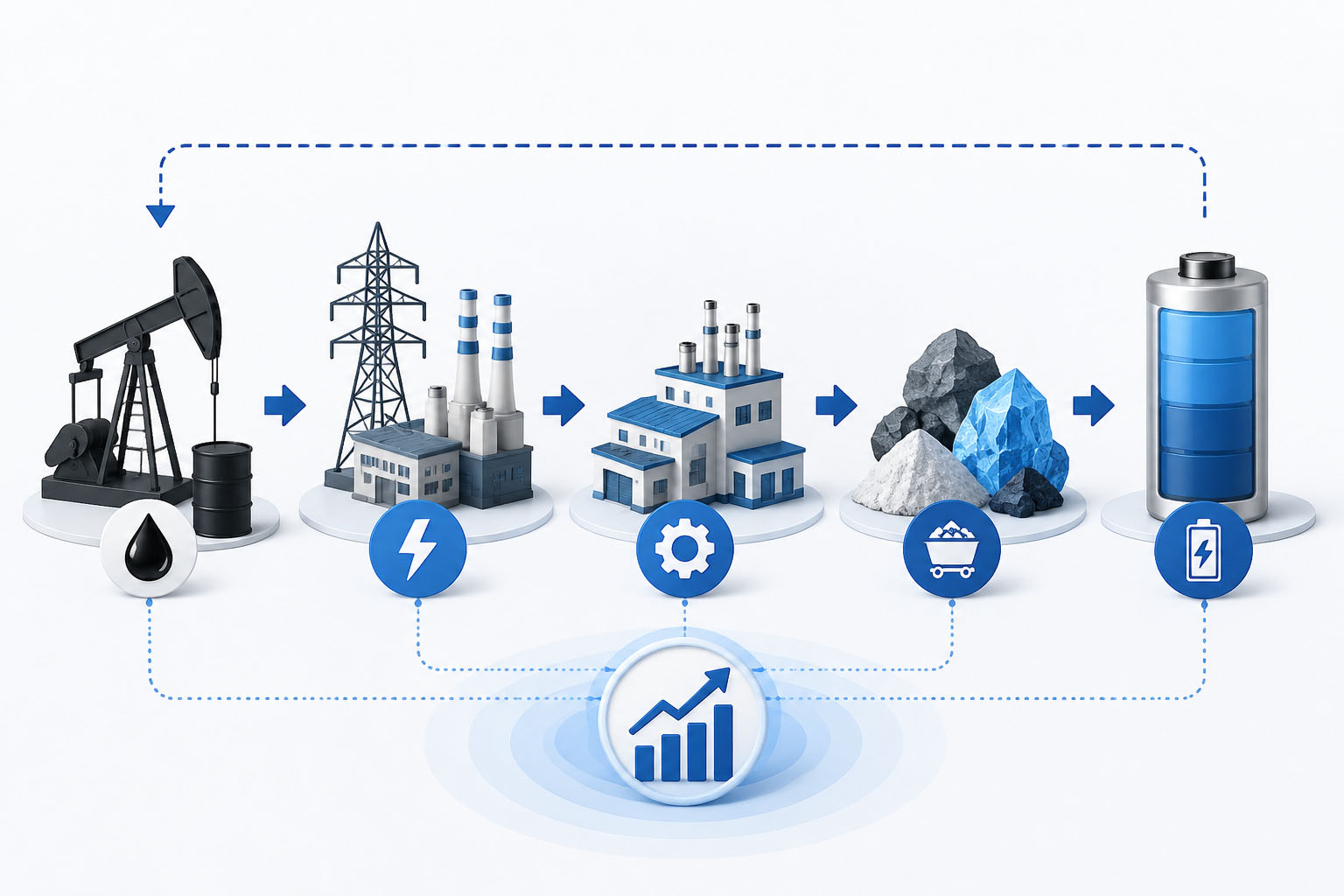
Illustration: How oil price fluctuations can indirectly flow into battery production costs through energy and industrial systems.
This article explores a simple but overlooked question: can oil price movements indirectly influence battery pricing? The answer lies in how global energy systems, industrial costs, and raw material markets interact.
Oil as a Macro Economic Signal
When most people think about oil, they immediately associate it with fuel prices or transportation costs. But in global markets, *oil* behaves more like a macroeconomic indicator than a simple commodity. It reflects expectations about inflation, global demand strength, and even investor risk appetite.
Oil as inflation signal
In financial systems, *oil* often acts as an inflation anchor. When energy prices rise, production costs across nearly every industry increase, which feeds directly into broader price levels. This is why central banks closely monitor *oil* movements when assessing inflation pressure.
Oil as global demand proxy
Beyond inflation, *oil* also reflects global economic activity. Rising demand typically signals industrial expansion, while falling demand often signals slowdown or recession expectations. This makes *oil* a forward-looking indicator for global demand cycles.
Financial market reaction
Equity markets, bond yields, and commodity indices often react instantly to *oil* price movements. Investors interpret these signals as shifts in macro conditions rather than isolated energy events.
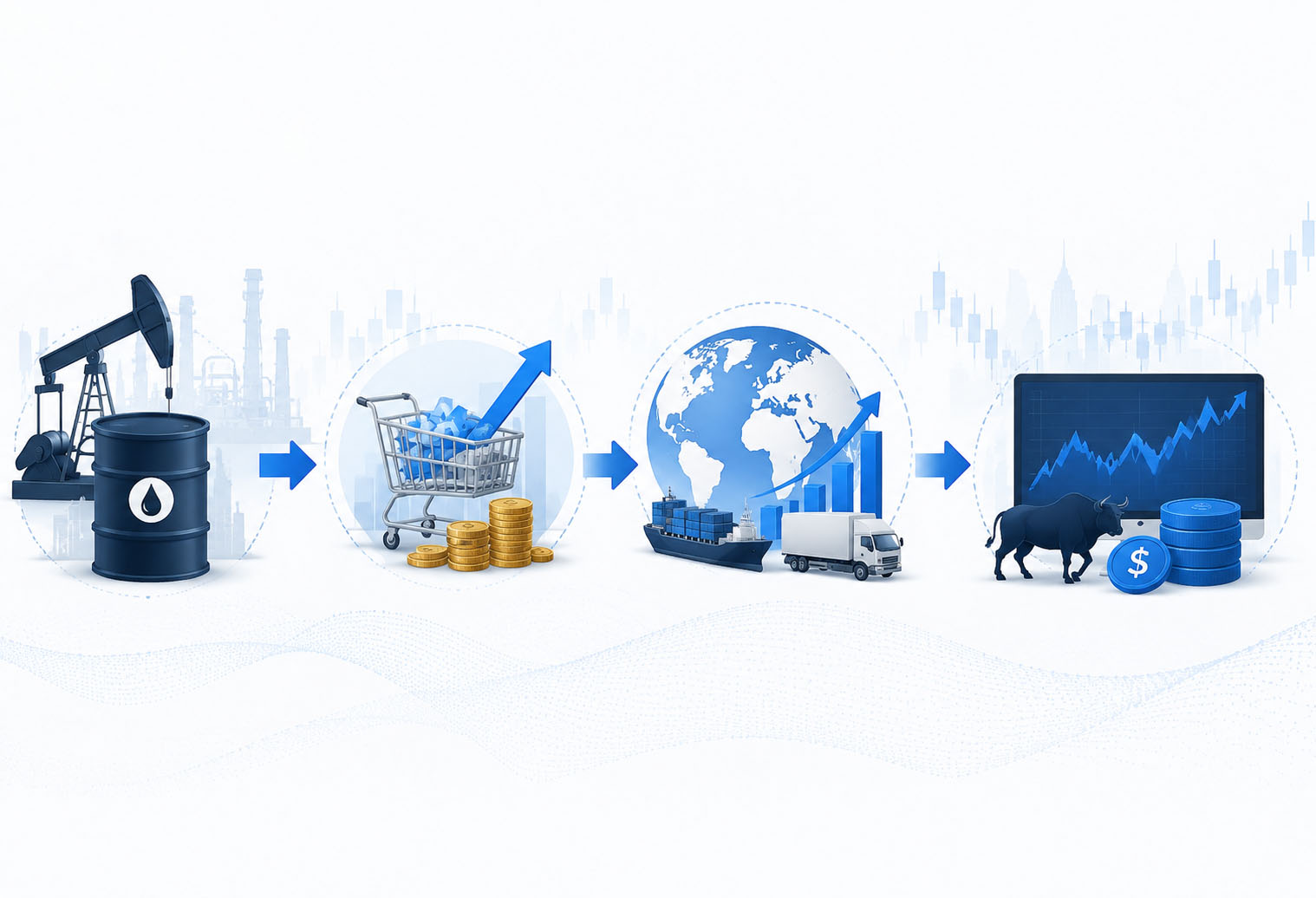
Illustration: Oil price movements do not directly determine battery pricing, but they influence global energy costs, logistics, and raw material supply chains that eventually feed into battery manufacturing economics.
Energy System Transmission
The influence of *oil* extends far beyond transportation fuel. It is deeply embedded in the global energy system, where changes in *oil* prices indirectly reshape electricity costs, industrial output, and even consumer inflation.
Fuel cost transmission
Higher *oil* prices increase diesel and shipping fuel costs. This immediately raises the cost of transporting raw materials and finished goods across global supply chains.
Electricity linkage
In many regions, gas and oil-based generation still influence electricity pricing. When *oil* markets tighten, energy substitution effects increase pressure on electricity grids, raising industrial costs.
Energy inflation loop
Energy costs flow through the entire economy: *energy → CPI → industry*. This creates a feedback loop where energy shocks amplify inflation across sectors.
| Energy Type | Impact |
|---|---|
| Oil | Direct fuel cost pressure |
| Gas | Electricity pricing driver |
| Coal | Industrial base energy source |
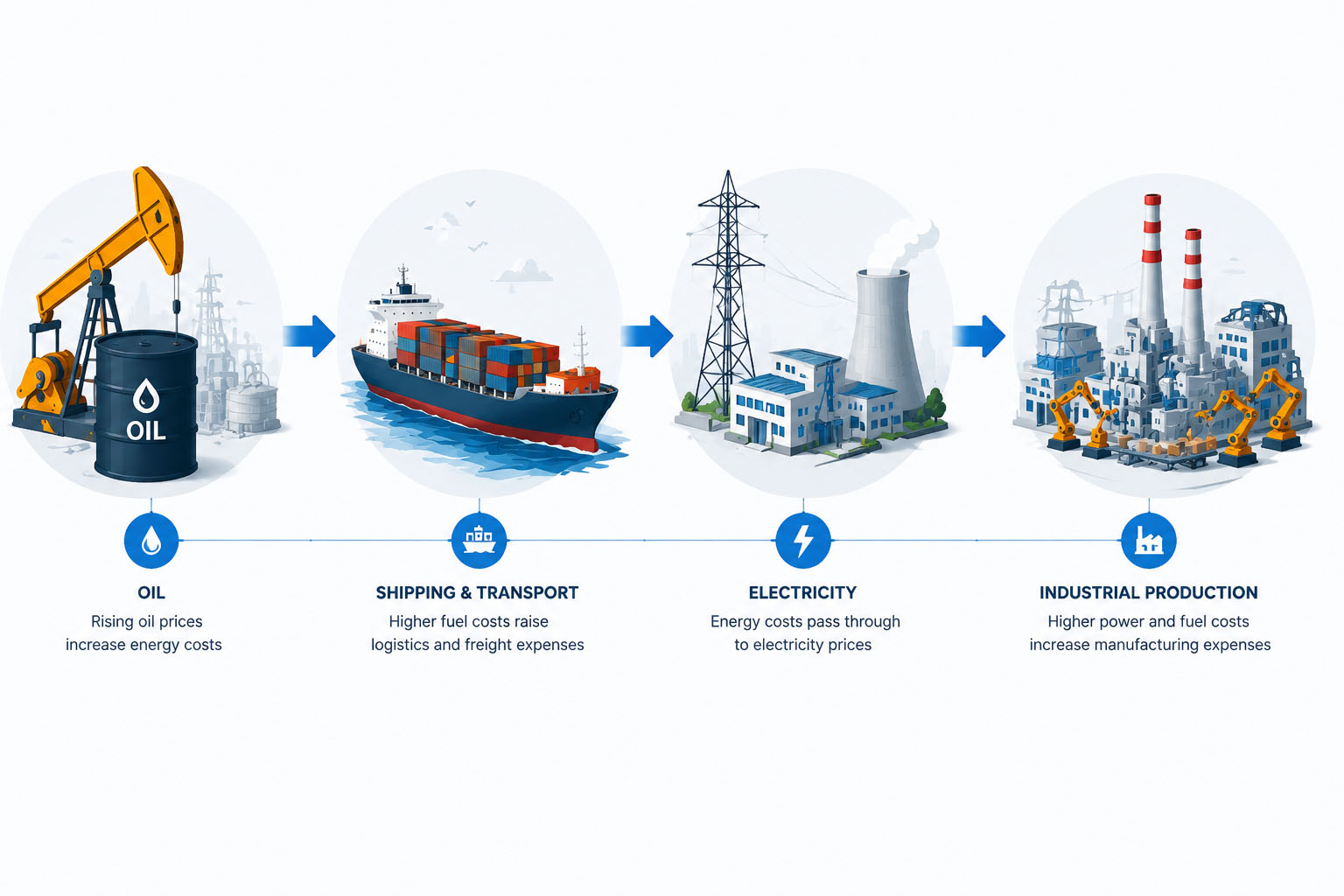
What looks like a simple change in oil prices actually moves through multiple layers of the global economy. First it affects shipping and transportation costs, then electricity pricing, and finally industrial manufacturing expenses. These combined effects eventually shape the cost structure of energy-intensive products like batteries.
Logistics and Global Transport Cost
When energy prices rise, the impact does not stay within the oil market. It quickly spreads into global logistics systems, where shipping fuel costs become one of the first visible transmission channels. What seems like a small change in crude oil pricing can significantly alter freight economics across continents.
For example, transporting industrial materials such as battery components from China to Europe becomes more expensive when bunker fuel prices increase. This is not just a marginal cost adjustment—it directly affects the landed cost of raw materials used in manufacturing supply chains.
Shipping fuel dependency
Global trade still relies heavily on marine transportation, and most cargo ships depend on oil-derived fuels. As a result, fluctuations in oil prices directly influence global freight rates and delivery schedules.
Global supply chain cost
Beyond shipping, supply chain networks experience layered cost increases. Warehousing, handling, and inland transportation all become more expensive when energy inputs rise.
Cross-border material transport
Industries that depend on cross-border sourcing—especially electronics and energy storage—feel the impact most. A slight increase in transport cost can amplify final product pricing across the entire chain.
Industrial Electricity and Manufacturing Cost
Once energy prices enter industrial systems, the impact becomes significantly more structural. Modern manufacturing—especially energy-intensive industries like battery production—depends heavily on stable and affordable electricity.
When electricity prices rise due to upstream energy shocks, factories face immediate cost pressure. This affects not only production efficiency but also long-term investment decisions in manufacturing capacity.
Industrial electricity pricing
Electricity pricing varies significantly across regions, but it is often influenced by underlying fuel and energy markets. In energy-dependent economies, this link becomes even more direct.
Chemical production energy use
Battery-related materials such as cathodes and electrolytes require energy-intensive chemical processes. These processes are highly sensitive to fluctuations in industrial energy costs.
Automation and factory load
Highly automated factories consume large and continuous amounts of electricity. Any increase in baseline energy cost directly scales into higher per-unit production costs.
| Cost Type | Share |
|---|---|
| Electricity | High |
| Labor | Medium |
| Materials | High |
Battery Manufacturing Energy Intensity
When we move deeper into the production system, the relationship between *oil prices* and battery costs becomes more structural. Battery manufacturing is not a simple assembly process—it is a highly energy-intensive industrial system where electricity, heat, and chemical processing all interact.
In reality, a battery is not just a product. It is a combination of *chemical engineering* and *energy consumption*. This is why fluctuations in upstream energy markets can gradually influence final battery pricing, even without direct material shortages.
Electrode production
Electrode manufacturing requires high-purity materials and controlled energy environments. The process depends heavily on stable electricity input, which is indirectly influenced by broader energy market conditions.
Cell assembly
During cell assembly, precision automation systems operate continuously. Any increase in industrial electricity cost directly increases per-unit production cost, especially in large-scale battery factories.
Formation process
The formation stage is one of the most energy-consuming steps in battery production. It requires long-duration electrical cycling, making it highly sensitive to *energy price volatility*.
Raw Material Supply Chain Economics
Beyond manufacturing, battery pricing is deeply shaped by raw material economics. Materials such as lithium, nickel, and cobalt are not just mining outputs—they are part of a global energy-dependent supply chain.
A key point often overlooked is that mining and refining are themselves energy-intensive processes. This means that *energy input cost* becomes a hidden driver of raw material pricing.
Lithium mining
Lithium extraction requires large-scale evaporation or hard-rock mining processes, both of which depend heavily on energy availability and cost structures.
Nickel refining
Nickel refining is highly energy-intensive, especially when producing battery-grade material. Energy price fluctuations directly affect production margins.
Cobalt supply chain
Cobalt supply chains are geographically concentrated, which amplifies the impact of energy costs on global pricing stability.
Commodity Feedback Loop
One of the most overlooked dynamics in global markets is that commodity prices do not move in isolation. Instead, they interact continuously across energy, materials, and industrial demand systems. This creates what economists often describe as a feedback loop rather than a linear relationship.
When *oil prices* rise, energy costs increase first. But that change then flows into material production costs, which in turn influence demand behavior. This cycle creates a reinforcing system where small shocks can amplify across multiple layers of the economy.
Oil → energy → materials
The first stage of the loop begins with *energy pricing*. Rising oil costs increase transportation and industrial energy expenses, which directly affect material production costs such as metals and chemicals.
Materials → demand feedback
As material costs rise, downstream industries adjust their purchasing behavior. This reduces demand elasticity and creates secondary price adjustments across supply chains.
Inflation amplification
Over time, these interactions generate an inflation amplification effect. Rather than a single price shock, markets experience cascading adjustments across multiple sectors. This is why *prices interact, not isolated*.
Battery Pricing Structure
To understand how *oil prices* ultimately influence batteries, it is necessary to break down the internal cost structure of a battery. Rather than a single cost driver, battery pricing is composed of multiple interconnected components.
Each component—materials, energy, logistics, and manufacturing—responds differently to macroeconomic changes. This is why battery pricing behaves more like a system than a fixed cost model.
Cost breakdown
The cost structure of a battery can be divided into three major categories: *materials*, *energy*, and *logistics*. Each plays a different role in determining final pricing.
kWh pricing logic
Battery pricing is often measured in cost per kilowatt-hour (kWh). This metric reflects both production efficiency and underlying energy input costs across the supply chain.
Market volatility
Because each component is influenced by global commodity markets, battery pricing is inherently volatile and sensitive to macroeconomic shifts.
| Factor | Impact |
|---|---|
| Oil | Indirect |
| Energy | High |
| Materials | High |
| Logistics | Medium |
Battery Technology Split
At this stage, it becomes easier to understand why battery markets react differently to the same macroeconomic signals. Not all batteries are affected in the same way, because their internal chemistry and usage environments differ significantly.
For example, *lithium-ion* systems are highly energy-dense and sensitive to raw material price fluctuations, while *NiMH batteries* behave differently due to their more stable discharge characteristics and mature industrial supply chains.
Lithium-ion characteristics
Lithium-ion batteries are widely used in electric vehicles and consumer electronics. Their pricing is strongly linked to raw material markets such as lithium, nickel, and cobalt, making them highly sensitive to commodity cycles.
NiMH characteristics
*NiMH batteries* are known for their stability, safety, and predictable discharge behavior. They are less exposed to volatile raw material markets compared to lithium-based systems.
Industrial usage difference
In industrial environments, selection often depends on reliability rather than maximum energy density. This is where NiMH systems continue to maintain strong relevance in embedded and backup applications.
NiMH batteries are widely used in applications requiring stable discharge behavior and reliability.
Macro Summary
When we step back and look at the entire system, the relationship between *oil prices* and battery costs is not direct, but layered through multiple economic channels.
Instead of a single cause-and-effect chain, what we observe is a structured transmission system where energy markets influence logistics, manufacturing, and material economics simultaneously.
Indirect relationship
The connection between oil and batteries is indirect but persistent. It flows through cost structures rather than direct pricing mechanisms.
Multi-layer transmission
Energy → logistics → manufacturing → materials → battery pricing. Each layer amplifies or absorbs cost shocks differently depending on market conditions.
System thinking
Understanding this system requires a shift from linear thinking to network-based thinking, where *prices interact, not isolated*.
Frequently Asked Questions
Below are the most common questions about how oil prices influence battery costs, energy systems, and global supply chains. Each answer is expanded to reflect real economic transmission mechanisms rather than simplified explanations.
Does oil affect battery prices directly?
The relationship is indirect. Oil prices do not directly set battery costs. Instead, they influence upstream systems such as energy pricing, global transportation costs, and industrial manufacturing expenses. These layers accumulate and eventually affect battery production economics.
Why are battery prices high?
Battery prices remain high due to structural cost drivers. Raw materials such as lithium and nickel account for a large share, while energy-intensive manufacturing processes add further pressure. In addition, global supply chain complexity increases logistics costs, especially when energy prices fluctuate.
What drives lithium cost?
Lithium pricing is shaped by mining output, refining capacity, and energy input requirements. Because extraction and processing are energy-intensive, fluctuations in global energy markets directly influence lithium production costs and supply stability.
How does energy affect manufacturing?
Manufacturing systems depend heavily on electricity and thermal energy. When energy prices rise, production costs increase across chemical processing, electrode production, and battery assembly lines. This makes energy one of the most important cost drivers in industrial production.
Are electric vehicles affected by oil prices?
Yes, but indirectly. Higher oil prices increase fuel costs for traditional vehicles, which accelerates EV adoption. This shift increases battery demand, which can indirectly influence material pricing and supply chain pressure.
Is NiMH still widely used?
NiMH batteries remain widely used in applications requiring stable discharge behavior, safety, and long-term reliability. While lithium-ion dominates high-energy applications, NiMH continues to serve industrial and embedded systems.
What is the biggest cost in battery production?
The largest cost components are raw materials and energy consumption. Together they account for the majority of total battery cost per kilowatt-hour (kWh), especially in large-scale production environments.
Do logistics costs affect battery pricing?
Yes. Logistics costs are strongly linked to oil prices because global shipping and transport depend on fuel. When oil prices rise, transportation costs increase across the entire battery supply chain.
How do raw material prices behave?
Raw material prices fluctuate due to supply constraints, mining output variability, and energy input costs. Metals like lithium, nickel, and cobalt are especially sensitive to global demand cycles and energy market volatility.
Will battery prices decrease in the future?
Long-term trends suggest cost reductions driven by scale and technological improvements. However, short-term volatility will remain due to fluctuations in energy markets, logistics costs, and raw material supply chains.