
Why GMCELL NiMH Battery Packs Are Widely Used in Embedded Applications
Embedded systems are everywhere. From industrial controllers and smart meters to medical devices, security equipment, IoT gateways, and edge computing hardware, embedded electronics have become the foundation of modern connected infrastructure.
When engineers discuss embedded system design, most attention usually goes to processors, firmware, sensors, wireless communication, and software architecture. However, one critical component is often overlooked until a failure occurs: the backup power system.
Many embedded devices must preserve memory, configuration settings, real-time clocks, logs, and operational data even when primary power is interrupted. In these situations, battery reliability often becomes more important than battery capacity. This is one reason why many manufacturers continue to rely on NiMH battery packs despite the widespread adoption of lithium-based technologies.
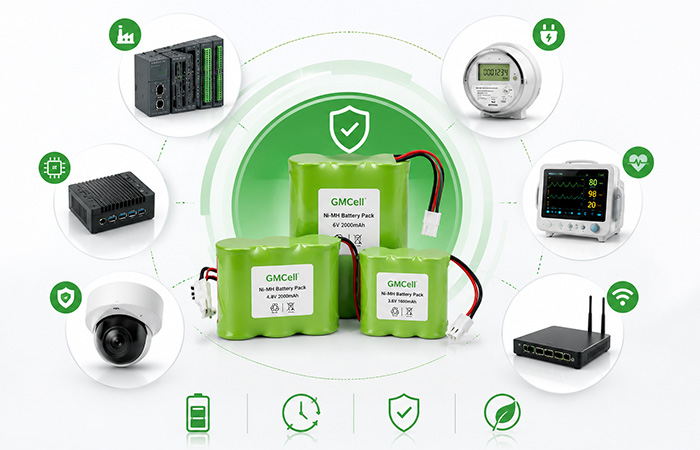
This article explores why NiMH technology remains relevant in embedded applications and why it continues to be selected for reliability-focused designs.
Why Embedded Systems Have Different Power Requirements
Most consumer electronics are designed around maximum energy density, lightweight structure, and long runtime between charges. But embedded systems usually work under a different logic.
For devices such as industrial controllers, smart meters, security devices, medical electronics, IoT gateways, and edge computing hardware, the battery is often not meant to power the whole system continuously. It works as a backup layer that protects critical functions when primary power becomes unavailable.
Consumer Electronics
Energy density, lighter weight, and longer runtime usually come first.
Embedded Systems
Stability, predictability, safety, long-term reliability, and low maintenance matter more.
Because of this role, reliability frequently outweighs capacity. A battery that performs predictably for years can be more valuable than a larger battery that behaves inconsistently in the field.
The Hidden Role of Backup Batteries in Embedded Devices
Many engineers underestimate how much information can be lost during an unexpected power interruption. In real applications, backup batteries often protect the data that allows a device to restart correctly.
Real-time clock retention
Memory backup
Configuration storage
Event logging
Emergency shutdown
Data protection
Without a reliable backup power source, embedded devices may lose critical settings, timestamps, calibration data, or operational records. In industrial and commercial environments, recovering from these failures can be far more expensive than the battery itself.
Why Many Embedded Devices Still Use NiMH Batteries
Although lithium-ion batteries dominate consumer electronics, NiMH batteries continue to play an important role in embedded systems. Their value is not only about capacity. It is about stable behavior, proven safety, and long-term reliability.
Stable Voltage Delivery
Embedded electronics often require predictable power behavior. NiMH batteries provide relatively stable discharge characteristics across a large part of their operating cycle.
Proven Safety Profile
In medical electronics, industrial control systems, security equipment, and infrastructure monitoring devices, safety is often a top priority.
Long Service Life
Many embedded devices are expected to remain operational for years. Properly managed NiMH batteries can reduce replacement frequency and maintenance costs.
Low Maintenance Requirements
Modern low-self-discharge NiMH technology offers better storage performance and lower maintenance needs than older battery generations.
Why Some Embedded Devices Still Choose NiMH Instead of Lithium
Many engineers automatically assume that lithium batteries are always the best choice. In reality, battery selection depends on application requirements rather than market popularity.
While lithium batteries offer higher energy density, embedded systems often evaluate additional factors such as safety, reliability, service life, environmental conditions, cost of failure, and maintenance requirements.
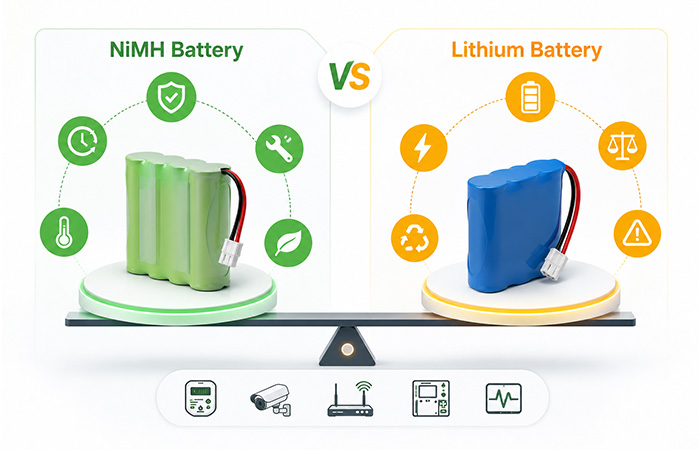
For applications where long-term operational stability is more important than maximum energy density, NiMH remains a highly practical solution. For a deeper comparison, read: Ni-MH vs Lithium Batteries .
Common Embedded Applications That Use NiMH Battery Packs
NiMH battery packs continue to be used in a wide range of embedded products because they support critical backup functions instead of simply chasing maximum capacity.
Why Battery Stability Often Matters More Than Capacity
Battery capacity is easy to measure. Battery stability is much harder to quantify. However, many embedded system failures are not caused by a lack of capacity, but by unstable performance over time.
Voltage instability
Cell imbalance
Inconsistent discharge behavior
Premature battery degradation
A slightly smaller battery that performs consistently over many years is often more valuable than a larger battery that delivers unpredictable performance. This is why experienced engineers frequently evaluate battery consistency before focusing on capacity specifications.
The Importance of Cell Matching in Battery Pack Design
One of the most overlooked aspects of battery pack performance is cell matching. When multiple cells are assembled into a pack, small differences in capacity, internal resistance, and voltage characteristics can gradually reduce overall performance.
Before Matching
Cells may age differently, discharge unevenly, and limit the performance of the whole battery pack.
After Matching
Charging and discharging become more balanced, helping improve cycle life, reliability, and maintenance performance.
For embedded systems expected to operate continuously for many years, cell consistency becomes a critical quality factor.
Why Manufacturers Choose OEM NiMH Battery Packs
Many embedded devices cannot operate effectively with standard off-the-shelf batteries. Once a product moves from prototype to real deployment, the battery often needs to match the device structure, voltage design, connector layout, and operating environment.
This is why manufacturers often choose OEM NiMH battery packs instead of loose cells. A custom pack can be built around the actual product, not forced into the product after the design is already finished.
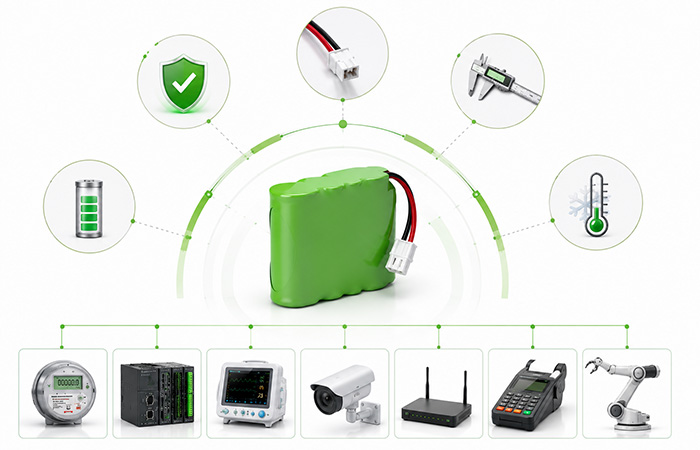
Voltage requirements
Runtime requirements
Connector design
Mechanical integration
Environmental protection
Common configurations include 2S packs, 3S packs, 4S packs, 5S packs, and custom assembled battery systems. As embedded products become more specialized, custom battery solutions become increasingly important. Learn more about OEM NiMH Battery Packs .
Why Consistency Matters More Than Specifications
Many battery suppliers can provide a battery. Far fewer suppliers can provide consistent battery performance across multiple production batches.
For embedded device manufacturers, consistency directly affects product reliability, maintenance costs, customer satisfaction, and long-term deployment success.
Stable batch quality helps embedded products perform predictably in real-world use.
Fewer battery-related failures can reduce field service and replacement pressure.
Reliable backup power helps devices restart correctly after power interruptions.
Consistent batteries support stable performance across years of operation.
Battery quality is often determined not only by chemistry, but also by manufacturing processes, quality control procedures, and testing standards. In long-life embedded products, battery consistency is not a minor detail. It is part of the product’s reliability strategy.
Why GMCELL Focuses on Battery Reliability
For embedded applications, battery performance is measured over years rather than days. A battery may look acceptable during early testing, but the real question is whether it can still perform consistently after long-term deployment.
This is why GMCELL focuses on quality factors that directly affect long-term battery reliability, especially when NiMH battery packs are used inside critical embedded products.
Helps cells work together more evenly inside the same pack.
Reduces large performance differences between cells and batches.
Supports predictable backup behavior during power interruption.
Makes quality history easier to review across production batches.
Checks whether battery packs can meet real application demands.
Helps manufacturers avoid quality shifts between repeat orders.
These quality control processes help embedded device manufacturers reduce risk, improve long-term system performance, and build products that remain dependable after they leave the factory.
Conclusion
As embedded devices continue to expand into industrial automation, smart infrastructure, medical electronics, and edge computing environments, reliable backup power remains essential.
Although lithium technology dominates many consumer products, NiMH rechargeable batteries continue to offer important advantages in applications where safety, consistency, predictability, and long-term reliability are priorities.
For many embedded systems, the goal is not simply to maximize capacity. The goal is to ensure that critical devices continue operating reliably when they are needed most.
Frequently Asked Questions
If you are comparing NiMH battery packs for embedded products, these are the questions engineers and product teams often ask before choosing a battery solution.
Why are NiMH batteries still used in embedded systems?
Because many embedded devices prioritize reliability, safety, and predictable performance over maximum energy density.
Are NiMH batteries safer than lithium batteries?
In many applications, NiMH batteries are considered a highly stable and proven technology with a long history of safe operation.
What embedded devices commonly use NiMH battery packs?
Industrial controllers, smart meters, medical devices, security systems, PLCs, IoT gateways, and edge computing equipment commonly use NiMH battery packs.
Why is battery stability important in embedded applications?
Stable battery performance helps protect memory, configuration data, and system reliability during power interruptions in embedded applications.
What is cell matching in a battery pack?
Cell matching is the process of selecting cells with similar characteristics to improve battery pack performance and lifespan.
Can custom NiMH battery packs be designed for specific devices?
Yes. Manufacturers often use custom NiMH battery packs to meet specific voltage, runtime, connector, and installation requirements.
Why do some engineers choose NiMH instead of lithium?
In certain applications, engineers prioritize safety, predictable behavior, long service life, and lower maintenance requirements over maximum energy density.
How long do NiMH battery packs typically last?
Depending on application and operating conditions, quality NiMH battery packs can provide hundreds to thousands of charge-discharge cycles.