
Battery Certifications & Export Compliance for Global Battery Trade
Battery certification and export compliance define the safety, transport, and regulatory requirements that govern international battery shipments. Understanding these standards is essential for manufacturers, OEM suppliers, and global buyers.
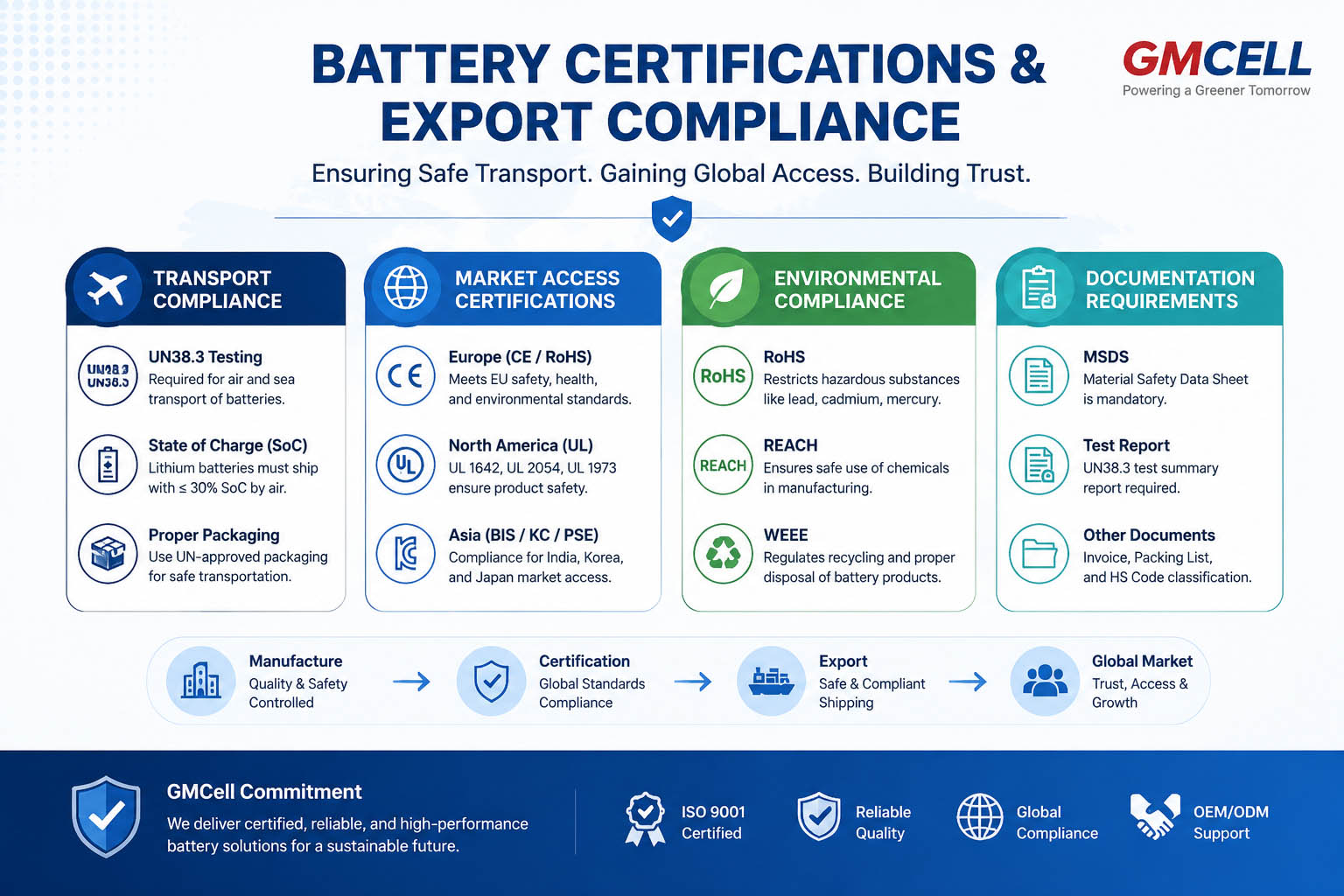
Example compliance systems are widely adopted by manufacturers such as GMCELL , which supports NiMH battery production under international export standards.
What is Battery Certification and Export Compliance?
Battery certification and export compliance define the global regulatory framework that ensures batteries meet safety, transportation, and environmental requirements before they are sold or shipped internationally.
For manufacturers, OEM suppliers, and industrial buyers, compliance determines whether battery products can legally enter global markets such as Europe, North America, and Asia.
This system is based on three essential questions:
✔ Is the battery safe to use under real operating conditions?
✔ Can it be legally transported across international borders?
✔ Does it meet regulatory requirements in the destination market?
Safety Compliance for Users and Devices
Battery certification ensures products meet strict safety requirements during real-world usage.
These requirements reduce risks such as overheating, short-circuit failure, leakage, and performance instability under extreme conditions.
Safety compliance applies to both individual cells and complete battery packs used in industrial systems, consumer electronics, and energy storage applications.
Companies such as GMCELL integrate compliance requirements throughout NiMH battery production, from engineering design to final testing.
Legal Requirements for Cross-Border Shipping
Batteries are classified as regulated goods in global logistics and must comply with international transport regulations before shipment.
The most widely recognized standard is UN38.3, which ensures batteries can safely withstand air and sea transport conditions.
✔ Certified packaging for hazardous goods transport
✔ State of charge (SOC) limitations
✔ Safety documentation for carriers
✔ Correct customs classification codes
Market Access Approval for Different Regions
Each global market applies its own regulatory requirements for battery products before allowing import or sale.
Europe
CE marking and RoHS compliance are required, often combined with IEC standards such as IEC 62133 or IEC 61951 for NiMH batteries.
North America
UL certification is commonly required, including UL 1642 for cells and UL 2054 for battery packs.
Asia-Pacific
Markets such as India, Korea, and Japan require BIS, KC, and PSE certifications depending on product category.
Manufacturer Responsibility for Documentation
Compliance requires complete and accurate documentation to support customs clearance and regulatory approval.
✔ MSDS (Material Safety Data Sheet)
✔ UN38.3 test reports
✔ Commercial invoice and packing list
✔ Product specifications
✔ HS code classification
Missing or incorrect documentation may result in shipment delays or customs rejection.
Industry Perspective and Manufacturer Role
Compliance is not a one-time requirement but a continuous process integrated into product design, manufacturing, and supply chain management.
Companies such as GMCELL integrate international compliance standards into NIMH Battery production to ensure global export readiness.
Why Export Compliance is Critical for Battery Manufacturers
When batteries move across borders, they are not treated like ordinary products. They are inspected as regulated energy products because improper handling, incorrect documentation, or missing certifications can create safety, logistics, and legal risks.
For *battery manufacturers*, *OEM buyers*, and global distributors, export compliance directly affects whether a shipment can leave the factory, pass customs, enter the destination market, and finally reach the customer without delays.
Non-compliant battery shipments may result in:
✔ Customs detention or shipment rejection
✔ Airline cargo refusal before departure
✔ Heavy regulatory fines or corrective costs
✔ Market access bans in regulated regions
These risks do not only affect the exporter. They also affect the buyer’s launch schedule, inventory planning, product approval timeline, and customer delivery commitments. A missing test report or incorrect shipping document can delay an entire production program.
This is why *export compliance for batteries* should be treated as part of product planning, not as a last-minute paperwork task before shipment.
For OEM buyers, compliance is not optional — it is a prerequisite for global distribution.
Global Battery Transport Safety Standards
Before batteries can be transported internationally, they must satisfy transport safety rules designed to reduce risks during air freight, sea freight, road transport, and customs handling.
These rules are especially important for *lithium battery shipments*, but they also shape how global buyers evaluate suppliers of *NiMH battery packs*, industrial battery systems, and export-ready battery assemblies.
UN38.3 Testing
UN38.3 is one of the most important global transport safety tests for batteries. It verifies whether a battery can withstand the physical and environmental stress that may occur during international transportation.
For buyers, UN38.3 is not just a technical certificate. It is often the document that carriers, freight forwarders, customs teams, and import partners request before accepting a shipment.
✔ Altitude simulation to test air transport pressure conditions
✔ Thermal cycling to check stability under temperature changes
✔ Vibration and shock testing to simulate transport movement
✔ External short-circuit testing to evaluate safety under fault conditions
State of Charge Regulation
For lithium-ion batteries shipped by air, state of charge control is a critical safety rule. In many air transport scenarios, lithium-ion batteries must be shipped at no more than 30% of their rated capacity.
This requirement mainly applies to *Li-ion battery transportation*, but it is useful for buyers to understand because different battery chemistries follow different shipping risk profiles.
Compared with lithium-based batteries, *NiMH batteries* are often easier to manage from a logistics risk perspective, but proper packaging, documentation, and product classification are still essential for smooth export.
Dangerous Goods Documentation
Transport compliance is not complete without correct documentation. Even when a battery product is properly tested, carriers may reject the shipment if the paperwork is incomplete, inconsistent, or incorrectly classified.
✔ MSDS, also known as Material Safety Data Sheet
✔ UN Test Summary Report for transport verification
✔ Certified packaging that matches transport and safety requirements
For *battery export compliance*, documentation is part of the product itself. A qualified battery supplier should be able to provide consistent technical records, safety sheets, transport reports, and packaging information before shipment.
Regional Certification Requirements for Battery Export
After a battery product meets basic transport safety requirements, it still needs to satisfy the market access rules of the destination country or region. This is where *battery export compliance* becomes more specific, because each market evaluates batteries through different safety, environmental, and product approval systems.
For *OEM battery buyers*, this step is especially important. A battery may be technically safe to ship, but still not qualified for sale or integration into a finished product if the correct regional certifications are missing.
North America
In North America, battery certification is strongly focused on electrical safety, thermal stability, fire risk control, and product reliability. UL standards are widely recognized by importers, distributors, retailers, and industrial customers.
Common certification references include:
✔ UL 1642 for battery cells
✔ UL 2054 for rechargeable battery packs
✔ UL 1973 for stationary battery systems and energy storage applications
If you are sourcing batteries for *industrial devices*, *backup power systems*, *medical equipment*, or *OEM electronics*, North American customers may request UL-related documentation even when it is not strictly required by customs. In many cases, UL certification functions as a buyer confidence signal as much as a regulatory requirement.
European Union
The European Union places strong emphasis on product safety, environmental protection, chemical restrictions, recycling responsibility, and traceable compliance documentation. For battery manufacturers and exporters, Europe is one of the most documentation-sensitive markets.
✔ CE marking indicates that the product meets applicable EU safety and regulatory requirements.
✔ RoHS compliance restricts hazardous substances in electrical and electronic products.
✔ IEC 62133 is commonly used for safety testing of portable sealed secondary cells and batteries.
✔ IEC 61951 is especially relevant for *NiMH batteries* and nickel-based rechargeable cells.
✔ EU Battery Regulation 2023/1542 introduces stricter requirements for sustainability, labeling, recycling, and battery lifecycle responsibility.
For *NiMH battery export*, IEC 61951 is particularly important because it connects the battery chemistry to recognized performance and safety expectations. This makes it more relevant than generic battery standards when the product is a rechargeable nickel-metal hydride cell or pack.
For buyers, European compliance is not only about entering the EU market. It also helps reduce long-term risks related to product recalls, distributor rejection, environmental claims, and documentation audits.
Asia Markets
Asian markets often have their own national certification systems. These requirements may vary depending on whether the battery is sold as an individual cell, assembled into a battery pack, imported as part of a finished product, or used in regulated consumer electronics.
✔ BIS is used in India for selected electronics and battery-related product categories.
✔ KC certification applies to Korea and focuses on safety and conformity requirements.
✔ PSE is used in Japan for regulated electrical products and certain battery-powered devices.
If your battery product will be used in *consumer electronics*, *industrial instruments*, *medical devices*, or *smart hardware*, the final certification path may depend on both the battery itself and the finished product category.
The safest approach is to confirm certification requirements before mass production, not after the product is ready to ship. This gives manufacturers and buyers enough time to prepare test reports, labeling files, packaging information, and market-specific documentation.
Environmental and Chemical Regulations
Battery compliance is not limited to electrical safety and transport approval. Many markets also require environmental and chemical compliance to ensure batteries do not introduce restricted materials into the supply chain.
These regulations are important for *battery manufacturers*, *OEM buyers*, and distributors because they affect product labeling, material declarations, recycling obligations, and long-term market eligibility.
RoHS Restrictions
RoHS restricts hazardous substances such as lead, cadmium, mercury, hexavalent chromium, and certain flame retardants in electrical and electronic products.
For battery buyers, RoHS compliance helps confirm that the product is suitable for integration into electronics that will be sold in regulated markets, especially in the European Union.
REACH Chemical Tracking
REACH focuses on the registration, evaluation, authorization, and restriction of chemicals. It requires manufacturers and importers to understand whether materials used in the product contain restricted or high-concern substances.
For *industrial battery supply chains*, REACH documentation provides another layer of traceability. It helps buyers reduce chemical compliance risks when batteries are used inside larger equipment or exported as part of finished products.
WEEE Recycling Requirements
WEEE governs the collection, recycling, and recovery of waste electrical and electronic equipment. While battery-specific recycling obligations may vary by market, WEEE is often relevant when batteries are integrated into electronic devices.
For global buyers, WEEE compliance supports responsible product lifecycle management and strengthens the credibility of the supply chain.
Why this matters for supplier credibility
Environmental compliance helps prove that a battery supplier is not only focused on passing shipment checks, but also capable of supporting long-term, responsible, and regulation-ready industrial supply chains.
Required Documents for Battery Export
Battery export is not only about producing a safe product. Before a shipment can move smoothly through carriers, customs, and destination-market inspection, the documentation must clearly prove what the battery is, how it is classified, how it should be handled, and whether it meets the required safety standards.
For *battery export compliance*, missing or inconsistent documents can cause delays even when the product itself is qualified. This is why professional buyers usually review export documents before confirming mass production or arranging international shipping.
Commercial Invoice
The commercial invoice identifies the seller, buyer, product name, declared value, quantity, country of origin, and transaction details. For batteries, the description should be precise enough for customs teams to understand the battery chemistry, product type, and intended export classification.
Packing List
The packing list shows carton quantity, gross weight, net weight, package dimensions, and shipment structure. For *industrial battery shipments*, this document helps carriers and customs verify whether packaging matches the declared product and transport requirements.
MSDS
MSDS, or Material Safety Data Sheet, explains the battery’s chemical composition, hazard information, handling instructions, storage conditions, emergency measures, and transportation guidance. It is one of the most commonly requested documents in international battery logistics.
UN38.3 Test Report
A UN38.3 test report verifies whether a battery can withstand transportation stress such as altitude changes, vibration, shock, temperature cycling, and short-circuit conditions. For many carriers and freight forwarders, this document is essential before accepting battery cargo.
HS Code Classification
HS code classification helps customs identify the battery type for tariff, import control, and regulatory review. Battery chemistry and product configuration matter because cells, battery packs, and finished devices may be classified differently.
✔ NiMH battery: commonly classified under HS code 850750
✔ Battery packs: classification depends on chemistry, assembly structure, and final application
A reliable supplier should be able to provide consistent documentation that matches the product specification, packaging method, and destination-market requirements. For *OEM battery buyers*, this reduces shipment uncertainty and helps avoid last-minute logistics problems.
NiMH Battery Compliance vs Lithium Batteries
Different battery chemistries carry different compliance risks. Lithium batteries usually receive more regulatory attention because of higher energy density, thermal runaway concerns, and stricter air transport limitations. By comparison, *NiMH battery compliance* is often simpler from a transport-risk perspective, especially for standard cells and many industrial battery pack applications.
This does not mean NiMH batteries can ignore export rules. Instead, it means the compliance focus is different. For NiMH products, buyers usually pay closer attention to product safety, environmental conformity, documentation accuracy, and whether the manufacturer can support stable export documentation across repeated shipments.
| Feature | NiMH | Lithium |
|---|---|---|
| Transport risk | Low | High |
| UN38.3 requirement | Often pack-level or application-dependent | Commonly mandatory for transport |
| Thermal instability | Low | Higher |
| Export complexity | Simpler | More complex |
For applications such as *industrial instruments*, *backup power devices*, *medical electronics*, *smart meters*, and *OEM rechargeable battery packs*, NiMH can be an attractive option when buyers need a stable battery chemistry with manageable export procedures.
The advantage is not only technical. It also affects procurement planning. A simpler compliance path can reduce shipment uncertainty, simplify documentation review, and help buyers maintain stable supply for recurring orders.
OEM Battery Compliance Support for Global Buyers
For global buyers, battery compliance does not stop at certificates. Once batteries are used in *OEM devices*, *industrial equipment*, or *private label battery packs*, the buyer also needs correct labeling, export documentation, product traceability, and technical support from the manufacturer.
This is why choosing a battery supplier is not only about price or capacity. A qualified supplier should help you reduce compliance uncertainty before mass production, not after the shipment is already packed.
OEM Labeling Compliance
OEM battery labels often need more than a logo. Depending on the destination market, labels may include voltage, capacity, chemistry, polarity, warning icons, recycling marks, model numbers, manufacturer information, and certification references. For *battery export compliance*, inaccurate labeling can create problems during customs review, product inspection, or distributor onboarding.
Private Label Export Documentation
If you sell batteries under your own brand, your documentation should match the private label product. This may include product specifications, MSDS files, packaging details, certification records, and commercial documents that correctly reflect the buyer’s brand, product model, and shipment information.
Custom Battery Pack Certification Support
Custom battery packs may require additional compliance review because the final structure can affect safety, packaging, and transport classification. Cell type, protection design, connector, wire harness, enclosure, capacity, and application environment may all influence the certification path.
Industrial Procurement Requirements
Industrial buyers usually need stable batch quality, long-term supply, consistent documentation, and engineering communication. For applications such as *medical electronics*, *backup power systems*, *industrial instruments*, and *smart meters*, procurement teams often evaluate whether the supplier can support repeat orders with the same compliance standard.
A strong OEM battery partner should be able to support your project from sample review to mass production, helping you prepare documentation, confirm market requirements, and reduce export risks before the batteries enter international logistics.
Why Choose GMCell as Your Battery Manufacturer
When you source batteries for global distribution, you need more than a product supplier. You need a manufacturer that understands *battery compliance*, *OEM customization*, and export-ready production requirements.
GMCell supports global buyers with compliant NiMH battery manufacturing.
GMCELL provides export-ready battery solutions for industrial and OEM Ni-MH Rechargeable Batteries applications worldwide.
ISO Certified Production System
An ISO certified production system helps ensure that battery manufacturing follows controlled processes, documented quality procedures, and consistent inspection standards. For OEM buyers, this supports more predictable batch quality and better supplier accountability.
Export-Ready Manufacturing Capability
Export-ready manufacturing means batteries are prepared with international shipment, documentation, packaging, and destination-market expectations in mind. This helps reduce delays caused by missing paperwork or unclear product classification.
Global Compliance Experience
Different regions may request different certificates, declarations, and shipment documents. A manufacturer with global compliance experience can help buyers prepare for Europe, North America, and Asia with fewer last-minute surprises.
Engineering Support for OEM Projects
OEM projects often require more than standard cells. Battery size, capacity, discharge behavior, connector design, pack structure, and application environment must be considered together. Engineering support helps buyers choose the right solution before moving into volume production.
Stable NiMH Supply Chain
A stable *NiMH battery supply chain* supports recurring orders, consistent documentation, and reliable delivery planning. For industrial buyers, this stability is often more valuable than choosing the lowest unit price.
Frequently Asked Questions About Battery Export Compliance
What certifications are required to export batteries internationally?
Common requirements include UN38.3, CE, RoHS, UL-related safety standards, and MSDS documentation. The exact requirements depend on the battery chemistry, product structure, shipping method, and destination market.
Do NiMH batteries require UN38.3 certification?
*NiMH batteries* generally have lower transport restrictions than lithium batteries. However, complete battery packs may still require UN38.3-related testing or transport documentation depending on configuration, shipment method, and carrier requirements.
What is the difference between CE and UL certification?
CE marking is mainly used for products entering the European market and relates to EU safety, health, and environmental requirements. UL certification is widely used in North America and focuses strongly on electrical, thermal, and product safety evaluation.
What documents are required for battery export?
Typical *battery export documents* include MSDS, commercial invoice, packing list, UN38.3 test report or UN test summary when applicable, product specifications, and HS code classification for customs clearance.
How does GMCell support export compliance?
GMCELL supports global buyers with certification documentation, OEM battery compliance guidance, export-ready production support, and technical communication for industrial battery shipments.