
Arduino Power Guide for Engineering Students
Best Rechargeable Batteries for Arduino Projects: Why Many Engineering Students Choose NiMH
When you search for the best battery for Arduino, an Arduino battery pack, or rechargeable batteries for Arduino, you are usually not just looking for a battery with the highest capacity. You are looking for a power source that keeps your project stable, safe, and easy to test in a real learning environment.
Many Arduino projects do not fail because the code is wrong. They fail because the voltage drops when a motor starts, the current is not enough for sensors and servos, or the wrong battery type is chosen for repeated classroom testing. For engineering students, the best rechargeable battery is often the one that is forgiving, reusable, and predictable during experiments.
That is why NiMH batteries are still widely used in engineering labs, robotics courses, STEM programs, and embedded system prototypes. They may not have the highest energy density, but they offer a practical balance of safety, durability, cost, and stable performance for student projects.
In this guide, you will learn how Arduino power requirements work, why many engineering students continue to choose NiMH batteries, how many battery cells different projects require, and how to avoid the most common power-related mistakes in robotics and embedded system development.
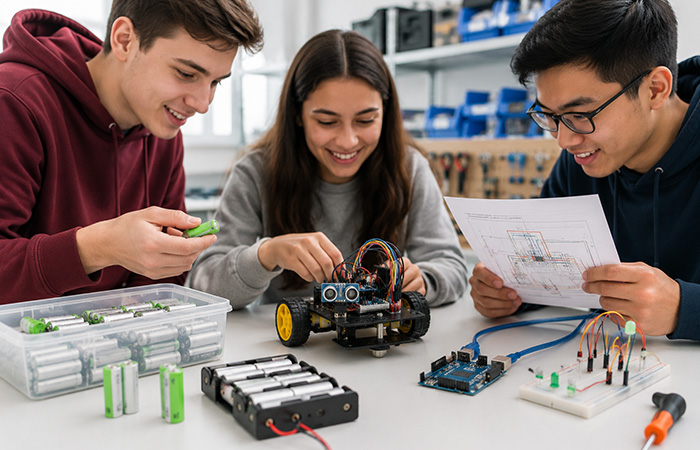
Quick Answer: What Is the Best Rechargeable Battery for Arduino Projects?
If you simply want the short answer, the best rechargeable battery for an Arduino project depends on what you are building. A basic classroom experiment does not have the same power requirements as a robot car, a wireless sensor node, or a research prototype. The good news is that you do not need an overly complicated power system to get reliable results.
For most students, hobbyists, and engineering learners, NiMH rechargeable batteries remain one of the safest and most practical starting points because they offer a strong balance of reliability, affordability, ease of charging, and stable power delivery during repeated testing and experimentation.
| User Type | Recommended Solution |
|---|---|
| Arduino Beginners | 4×AA NiMH |
| Engineering Students | 4×AA or 5×AA NiMH |
| Robotics Projects | 5×AA or 6×AA NiMH |
| Portable Prototypes | Lithium-Ion |
| Research Projects | Custom Battery Pack |
If your priorities are safety, cost efficiency, and a low learning curve, NiMH batteries are often the most balanced option. They are forgiving during testing, easy to replace, and capable of delivering the current required by many Arduino projects, robotics systems, and STEM learning activities.
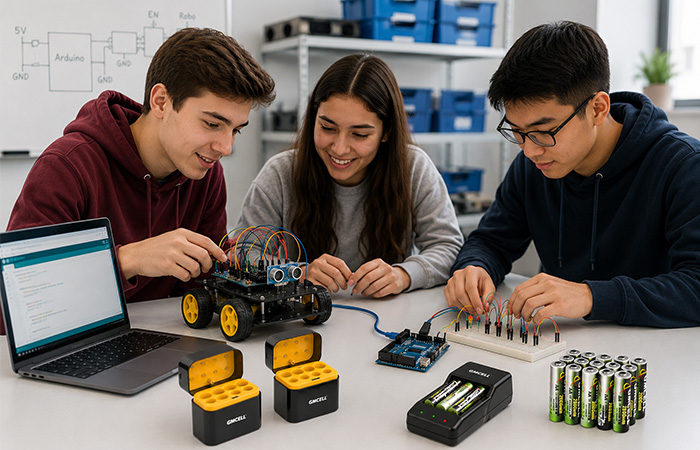
Why Power Design Matters More Than Most Arduino Beginners Realize
One of the most common misconceptions among beginners is assuming that Arduino projects consume significant amounts of power. In reality, most Arduino boards draw relatively little current. The board itself is rarely the source of power-related problems.
The real challenge usually comes from the components connected to the Arduino. Devices such as servo motors, DC motors, LCD displays, Wi-Fi modules, and Bluetooth modules can dramatically increase current demand, especially during startup or peak operating conditions.
| Device | Typical Current Draw |
|---|---|
| Arduino Uno | ~70mA |
| Servo Motor Startup | 800mA+ |
Looking at the numbers above, you can immediately see the difference. A single servo motor may require more than ten times the current drawn by the Arduino board itself. This is why a project that works perfectly on a desk can suddenly become unstable once motors begin moving.
Common Symptoms of Poor Power Design
- Voltage Sag – battery voltage drops under load.
- Brownout – the microcontroller temporarily loses stable operating voltage.
- Random Reset – the board unexpectedly restarts when motors or wireless modules activate.
Understanding these issues early can save hours of troubleshooting. In many cases, improving the battery system has a bigger impact on project reliability than changing code or replacing hardware components.
Understanding Arduino Power Requirements
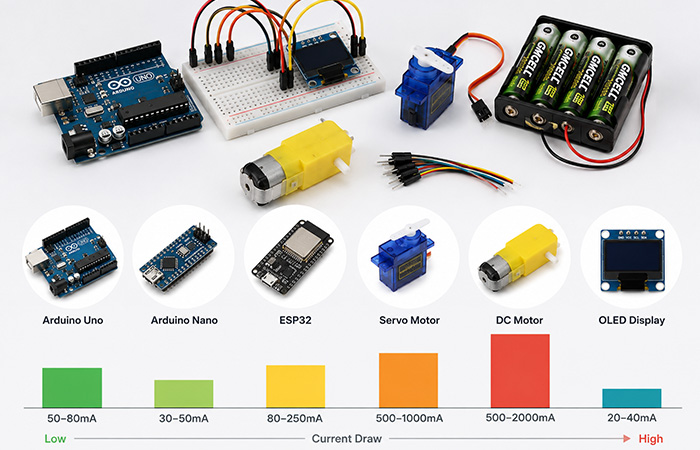
Before choosing a battery, it is important to understand where power is actually consumed in an Arduino project. Many beginners assume that the Arduino board itself is the primary power consumer, but that is rarely the case. In most Arduino projects, robotics systems, and embedded prototypes, the largest power demands come from external components rather than the microcontroller board.
Understanding these power requirements helps you choose the right battery configuration, avoid unexpected shutdowns, and build projects that remain stable during testing and demonstrations.
| Component | Typical Current |
|---|---|
| Arduino Uno | 50–80mA |
| Arduino Nano | 30–50mA |
| ESP32 | 80–250mA |
| Servo Motor | 500–1000mA |
| DC Motor | 500–2000mA |
| OLED Display | 20–40mA |
The key takeaway is simple: battery selection should be based on the power requirements of the entire system, not just the Arduino board itself. Motors, wireless modules, and sensors often determine whether a project performs reliably or suffers from voltage drops, brownouts, and unexpected resets.
What Makes NiMH Batteries Ideal for Arduino Projects?
When selecting a rechargeable battery for an Arduino project, the goal is not simply to maximize capacity. A good battery should be easy to use, safe in educational environments, capable of handling changing loads, and affordable enough to support repeated testing. This is where NiMH rechargeable batteries continue to stand out.
Direct Replacement for AA Batteries
One of the biggest advantages of NiMH batteries is their compatibility with standard AA battery holders. Students can use existing battery compartments, battery boxes, and project kits without redesigning hardware. This makes them particularly practical for classroom projects, robotics kits, and STEM learning activities.
Safer Than Lithium-Based Alternatives
Lithium batteries offer excellent energy density, but they also require more careful handling. NiMH batteries are generally considered more forgiving in educational settings.
- Lower risk of thermal runaway.
- Well suited for classroom environments.
- Easier for students and beginners to handle safely.
- Less concern about battery damage during everyday experimentation.
High Surge Current Capability
Many servo motors, DC motors, and robotics systems require brief bursts of high current when starting or changing direction. Because NiMH batteries have relatively low internal resistance, they can respond to these short-term demands more effectively than many disposable batteries, helping reduce voltage sag and improve overall system stability.
Simple Charging Requirements
Unlike many lithium battery systems, NiMH batteries do not require complex balancing circuits or advanced battery management systems. This simplicity reduces the learning curve for beginners and makes battery maintenance easier during frequent project testing.
Cost-Effective for Repeated Experiments
A quality NiMH battery can typically be recharged hundreds of times, with many cells supporting between 500 and 1,000 charge cycles. For students who regularly test code, modify hardware, and rebuild projects, this significantly lowers long-term operating costs while reducing battery waste.
How Many NiMH Batteries Does an Arduino Project Need?
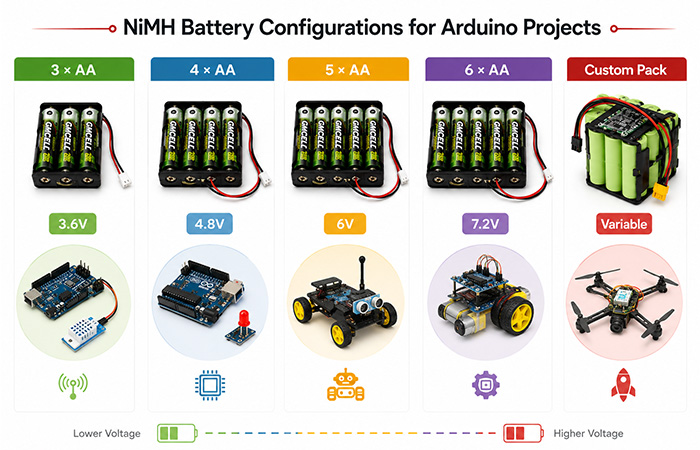
One of the most common questions students ask is how many batteries an Arduino project actually needs. The answer depends on the voltage requirements of your board, the type of peripherals connected to it, and whether motors are involved. Choosing too few cells may result in unstable operation, while using more cells than necessary can increase weight, cost, and complexity.
Since each NiMH battery cell provides approximately 1.2V, different battery configurations are commonly used depending on the application.
| Configuration | Voltage | Application |
|---|---|---|
| 3×AA | 3.6V | Low Power Sensors |
| 4×AA | 4.8V | Basic Arduino Projects |
| 5×AA | 6V | Robotics |
| 6×AA | 7.2V | Motor-Driven Systems |
| Custom Pack | Variable | Advanced Projects |
In practice, 4-cell and 5-cell configurations are by far the most common choices in educational environments. A 4×AA pack provides approximately 4.8V, which is suitable for many entry-level Arduino projects, while a 5×AA pack delivers around 6V and offers additional voltage headroom when motors, sensors, and communication modules are connected simultaneously.
This balance between voltage, runtime, and simplicity is one reason why NiMH battery packs remain popular in robotics classes, engineering labs, and student design competitions.
Why Does My Arduino Reset When a Servo Motor Starts?
If you have ever connected a servo motor to an Arduino and watched the board suddenly restart, you are not alone. This is one of the most common problems encountered by students, hobbyists, and robotics beginners. Surprisingly, the issue is often not caused by software at all—it is usually a power system problem.
Voltage Drop
When a servo motor starts moving, it can suddenly demand far more current than it requires during normal operation. If the battery cannot respond quickly enough, the voltage supplied to the Arduino drops below a safe operating level, causing the board to reset.
Startup Current Spike
Servo motors typically draw their highest current during startup. A motor that normally consumes a few hundred milliamps may briefly require close to an ampere when beginning movement, especially under mechanical load.
Weak Batteries
Partially discharged batteries, aging cells, or low-quality rechargeable batteries often struggle to supply sudden bursts of current. As a result, voltage stability suffers when motors activate.
High Internal Resistance
Every battery has internal resistance. The higher this resistance becomes, the greater the voltage loss during high-current events. This is one reason why disposable batteries often perform poorly in motor-driven robotics projects.
Practical Solutions
- Use separate power rails for motors and microcontrollers.
- Increase battery capacity where appropriate.
- Choose batteries with lower internal resistance.
- Reduce wiring losses and connector resistance.
- Verify that the power source can support startup current demands.
This is where high-quality NiMH batteries often have a clear advantage. Their relatively low internal resistance allows them to deliver strong transient current during motor startup, helping maintain voltage stability and reducing the likelihood of unexpected Arduino resets.
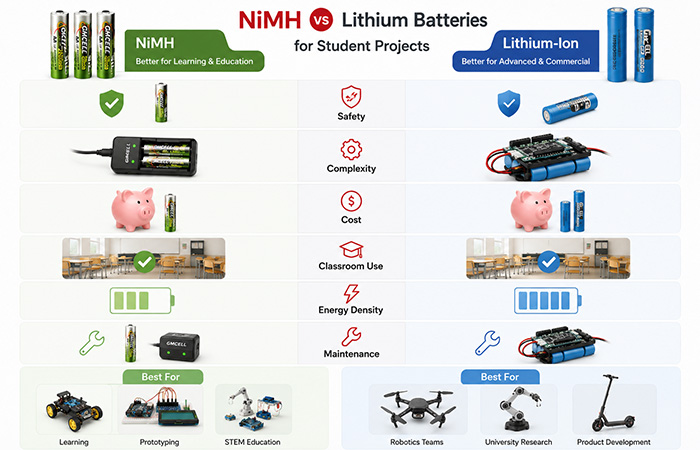
NiMH vs Lithium Batteries for Student Projects
Both NiMH batteries and lithium-ion batteries can power Arduino projects, but they serve different learning goals. If you are building a classroom robot, a sensor project, or an early prototype, safety and simplicity usually matter more than maximum energy density.
Lithium batteries are excellent for compact commercial products, drones, and weight-sensitive devices. NiMH batteries, however, are often easier for students to understand, safer to handle during repeated testing, and more forgiving when mistakes happen in a lab environment.
| Feature | NiMH | Lithium-Ion |
|---|---|---|
| Safety | Excellent | Moderate |
| Complexity | Low | Higher |
| Cost | Low | Medium |
| Classroom Use | Excellent | Good |
| Energy Density | Moderate | High |
| Maintenance | Easy | Moderate |
The practical conclusion is simple: for student projects, STEM education, and early-stage Arduino prototypes, NiMH vs Lithium-Ion batteries comparisons consistently show that NiMH is usually the safer and easier choice. For compact commercial products where size and weight are critical, lithium-ion batteries often become the better option.
Choosing Between AA Cells and Custom Battery Packs
Once you understand the basic differences between battery types, the next decision is whether your project should use standard AA cells or a custom battery pack. For many beginners, standard AA cells are the easiest way to start. They are simple, affordable, and compatible with widely available battery holders.
Standard AA Cells
Standard AA cells are a good fit when your main goal is learning, testing, and quick prototyping. They work especially well for:
- Learning basic Arduino power design.
- Prototyping simple circuits and sensor systems.
- STEM education projects that need easy battery replacement.
Custom Battery Packs
As projects become more advanced, standard AA holders may no longer be enough. Custom battery packs become more useful when the project needs a specific voltage, longer runtime, better mechanical integration, or more consistent performance under load.
- Robotics teams that need stable power during repeated motion tests.
- University research projects with specific voltage and runtime requirements.
- Product development prototypes that must fit into a defined enclosure.
Many engineering programs and robotics teams prefer using reliable NiMH batteries because they provide stable voltage, predictable performance, and straightforward integration into educational projects.
In simple projects, AA cells help students move quickly from theory to practice. In more advanced projects, custom packs help bridge the gap between classroom learning and real engineering design.
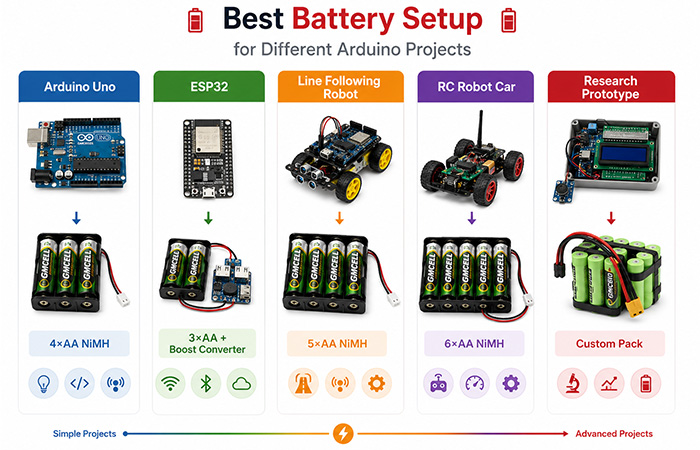
Best Battery Setup for Different Arduino Projects
The best battery setup depends on what your project needs to power. A simple Arduino Uno experiment may only need a basic AA battery holder, while an RC robot car or research prototype needs more stable current delivery, longer runtime, and better mechanical integration.
| Project Type | Recommended Power Setup |
|---|---|
| Arduino Uno | 4×AA NiMH |
| ESP32 | 3×AA + Boost Converter |
| Line Following Robot | 5×AA NiMH |
| RC Robot Car | 6×AA NiMH |
| Research Prototype | Custom Pack |
Simple Arduino Experiments
For basic LED, sensor, and classroom demonstration projects, a 4×AA NiMH setup is usually enough. It keeps the circuit simple and gives you a practical way to test code without depending on disposable batteries.
Robotics and Motor Projects
When your project includes servo motors, DC motors, or moving platforms, you need more voltage headroom and stronger current delivery. This is why 5×AA or 6×AA NiMH configurations are common in line following robots and RC robot cars.
Research and Prototype Development
For university research, advanced embedded systems, or product prototypes, battery selection becomes part of the engineering design process. At this stage, runtime, size, discharge current, connector type, and enclosure fit all become important.
When Should You Move Beyond Standard AA Batteries?
Standard AA batteries are excellent for learning, early testing, and many classroom projects. But they are not always the final answer. As your project becomes more advanced, you may need a battery solution that is designed around the device instead of forcing the device to fit a standard battery holder.
This usually happens when you move from an Arduino student project to an engineering team project, a research lab prototype, or a more serious product development application.
Standard AA Batteries May Not Be Enough When You Need:
- Special battery dimensions for a fixed enclosure.
- Higher capacity for longer runtime.
- Specific discharge performance for motors or embedded devices.
- More reliable wiring, connectors, and mechanical integration.
As projects become more sophisticated, engineering teams often transition to custom-designed NiMH battery packs that are optimized for runtime, voltage requirements, and device integration.
Where Custom Battery Packs Make Sense
- University research labs that need repeatable performance during testing.
- Robotics competitions where runtime and current delivery affect results.
- Industrial prototypes that require stable operation before product validation.
- Long runtime systems that cannot rely on basic battery holders.
Final Recommendations
If you have read this far, one thing should already be clear: there is no single battery setup that works best for every Arduino project. The right choice depends on your experience level, project complexity, power requirements, and future development goals.
Rather than focusing only on battery capacity, it is often more useful to think about safety, reliability, current delivery, and how easily the battery system fits into your learning or development process. The recommendations below provide a practical starting point for different types of users.
Arduino Beginners
Start with a simple 4×AA NiMH setup. It is easy to understand, widely supported by battery holders, and ideal for learning the fundamentals of Arduino power design.
Engineering Students
A 5×AA NiMH configuration offers a practical balance between voltage, runtime, and project flexibility. It works particularly well for embedded systems, robotics coursework, and engineering laboratory projects.
Robotics Teams
For projects with motors, servos, and mobile platforms, a 6×AA NiMH battery configuration typically provides stronger current delivery and improved voltage stability during movement and load changes.
Research Projects
Once a project requires specific voltage requirements, extended runtime, or custom mechanical integration, a custom battery pack often becomes the more practical engineering solution.
Product Development Teams
Commercial prototypes and pre-production devices rarely fit standard battery holders. In these situations, a custom battery pack solution can help optimize device size, runtime, voltage requirements, and overall system integration.
For most Arduino projects, STEM education programs, and engineering student projects, NiMH remains one of the most practical rechargeable battery technologies available. It combines safety, affordability, durability, and ease of use in a way that is difficult for many alternatives to match.