
Why Industrial Control Systems Still Depend on Rechargeable Backup Batteries
In a factory, a power interruption does not always damage the machine itself. The bigger risk is often quieter: a PLC loses its control parameters, an HMI forgets production settings, an industrial PC resets its clock, or a robot controller loses the data it needs to restart safely. When that happens, the real cost is not the battery. It is the lost production time, manual troubleshooting, reconfiguration work, and uncertainty before the line can run normally again.
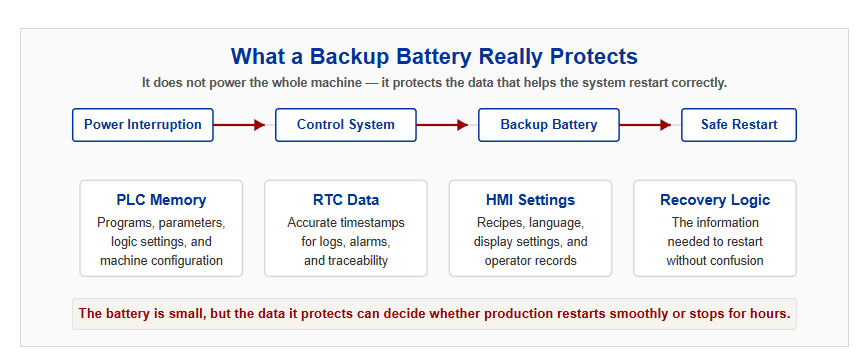
In industrial environments, a backup battery is not installed to run the whole machine. Its job is to protect the small but critical layer of memory retention, real-time clock data, configuration settings, and control information that allows the machine to restart correctly after maintenance, shutdown, or an unexpected power failure.
Why Backup Batteries Matter in Industrial Control Systems
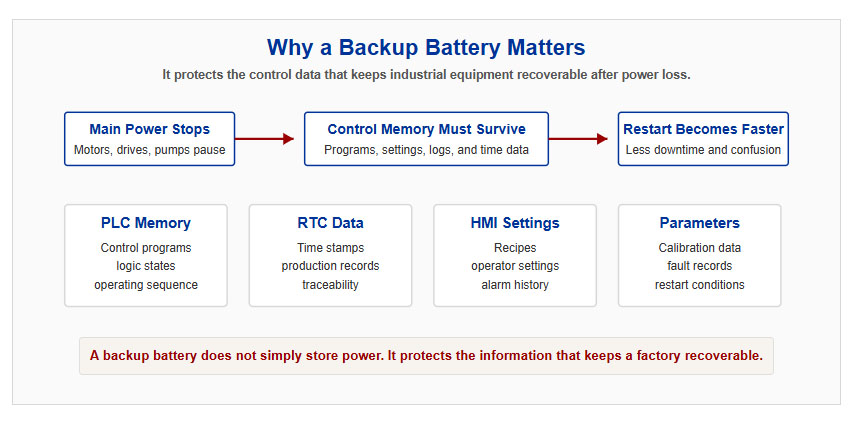
When an industrial control system loses main power, the visible equipment may stop first: motors slow down, pumps shut off, compressors pause, drives disconnect, and production comes to a halt. But the more serious problem often happens inside the control layer. The system still needs to remember its program logic, operating parameters, time records, fault history, and restart conditions. Without that information, power restoration does not always mean production recovery.
This is why a backup battery matters. Its purpose is not to keep the whole machine running for hours. Instead, it protects the small but essential data layer that allows the control system to restart correctly after a power interruption. In many factories, that protected layer includes PLC memory, real-time clock data, HMI settings, control parameters, calibration data, alarm history, and event logs.
In practical terms, a backup battery helps the system “remember who it is.” It preserves the last known operating state, the control program, the parameter settings, the fault records, and the timestamps that engineers need for diagnosis. That memory is what supports operational continuity. When it is lost, the cost is rarely limited to replacing a small battery. The real cost may appear as downtime, manual reconfiguration, delayed production, and longer troubleshooting after the equipment should already be back online.
What Happens When a Backup Battery Fails?
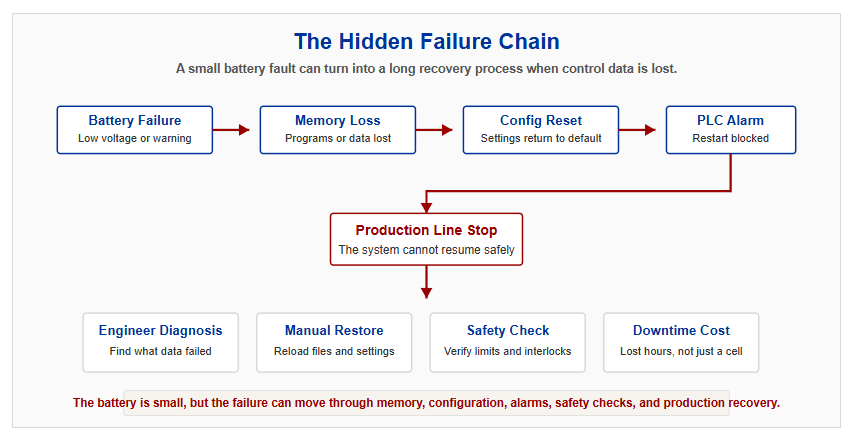
A failed backup battery rarely looks dramatic at first. The machine may still power on, the cabinet may look normal, and the operator may only see a warning message, a wrong clock value, or an unexpected alarm. But inside the industrial control system, the failure can already have started a chain reaction: battery failure leads to memory loss, memory loss leads to configuration reset, configuration reset leads to PLC alarms, and PLC alarms can lead directly to a stopped production line.
The real problem is not always the loss of electrical power. It is the loss of control information. A PLC may lose user programs or operating parameters. An HMI may return to default display settings. A real-time clock may reset, causing alarm timestamps and maintenance records to become unreliable. A data logger may fail to record the correct batch sequence. When the machine restarts, it may not know which parameters, limits, recipes, or safety states should be restored.
Once that happens, recovery becomes an engineering task rather than a simple restart. A technician may need to reload PLC logic, restore configuration files, check calibration values, verify safety interlocks, confirm alarm records, and test whether the machine can safely return to operation. This is why a small battery can create a large downtime cost. The battery itself may be inexpensive, but the lost production time, engineer diagnosis, manual restoration, and delayed restart can be far more expensive.
How Rechargeable Backup Batteries Protect PLC Memory and System Data
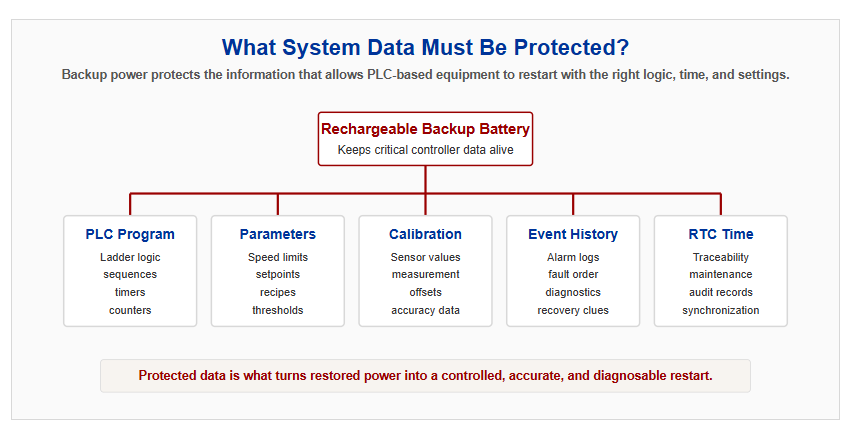
A rechargeable backup battery protects an industrial control system by supporting the parts of the controller that cannot afford to forget information. In many PLC-based systems, the most valuable information is not stored in motors or power components. It is stored in the controller: program logic, configuration values, calibration data, alarm history, event records, and real-time clock information.
PLC program retention is one of the most important functions. A PLC may rely on ladder logic, function blocks, sequence logic, timers, counters, and operating parameters to control a machine. If that logic disappears or resets after a shutdown, the equipment may power on but still fail to operate correctly. The backup battery helps preserve the control instructions that allow the machine to restart in a known state.
Configuration parameters are equally important. Speed limits, temperature setpoints, pressure ranges, delay times, sensor thresholds, recipe values, and position limits may all depend on stored settings. If those values are lost, the system may not simply run slower; it may run incorrectly. That can affect product quality, operator safety, and the ability to resume production without manual reprogramming.
Calibration data also needs protection. Sensors, instruments, weighing modules, measurement channels, and control modules may rely on calibration values to convert raw signals into usable process data. If calibration data is lost, a machine may still move, heat, count, or measure, but its output may no longer be accurate. In industrial environments, wrong data can be more dangerous than no data because it can make the system appear normal while operating outside acceptable limits.
Alarm and event history helps engineers understand what happened before and after a fault. If the backup battery fails and logs are lost or timestamps become unreliable, troubleshooting becomes slower. Engineers may need to reconstruct events manually instead of reading the actual sequence from the controller. That delay can increase downtime and make recurring faults harder to diagnose.
The real-time clock is not a minor feature. Accurate RTC data supports batch traceability, maintenance logs, audit records, network synchronization, and fault diagnosis. When the clock resets, alarms may appear in the wrong order, production records may lose credibility, and maintenance teams may struggle to prove when a fault occurred. A reliable rechargeable backup battery helps preserve the time reference that keeps industrial data useful.
Why Continuous Trickle Charging Is the Key Difference
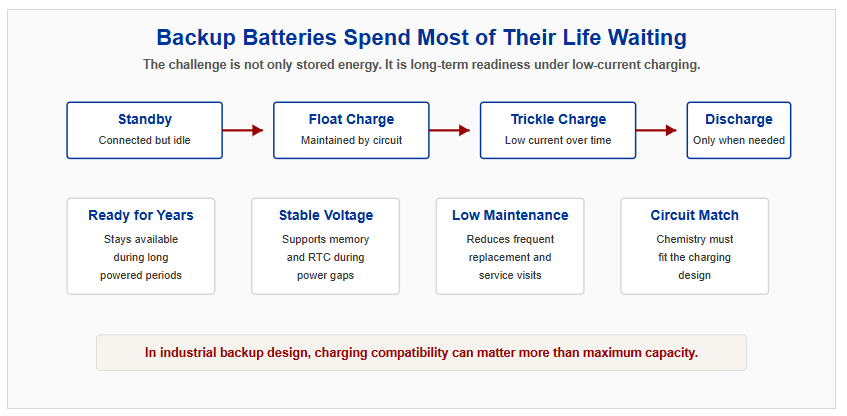
In most industrial control equipment, the backup battery is not deeply discharged every day. The machine may stay powered for months or years, while the battery remains connected in a quiet standby role. During normal operation, it may sit under float charge, trickle charge, or low-current maintenance charging. It only becomes active during maintenance, shutdown, controller replacement, or an unexpected power interruption.
That is why the most important question is not simply “Which battery has the highest capacity?” A backup battery in an industrial control system must remain ready for a long time, tolerate low-current charging, hold stable voltage, avoid leakage risks, reduce maintenance visits, and match the charging circuit designed into the controller. In this kind of application, long-term compatibility can matter more than the headline capacity printed on a cell.
For many backup applications, NiMH batteries remain practical because they can support rechargeable backup designs, stable discharge behavior, and long service life when properly matched with the charging circuit. This does not mean every control cabinet should use the same battery. It means the battery chemistry, charge current, voltage window, temperature range, and expected replacement cycle must be selected as part of the complete backup design.
A primary battery cannot be treated as a rechargeable component. A consumer battery may not be suitable for years of industrial standby duty. A battery with impressive capacity may still perform poorly if it is not compatible with the controller’s charging method. In industrial backup design, the battery is not an isolated part; it is a controlled energy reserve that must work with the circuit around it.
Why Primary Batteries Are Not Always Suitable for Industrial Control Backup
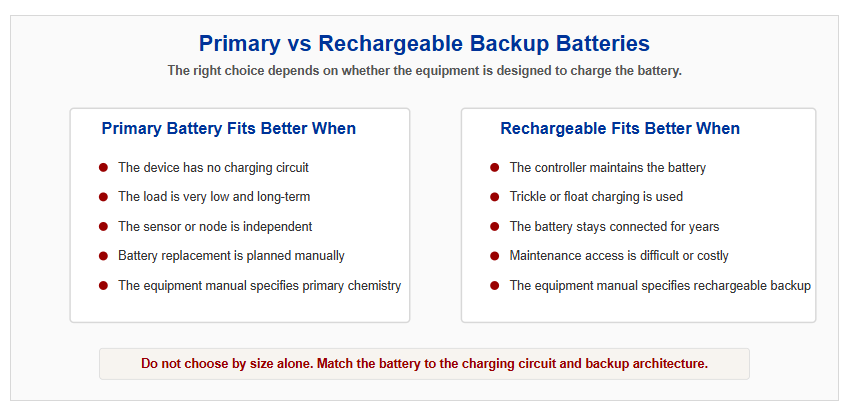
Primary batteries are not “bad” batteries. They are simply designed for a different kind of job. In the right application, they can be excellent for long-term low-power devices, non-rechargeable equipment, independent sensors, remote monitoring nodes, and systems where the battery is expected to discharge slowly over a long period without being connected to a charging circuit.
The problem appears when a primary battery is placed into a system designed around a rechargeable backup architecture. Many industrial controllers keep the backup battery connected to the board while the machine is powered. If the board provides a maintenance charge, trickle charge, or other charging path, a non-rechargeable battery may be the wrong component for the design. The issue is not only capacity. It is electrical compatibility.
In that situation, using the wrong battery can create several risks: the battery may not tolerate charging, replacement intervals become fixed and labor-intensive, maintenance teams may need to inspect many cabinets manually, and there is a higher chance of installing a battery that looks physically similar but behaves differently in the circuit. Long-term storage aging and leakage concerns can also become more important when spare batteries sit in maintenance rooms for years.
The practical rule is simple: if the equipment is designed as a rechargeable backup system, it should use a rechargeable backup battery that matches the controller’s voltage, current, charging behavior, temperature range, and maintenance plan. If the equipment is designed for primary backup power, then a suitable primary chemistry may be correct. The safest decision begins with the original equipment specification and the actual circuit design.
Where Rechargeable Backup Batteries Are Used in Industrial Automation
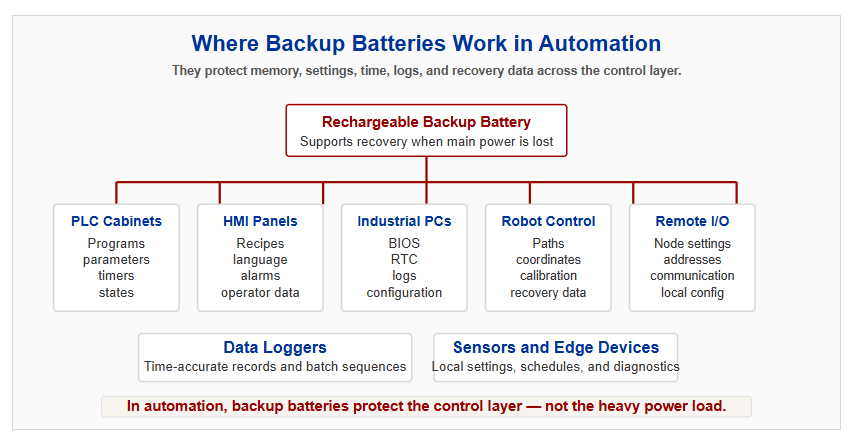
In industrial automation, rechargeable backup batteries are usually hidden inside control cabinets, operator panels, controllers, and monitoring devices. You may not notice them during normal production, but they become important whenever the system loses main power, enters maintenance mode, or restarts after a shutdown. Their purpose is not to drive motors or run heavy loads. Their purpose is to preserve the information that lets the automation system recover correctly.
PLC control cabinets often use backup batteries to preserve program logic, operating parameters, timers, counters, and system states. If those values disappear, the production line may not restart in the correct sequence. In this case, the battery protects the controller’s memory rather than the machine’s power circuit.
HMI panels may depend on backup power to retain screen settings, language preferences, recipes, alarm records, and operator data. In many production environments, a lost recipe or reset alarm list can slow the restart process because operators and engineers must confirm whether the system is safe and ready to run again.
Industrial PCs may use backup batteries to protect BIOS settings, real-time clock data, system configuration, and diagnostic logs. If an industrial PC loses its time reference or configuration, it may still power on, but its logs, network synchronization, and maintenance records may become unreliable.
Robot controllers may store paths, coordinates, calibration data, axis references, and recovery parameters. If this information is lost after a power interruption, the robot may require manual verification before it can safely return to operation. Backup batteries help preserve the data that supports repeatable movement and controlled recovery.
Remote I/O modules and distributed control nodes often need to retain local configuration, communication settings, and node addresses. Without backup support, a remote module may require reconfiguration after power loss, especially in systems spread across large factory floors or outdoor industrial sites.
Data loggers rely on backup power to keep time records accurate and data sequences complete. In quality control, energy monitoring, temperature tracking, and production traceability, incorrect timestamps can make the data less useful even if the measurements themselves were captured correctly.
Industrial sensors and edge devices may use rechargeable backup batteries to preserve local settings, communication parameters, sampling schedules, and diagnostic records. This is especially important in factory automation, remote monitoring, and edge-control systems where every device must return to service without requiring manual setup after every power event.
Choosing the Right Rechargeable Battery Chemistry
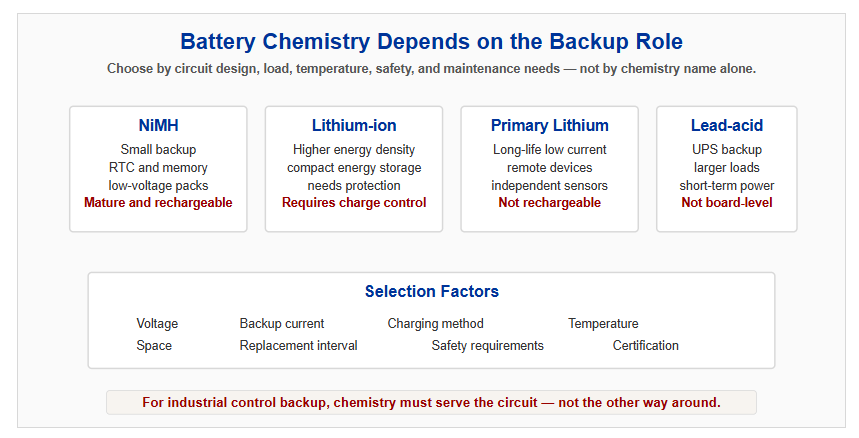
There is no single battery chemistry that fits every industrial control system. The right choice depends on the electrical design and the working environment. Before choosing a backup battery, engineers should confirm voltage, backup current, charging method, operating temperature, available space, expected replacement interval, safety requirements, and any certification or transport requirements.
NiMH is often suitable for many small backup, RTC, control-board, and low-voltage battery pack applications. Its advantages are maturity, stable rechargeable behavior, practical maintenance requirements, and proven use in compact backup designs. When properly matched with the charging circuit, NiMH can be a practical choice where long-term standby and controlled recharge behavior matter.
Lithium-ion offers high energy density, which can be useful where more energy is needed in limited space. However, it also requires protection circuits, careful charge control, and suitable safety management. In small industrial backup roles, the higher energy density is not always the deciding factor if the device mainly needs memory support and long-term standby reliability.
Primary lithium can be very useful for low-power devices that are not designed to recharge the battery. It is often suitable for remote, long-life, low-current equipment. But because primary lithium batteries are not rechargeable, they should not be used in circuits designed to maintain or recharge a backup battery.
Lead-acid batteries are common in UPS systems and larger short-term backup power applications. They can support heavier loads than small board-level backup batteries, but they are generally not the best fit for compact PLC memory, RTC backup, or small internal control-board backup designs. For industrial control backup, the key is not simply chemistry name. The key is matching the battery to the circuit, the load, and the maintenance plan.
Why Maintenance Cost Matters More Than Battery Price
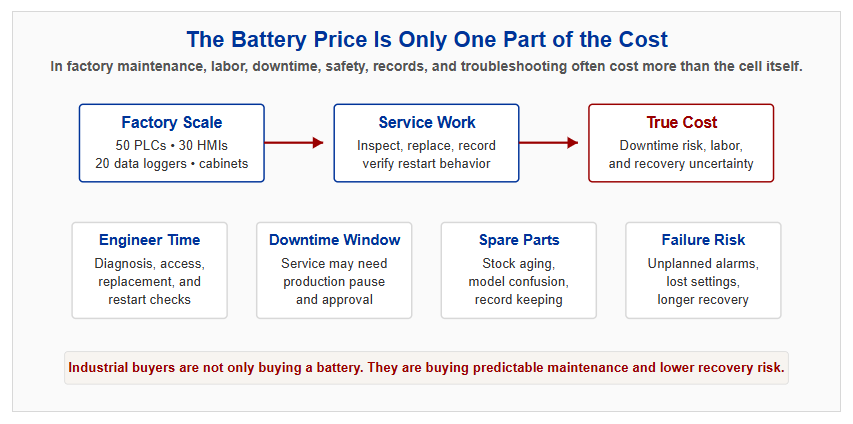
In a factory, the real cost of an industrial backup battery is rarely limited to the price of a single cell or pack. A plant may have 50 PLCs, 30 HMI panels, 20 data loggers, and several remote control cabinets spread across production areas. If each backup battery requires manual inspection, scheduled replacement, record keeping, and restart verification, the cost quickly moves beyond the battery itself.
Every maintenance task consumes engineer time. It may require opening a control cabinet, following safety procedures, waiting for an approved service window, confirming polarity and connector type, recording the replacement date, and checking whether the controller restarted correctly. When the equipment is part of a live production line, even a short task can become difficult if access is limited or shutdown approval is required.
This is why maintenance cost often matters more than battery price. The factory is not only paying for a backup battery. It is paying for engineer labor, downtime windows, safety approval, spare-part management, documentation, troubleshooting risk, and the possibility of an avoidable production interruption. A cheaper battery can become expensive if it causes more inspections, uncertain service life, or inconsistent performance across many devices.
For industrial customers, the better question is not “Which battery is cheapest?” The better question is “Which battery helps reduce maintenance uncertainty?” A good backup battery should support stable operation, consistent batch quality, predictable replacement intervals, and reliable supply. In industrial control systems, reliability and consistency often create more value than a small saving on the purchase price.
Industrial Environments Demand More Than Capacity
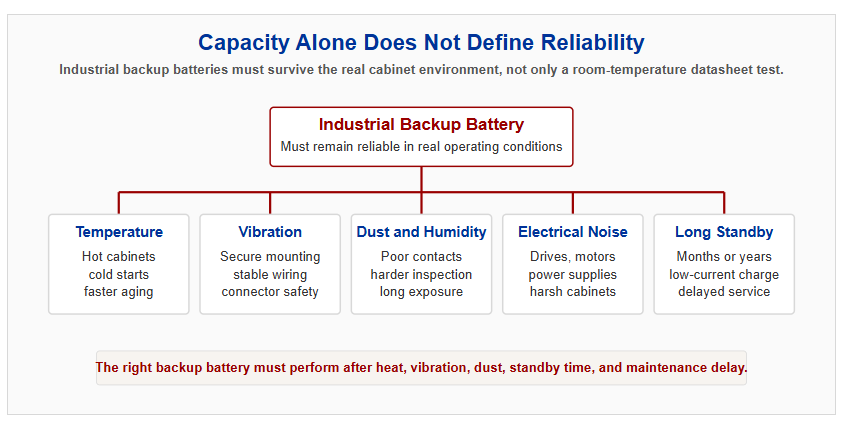
Many battery discussions start with capacity, but industrial environments are more complicated than a laboratory test. A backup battery inside a control cabinet may face temperature changes, cabinet heat, vibration, dust, humidity, electrical noise, long standby periods, and delayed maintenance. These conditions can affect real-world performance even when the battery looks suitable on paper.
Temperature is one of the most important factors. A battery that performs well at room temperature may age faster in a hot cabinet near drives, power supplies, or motors. Cold environments can reduce available output and make voltage behavior less predictable during a short backup event. For industrial control backup, the battery must be selected with the actual cabinet environment in mind, not only a standard capacity rating.
Vibration and installation conditions also matter. A battery pack may need secure mounting, stable wiring, correct connector polarity, and resistance to movement over time. Dust and humidity can make poor connections harder to detect. Electrical noise may not directly damage the battery, but it can make the control environment less forgiving when a system is already recovering from a power event.
This is why an industrial backup battery should not be treated like a consumer battery placed inside a machine. It needs to remain stable during long standby, tolerate the charging behavior of the control board, survive realistic environmental stress, and still support a clean restart when needed. In industrial control systems, the best battery is not always the one with the biggest capacity. It is the one that remains reliable under the conditions where the equipment actually works.
How to Select a Backup Battery for Industrial Control Systems
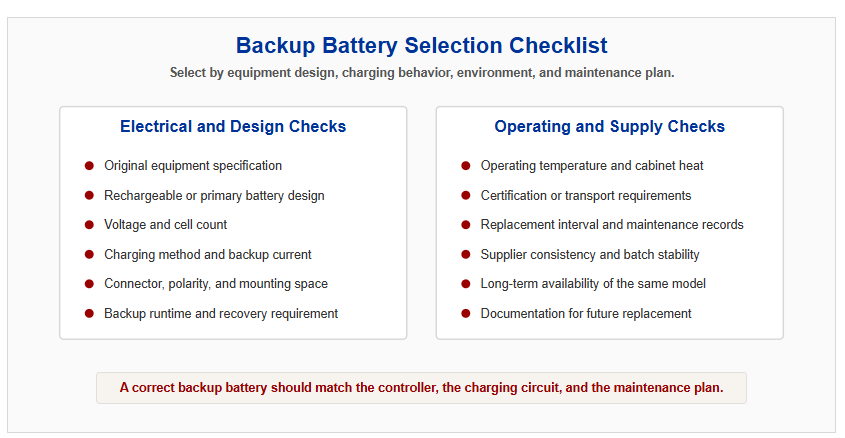
Selecting a backup battery for an industrial control system should start with the equipment design, not with the battery shelf. The same physical size does not always mean the same chemistry, voltage, charging behavior, connector polarity, temperature tolerance, or service life. Before replacing or specifying a backup battery, you need to understand what the controller expects the battery to do.
Start with the original equipment specification. Confirm whether the system was designed for a rechargeable or primary backup battery, then check the voltage, cell count, backup current, charging method, operating temperature, connector type, mounting space, backup runtime, certification needs, replacement interval, and supplier consistency. This is especially important when the battery is used to protect PLC memory, real-time clock data, HMI settings, or control parameters.
For equipment manufacturers or maintenance teams that need a fixed voltage, connector, size, or mounting structure, custom NiMH battery packs can be designed around the control board, charging circuit, operating temperature, and replacement requirements. This helps reduce compatibility risk and makes maintenance more predictable across multiple machines or production sites.
Common Mistakes When Replacing Industrial Backup Batteries
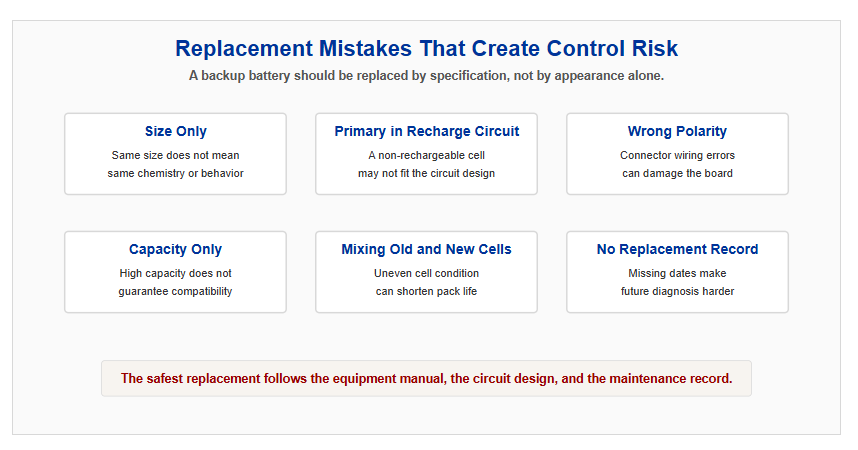
Replacing an industrial backup battery may look simple, but many failures happen because the replacement decision is based on appearance rather than system compatibility. A battery that fits into the holder may still be wrong for the charging circuit, control board, temperature range, connector polarity, or expected service life.
One common mistake is matching size but not chemistry. Two batteries can look similar while one is rechargeable and the other is primary. Another serious mistake is using a primary cell in a rechargeable circuit. If the controller is designed to maintain a rechargeable backup battery, installing a non-rechargeable cell can create risk and may not follow the equipment design.
Connector polarity is another detail that should never be ignored. A battery pack may have the correct voltage and size but the wrong connector orientation or wiring order. In control equipment, wrong polarity can damage the board or create a fault that is more expensive than the battery replacement itself.
Only looking at capacity is also risky. Backup batteries are not chosen only for how much energy they store. They must remain stable during long standby, match the charging method, preserve memory and RTC data, and support reliable restart behavior. A high-capacity battery that does not fit the circuit can be worse than a lower-capacity battery that is properly specified.
Maintenance teams should also avoid mixing old and new cells in the same pack and should always record replacement dates. Mixed cells can reduce pack life and create uneven performance. Missing replacement records make future troubleshooting harder because engineers cannot easily know whether a fault is caused by battery age, circuit behavior, or another control-system problem.
When Should Industrial Backup Batteries Be Replaced?
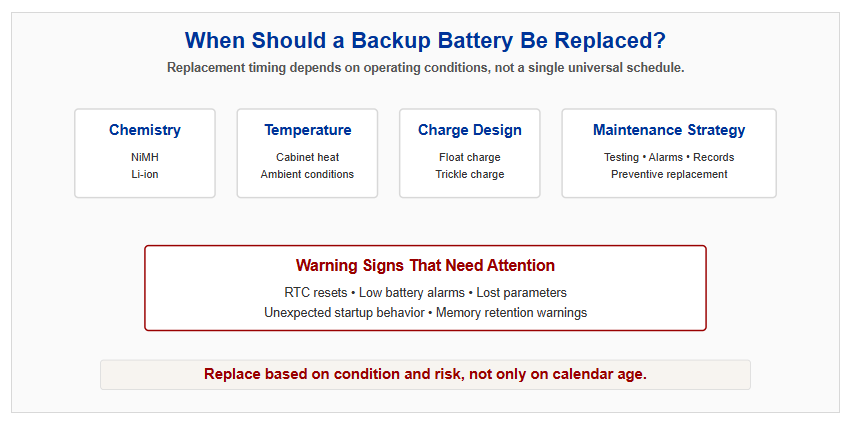
There is no universal replacement interval for an industrial backup battery. The correct timing depends on several factors, including battery chemistry, operating temperature, charging design, discharge frequency, cabinet conditions, equipment age, and the recommendations provided by the original equipment manufacturer.
A battery installed inside a climate-controlled control cabinet may remain healthy far longer than the same battery operating in a hot production environment. Likewise, a battery connected to a well-designed charging circuit may age differently from one exposed to unstable charging conditions or frequent power interruptions.
For this reason, many industrial maintenance teams do not replace backup batteries according to a fixed calendar date alone. Instead, they combine several inputs:
- Equipment manufacturer recommendations
- Annual preventive maintenance programs
- Battery alarms or low-voltage warnings
- Capacity testing results
- Historical replacement records
- Operational risk assessments
Certain warning signs should never be ignored. If you begin seeing RTC resets, unexpected time changes, low-battery alarms, lost parameters, configuration resets, memory retention warnings, or abnormal startup behavior, the backup battery should be inspected immediately. Waiting until a complete failure occurs may result in longer recovery times and unnecessary production disruption.
Conclusion
Industrial control systems depend on backup batteries for a reason that is often misunderstood. Their primary purpose is not to keep an entire machine running during a power outage. Their real job is to protect the control layer that allows the machine to recover correctly once power returns.
PLC programs, real-time clocks, configuration parameters, calibration records, alarm history, event logs, and recovery settings all rely on some form of backup power. Without that protection, a short power interruption can turn into a lengthy recovery process involving diagnostics, reconfiguration, testing, and production delays.
Rechargeable backup batteries remain widely used because many industrial systems spend most of their life powered on while keeping the backup battery connected through low-current maintenance charging. In this environment, long-term readiness, charging compatibility, predictable maintenance, and operational reliability become more important than maximum capacity alone.
Ultimately, selecting the right backup battery is not about buying a small component. It is about reducing downtime risk, protecting critical system data, and ensuring that industrial equipment can return to operation safely, accurately, and predictably when it matters most.
Frequently Asked Questions
Why do industrial control systems need backup batteries?
Industrial control systems need backup batteries because PLCs, HMIs, real-time clocks, industrial PCs, and controllers must retain programs, parameters, time data, logs, and configuration information during power loss. The backup battery is not there to drive the whole machine. It helps the system recover to the correct state after shutdown, maintenance, or an unexpected power interruption.
What happens if a PLC backup battery fails?
If a PLC backup battery fails, the controller may lose user programs, operating parameters, real-time clock data, alarm history, or configuration records. In serious cases, the equipment may not restart normally and an engineer may need to reload PLC logic, restore settings, verify calibration data, and check safety conditions before production can resume.
Why use rechargeable batteries instead of primary batteries?
Rechargeable batteries are used when the equipment is designed with a charging circuit and the battery remains connected for long periods under standby, float charge, or trickle charge conditions. A primary battery cannot be recharged, so it is better suited for low-power devices that do not include a charging path, such as independent sensors or certain remote monitoring devices.
Are NiMH batteries suitable for industrial backup applications?
NiMH batteries can be suitable for many low-voltage control-board backup, RTC backup, memory retention, and small battery pack applications. They are mature, rechargeable, stable in many backup designs, and can provide reliable performance when properly matched with the charging circuit, operating temperature, and maintenance requirements.
How long do industrial backup batteries last?
The service life of an industrial backup battery depends on chemistry, temperature, charge design, discharge frequency, cabinet condition, equipment age, and maintenance practice. Industrial equipment should normally follow the original equipment manual, preventive maintenance schedule, alarm signals, and testing results when deciding when to inspect or replace the battery.
Can rechargeable backup batteries stay connected all the time?
Yes, but only when the battery type and charging circuit are designed to work together. Many industrial backup batteries are intended to remain connected to the circuit for long periods, with low-current charging keeping them ready for power interruptions. The battery chemistry, voltage, charge current, and temperature range must match the controller design.
What is the difference between a UPS battery and a PLC backup battery?
A UPS battery usually supports larger loads for a short time, such as computers, servers, power supplies, or control cabinet equipment. A PLC backup battery is usually much smaller and is mainly used to preserve programs, parameters, RTC data, memory, and internal controller information. It is not designed to power the whole machine.
How do I choose the right backup battery for industrial equipment?
To choose the right backup battery, confirm the equipment specification, voltage, capacity, chemistry, rechargeable or primary design, charging method, connector, mounting space, operating temperature, maintenance interval, certification needs, and supplier consistency. Do not choose by size or capacity alone. The battery must match the equipment design and the recovery role it is expected to support.