
How to Build Topical Authority Through Complete Keyword Coverage
A practical framework for building search coverage, E-E-A-T, and long-term organic growth.
If your keyword research only keeps commercial terms, low-difficulty opportunities, and tool-labeled transactional intent, your content strategy may look efficient at first. But over time, it can leave your website too thin to prove real expertise.
- ✓ Learn why keywords are not only traffic opportunities, but proof of expertise.
- ✓ See how complete topic coverage helps Google understand your authority.
- ✓ Build a keyword asset library instead of a short-term keyword list.
- ✓ Apply the framework to SaaS, DevOps, status pages, and incident communication.
The Problem With ROI-Only Keyword Research
Most SEO teams start keyword research with a simple question:
Which keywords are most likely to generate revenue?
On the surface, that sounds like a smart business decision. You focus on transactional keywords, commercial intent terms, low-difficulty opportunities, and phrases that appear closest to a purchase decision.
At the same time, many teams remove informational keywords, conceptual topics, beginner questions, and low-volume searches because they do not seem to contribute directly to conversions.
The result is a content strategy built around a handful of commercial pages rather than a complete understanding of the topic itself.
ROI matters. But when keyword research focuses only on ROI, topical coverage becomes incomplete.
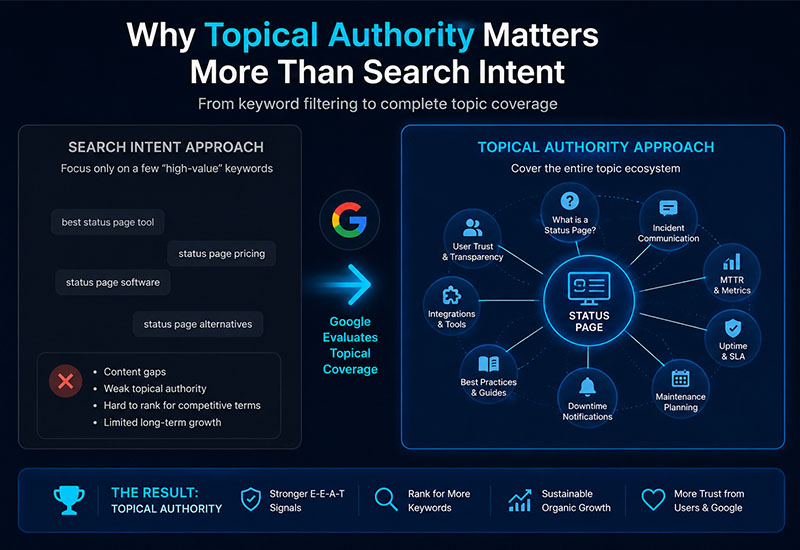
Imagine a SaaS company that only creates content around:
- best status page software
- status page pricing
- status page tool
- status page alternatives
These are valuable keywords. They are closely connected to product evaluation and buying decisions.
But what happens if the same company never covers topics such as incident communication, MTTR, maintenance planning, uptime management, downtime notifications, or service reliability?
Google may understand what the company sells, but it has less evidence that the company truly understands the broader subject area.
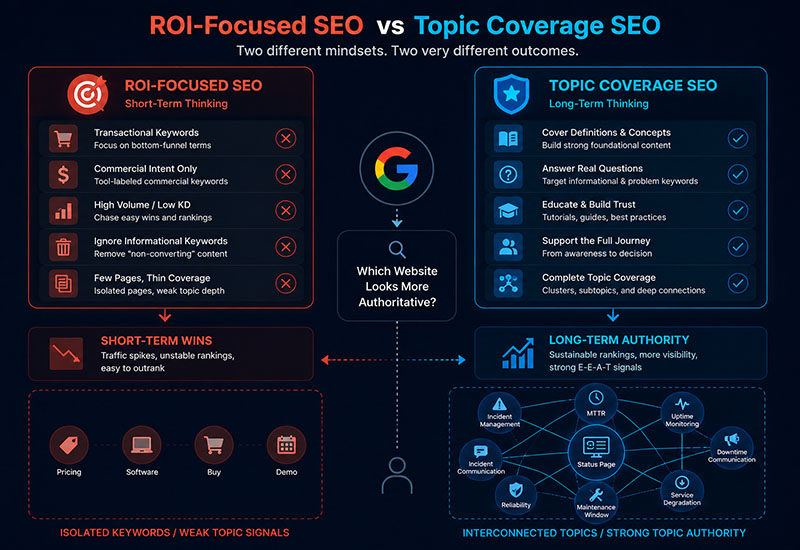
Conversion-focused keywords are often the entry points that generate revenue. Informational keywords, conceptual topics, and problem-solving content form the foundation that makes those commercial pages stronger. Without that foundation, long-term topical authority becomes difficult to build.
Keywords Are Not Just Traffic Opportunities
Traditional keyword research often evaluates opportunities using only three metrics:
- Search volume
- Keyword difficulty
- Commercial potential
These metrics are useful, but they only describe the traffic potential of a keyword. They do not explain its role within a larger topic ecosystem.
Keywords are not only traffic opportunities.
They are evidence of expertise.
Every keyword represents a question, a problem, a workflow, a concept, or a decision that users need help understanding.
When you cover enough of those questions, Google begins to see your website as a comprehensive resource rather than a collection of isolated landing pages.
Consider a company that claims expertise in DevOps reliability.
If its content never discusses MTTR, incident management, uptime monitoring, maintenance windows, service degradation, status pages, or downtime communication, can search engines confidently identify it as an authority on reliability operations?
Probably not.
Topical authority emerges when related concepts connect together and form a complete knowledge network. The more relevant questions you answer, the easier it becomes for both users and search engines to understand the depth of your expertise.
Topical Authority Is Built Through Complete Search Coverage
Topical authority is not built by publishing one strong article around one big keyword.
It is built when your website covers the full topic ecosystem around what your audience actually needs to understand.
This is where E-E-A-T becomes practical. It is not only about having an author bio or an About page. It is about proving depth through useful, connected, and trustworthy content.
For example, a SaaS company should not only write about status page software or best status page tools.
If it wants to become a trusted resource around status pages and incident communication, it also needs to cover topics such as what a status page is, public vs. private status pages, incident communication templates, MTTR meaning, uptime SLA, maintenance announcements, and how to reduce support tickets during downtime.
Some of those keywords may not convert immediately. But together, they help search engines understand that your website is not just selling a tool. It is helping users understand the entire problem space.
The same logic applies in technical industries. A complete topic cluster often includes foundational explanations, such as this guide on what a NiMH cell is, because basic concepts often support the authority of more advanced technical pages.
The Search Coverage Framework
Instead of treating keyword research as a filtering task, treat it as a coverage-building process. Your goal is not to find a few “perfect” keywords. Your goal is to understand the full language of your market.
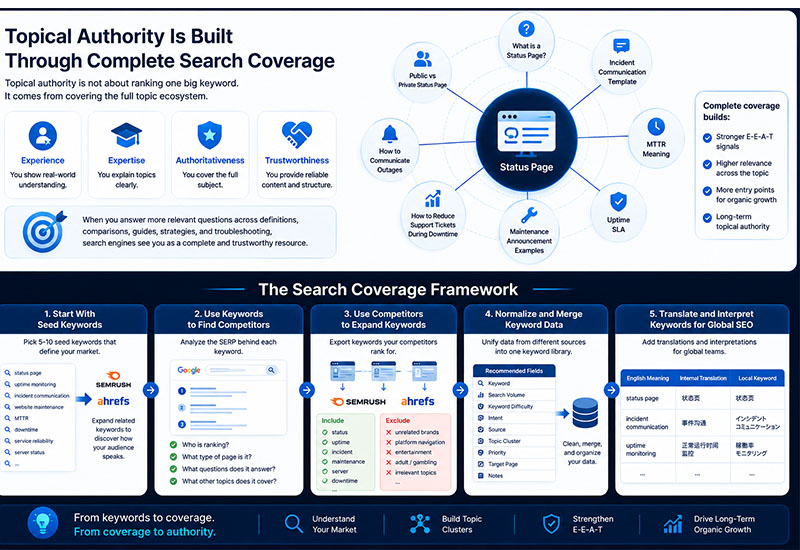
Search coverage starts with seed keywords, expands through SERPs, grows through competitor research, and becomes useful only when the data is cleaned, grouped, and mapped to topics.
Start With Seed Keywords
Begin with 5–10 seed keywords that describe your market. For a SaaS or status page product, these may include status page, uptime monitoring, incident communication, website maintenance, server status, MTTR, downtime, and service reliability.
Then use tools such as Semrush or Ahrefs to expand related terms. At this stage, you are not trying to select winners. You are trying to discover how your audience describes the problem.
Use Keywords to Find Competitors
Every keyword has a SERP behind it. The websites ranking there show what Google currently considers relevant.
Look beyond the keyword data. Ask who is ranking, what type of page ranks, whether the result is a product page or an article, and what questions the page answers. Your real content competitors are often the sites Google already trusts for that topic.
Use Competitors to Expand Keywords
After you identify relevant competitors from the SERP, export the keywords they rank for. This often reveals opportunities that never appear when you only expand from seed keywords.
If you analyze large platforms such as Reddit, Wikipedia, Amazon, or broad media sites, do not export everything blindly. Their keyword databases are too large and noisy.
status, uptime, incident, maintenance, server, downtime
unrelated brands, platform navigation terms, entertainment keywords, adult or gambling content
Normalize and Merge Keyword Data
Keyword exports from different tools and workflows often use different column structures. If you merge them without cleaning the format, your data can become unreliable.
A practical keyword library should include fields such as Keyword, Search Volume, Keyword Difficulty, Intent, Source, Topic Cluster, Priority, Target Page, and Notes.
Source tells you where the keyword came from. Topic Cluster tells you where it belongs. Without those two fields, your keyword research remains a spreadsheet instead of becoming a content strategy.
Translate and Interpret Keywords for Global SEO
For multilingual SEO, translation is not only about converting words from one language to another. It is about helping your team understand the search intent behind local language keywords.
Add columns such as English Meaning, Internal Translation, and Local Language Keyword. The biggest risk in global SEO is not poor translation. It is misunderstanding the keyword and building the wrong page around it.
Why You Should Not Blindly Delete Informational Keywords
Informational keywords are often the first keywords removed during SEO planning.
They do not always look commercial. They may not contain words like “pricing,” “software,” “tool,” “alternative,” or “buy.” Because of that, many teams assume they are not worth targeting.
But search intent labels are generated by tools. They are useful signals, not final business decisions.
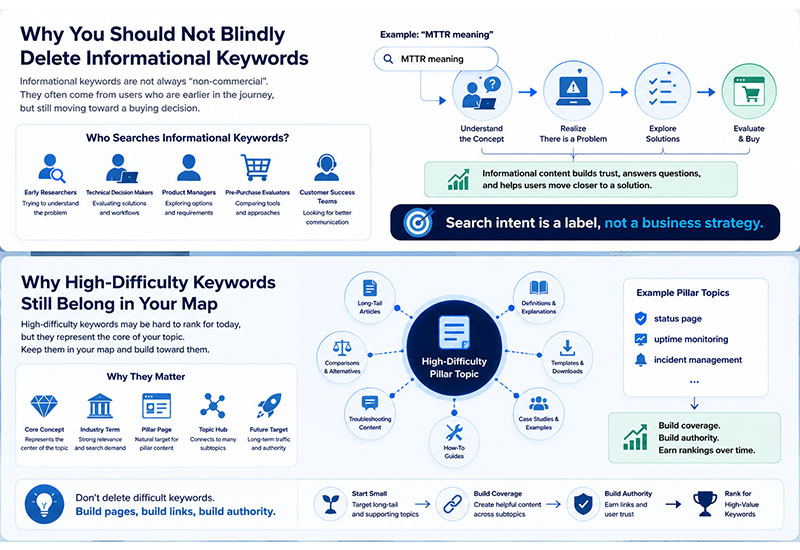
Search intent is a label,
not a business strategy.
An informational keyword may come from an early-stage researcher. It may also come from a technical decision-maker, product manager, DevOps engineer, procurement evaluator, or customer success leader who is trying to understand a real operational problem.
For example, “MTTR meaning” looks like a simple definition query. But the person searching for it may be dealing with incident management, downtime reporting, support pressure, or reliability goals.
That user may not be ready to buy a status page tool today. But they are entering the problem space that a status page product helps solve.
If you delete those keywords too early, you may also delete the content that helps users discover the problem, understand the cost of inaction, and eventually evaluate a solution.
Why High-Difficulty Keywords Still Belong in Your Map
High-difficulty keywords are another common casualty of keyword filtering.
For a new website, this reaction is understandable. If a keyword looks too competitive, it may feel unrealistic to target it.
But removing a difficult keyword from your plan is not the same as deciding not to rank for it today. Sometimes, a difficult keyword represents the center of the topic.
High-difficulty keywords do not always need to be your first ranking target. But they should often remain part of your topic map.
These keywords may represent core concepts, category-defining terms, pillar page opportunities, and future content hubs.
A new SaaS website may not quickly rank for terms like status page, uptime monitoring, or incident management.
That does not mean those topics should disappear from the strategy. Instead, they can become pillar pages supported by long-tail articles, comparison content, templates, definitions, and troubleshooting guides.
In other words, keyword difficulty should influence prioritization, not erase important topics from your search coverage.
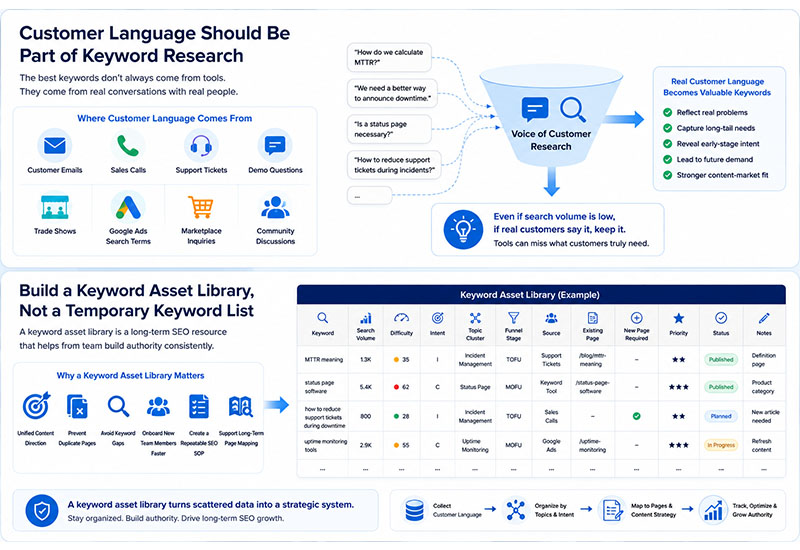
Customer Language Should Be Part of Keyword Research
SEO tools are useful, but they are not the only source of keyword opportunities.
Some of the most valuable keywords do not come from keyword databases. They come from real conversations with customers, prospects, users, sales teams, support teams, and communities.
This is often called Voice of Customer Research. Instead of asking only what a tool reports, you also ask how real people describe their problems before they know the official industry terminology.
If real customers use a term, record it.
Even when the search volume looks small, the business signal may be real.
Useful customer language can come from many places:
Keyword tools may not capture every long-tail phrase, especially in niche B2B, SaaS, technical, or multilingual markets.
If a phrase repeatedly appears in sales calls, support tickets, or customer emails, it deserves a place in your keyword research process. It may become a future article, FAQ, comparison page, support resource, or product messaging insight.
Build a Keyword Asset Library, Not a Temporary Keyword List
Keyword research should not disappear after one content campaign.
If your keyword research only lives in a temporary spreadsheet, it becomes easy for teams to lose context, repeat the same work, create overlapping pages, or ignore important topics when people change roles.
A better approach is to build a Keyword Asset Library: a long-term SEO resource that supports content planning, page mapping, topic clustering, and team alignment.
Keyword libraries become especially valuable in technical industries where search demand is spread across many related questions. Instead of creating isolated pages, successful teams organize keywords into connected topic clusters that support long-term authority building.
A practical example is this rechargeable battery knowledge hub covering battery chemistry, charging, lifespan, voltage behavior, maintenance, and application-specific guidance: NiMH battery resource center .
A keyword list helps you plan articles. A keyword asset library helps your team build authority consistently over time.
A strong keyword asset library helps you:
At minimum, your library should include fields such as Keyword, Search Volume, Difficulty, Intent, Topic Cluster, Funnel Stage, Source, Existing Page, New Page Required, Priority, Status, and Notes.
These fields turn raw keyword data into a decision-making system. Instead of asking “Should we write this keyword?”, your team can ask “Where does this keyword belong in our topic ecosystem?”
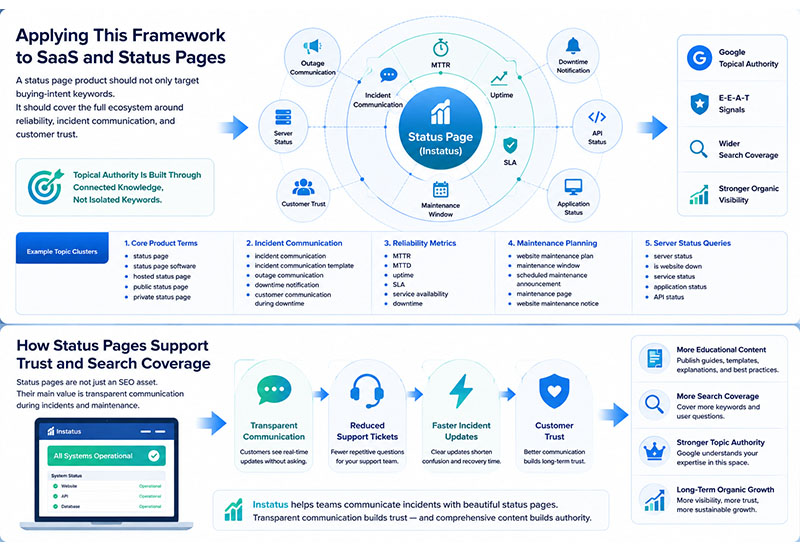
Applying This Framework to SaaS and Status Pages
Understanding topical authority is useful in theory. The real question is how to apply it to a SaaS product.
For status page software, one of the most common mistakes is building content around a handful of commercial keywords and assuming the topic is fully covered.
In reality, Google evaluates an entire topic ecosystem. If your content only targets buying-intent keywords, it becomes difficult to demonstrate expertise in reliability, incident communication, maintenance planning, and operational transparency.
Topical Authority Is Built Through Connected Knowledge, Not Isolated Keywords
A status page platform can organize its content into multiple related topic clusters.
Core Product Terms
status page · status page software · hosted status page · public status page · private status page
Incident Communication
incident communication · outage communication · downtime notification · incident communication template · customer communication during downtime
Reliability Metrics
MTTR · MTTD · uptime · SLA · service availability · downtime
Maintenance Planning
website maintenance plan · maintenance window · maintenance page · scheduled maintenance announcement · website maintenance notice
Server Status Queries
server status · service status · API status · application status · is website down
This is where many SaaS content strategies fall short.
If a company only publishes content around “status page software” and “best status page tool,” Google sees a product category.
But when it also covers uptime metrics, outage communication, maintenance planning, customer trust, and incident workflows, Google begins to see expertise across the broader status page ecosystem.
How Status Pages Support Trust and Search Coverage
Status pages are not primarily an SEO tool.
Their primary purpose is to help teams communicate clearly when systems experience maintenance, degradation, or unexpected outages.
Platforms such as Instatus help companies create transparent status communication so customers always know what is happening, what is being fixed, and when service is expected to recover.
There is also an indirect SEO benefit.
When a company publishes educational content around status pages, uptime metrics, outage communication, maintenance planning, and reliability best practices, it expands its search coverage across a much wider topic landscape.
For a product like Instatus, topical authority can extend beyond status page software itself and into the broader areas of incident communication, uptime education, service reliability, and operational transparency.
The result is a stronger content ecosystem that helps both users and search engines understand what the company truly knows.
Common Mistakes When Building Topic Coverage
Building topic coverage does not mean publishing every keyword you can find.
It means understanding which topics belong in your ecosystem, how they connect, and which pages should answer each user need. When teams skip that planning step, keyword research quickly turns into scattered content.
Low volume does not always mean low value, especially in B2B and SaaS markets where one specific query can reflect a real buying problem.
Intent labels are helpful, but they are not final judgment. Your industry knowledge should decide whether a keyword belongs in the map.
Low-difficulty keywords can help you gain traction, but difficult core topics still need a place in your long-term authority plan.
Without page mapping, keywords remain a messy spreadsheet. Each topic should have a clear destination, whether it is an existing page or a new page.
Your keyword library should keep growing through customer feedback, Google Ads search terms, GSC data, sales insights, and new product use cases.
Strong topic coverage is not built by collecting keywords once. It is built by continuously improving your understanding of the market language your users rely on.
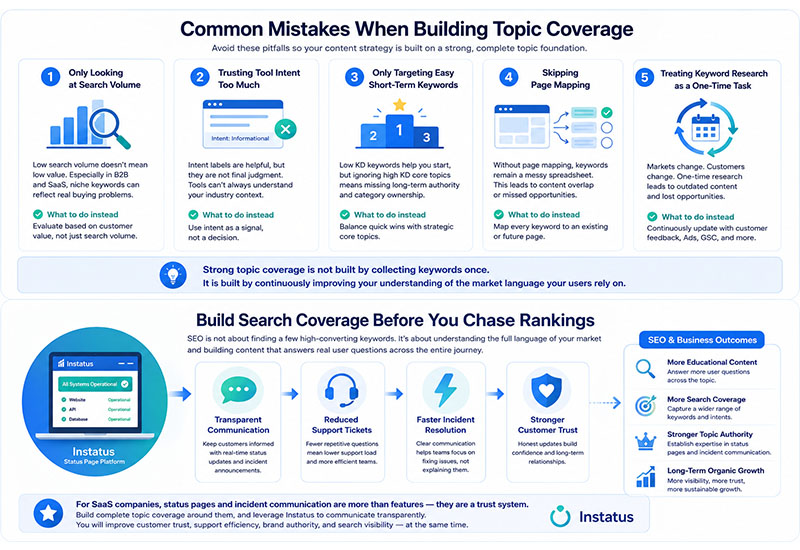
Build Search Coverage Before You Chase Rankings
SEO does not end when you find a few high-converting keywords.
Long-term organic growth comes from understanding the full language of your market and building content that answers the real questions users ask across the entire journey.
Search volume, keyword difficulty, and search intent are useful. But they should guide your judgment, not replace it.
The goal is not to delete most keywords.
The goal is to understand where each keyword belongs.
For SaaS companies, this is especially important. A product category is rarely just a product category. It is surrounded by definitions, workflows, customer problems, decision criteria, and trust signals.
Status pages and incident communication are a good example. They are not only software features. They are part of a trust system between companies and their users.
When you build content around the questions users actually care about, and combine that content with a transparent status page tool like Instatus, you can improve customer trust, support efficiency, brand authority, and search visibility at the same time.
Build the map first. Then build the pages. Rankings become more achievable when search engines can clearly see the depth, structure, and usefulness of your topic coverage.
Frequently Asked Questions
Is search intent the most important factor in keyword research?
No. Search intent is useful, but it should not be the only factor. If you only keep transactional keywords, you may miss the educational content needed to build topical authority.
What is topical authority in SEO?
Topical authority means search engines can understand that your website covers a subject deeply through related concepts, questions, tutorials, examples, and use cases.
Why do informational keywords matter?
Informational keywords often come from users who are researching a problem. They may not convert immediately, but they help build trust, educate users, and support long-term authority.
Should high-difficulty keywords be removed?
Not always. High-difficulty keywords often represent important pillar topics. They may be hard to rank for now, but they should still guide long-term content planning.
How does keyword coverage support E-E-A-T?
Complete keyword coverage helps demonstrate experience, expertise, authority, and trust by showing that your website can explain a topic from multiple useful angles.
What is a keyword asset library?
A keyword asset library is a long-term SEO resource that organizes keywords by topic cluster, intent, source, priority, page mapping, and content status.
Why should customer language be included in keyword research?
Customer emails, sales calls, support tickets, and demo questions often reveal real search language that SEO tools may miss, especially in SaaS and B2B markets.
What is the difference between a keyword list and a topic cluster?
A keyword list is a collection of search terms. A topic cluster connects related keywords into a structured content system that supports topical authority.
How can SaaS companies use topic coverage?
SaaS companies can build topic coverage by answering product questions, industry definitions, customer pain points, workflow problems, and comparison searches across the full user journey.
How do status pages contribute to topical authority?
Status pages support customer trust, while content around incident communication, uptime, maintenance planning, and reliability helps build authority in the broader operations space.