
GMCELL Tech Shares Why Some Industrial OEMs Still Choose NiMH Battery Packs
GMCELL Tech shares insights on reliability, lifecycle stability, and long-term power design for industrial applications.
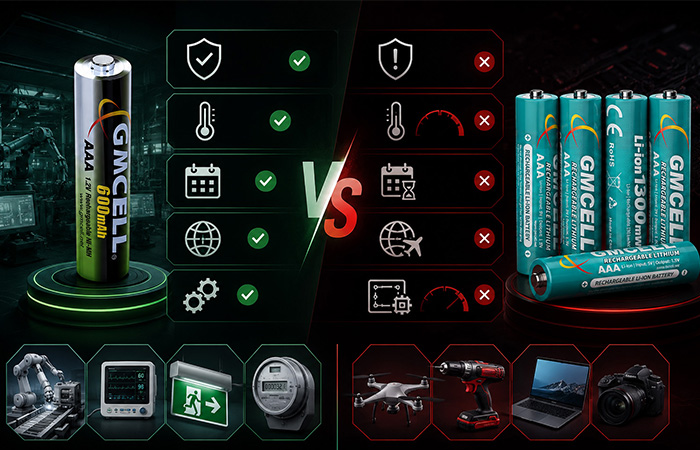
Lithium-ion batteries dominate headlines, consumer electronics, and electric vehicles. Their high energy density has made them the default choice for many portable devices.
However, industrial battery selection follows a very different set of priorities. Engineers responsible for automation systems, medical equipment, emergency devices, and embedded electronics are often focused on something entirely different: reliability, predictability, safety, and long-term availability.
This is one reason why NiMH battery packs continue to appear in new industrial designs despite the widespread adoption of lithium-ion technologies.
For many OEMs, the question is not which battery chemistry stores the most energy. The real question is which battery introduces the least operational risk over the life of the product.
Why Is NiMH Still Being Designed Into New Industrial Equipment?
If lithium-ion batteries are used in smartphones, laptops, power tools, electric vehicles, and many portable devices, it is reasonable to ask a simple question: why are some industrial OEMs still designing equipment around NiMH battery packs?
The answer is not that NiMH is newer, lighter, or more energy-dense. It is that industrial power design is not always driven by the same priorities as consumer electronics. In many industrial systems, the battery is not selected to impress the market with maximum capacity. It is selected to keep a device predictable, serviceable, and available over a long operating life.
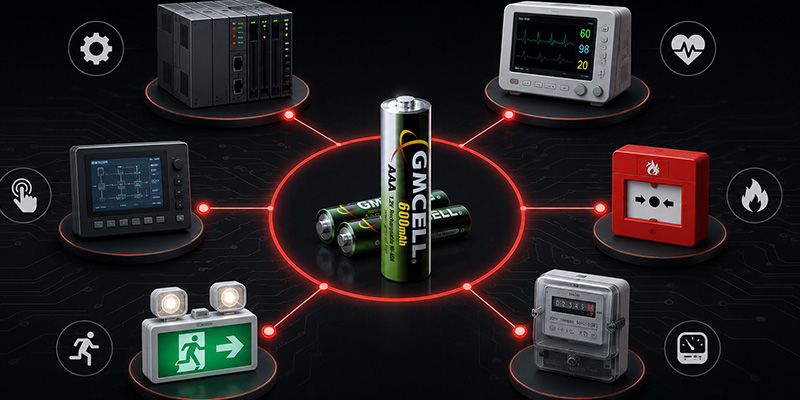
PLC & HMI Systems
Control systems need stable backup power for memory, parameters, clocks, and recovery data.
Medical Monitors
Medical equipment often values predictable operation and proven chemistry over maximum energy density.
Fire & Emergency Devices
Fire alarms and emergency lighting systems need dependable standby power when failure is not acceptable.
Utility Meters
Metering products may remain in the field for years, making long-term support more important than headline capacity.
Backup Power Modules
Many backup applications need stable behavior during standby, replacement, and recovery cycles.
Embedded Electronics
Embedded devices often need compact, proven power solutions for RTC backup, memory retention, and system recovery.
In these applications, the battery is part of a larger reliability decision. A factory controller, a medical monitor, a fire alarm, an emergency light, or a utility meter does not always need the highest possible energy density. What it often needs is predictable operation, stable performance, low maintenance, and long product support.
That is why NiMH continues to appear in industrial designs even when lithium-ion receives more attention in the wider market. For an OEM, choosing a battery is rarely about chasing the most advanced chemistry on paper. It is about choosing the chemistry that fits the actual operating environment, service model, and product lifecycle.
In industrial environments, reliability often outweighs maximum battery capacity.
Reliability Often Matters More Than Energy Density
In the consumer battery world, it is easy to assume that a better battery simply means higher capacity, longer runtime, or more energy stored in a smaller space. That logic works well for smartphones, drones, laptops, and other portable devices where users directly feel the difference between a shorter and longer runtime.
But in industrial battery selection, the priority is often very different. For many OEM engineers, the real question is not, “How much energy can this battery store?” The more important question is, “How much operational risk does this battery introduce into the system?”
Higher capacity means better performance.
Lower system risk means better design.
This difference matters because industrial equipment rarely operates in a clean, predictable, easy-to-service environment. A battery pack may sit inside a controller cabinet, a medical device, an emergency lighting unit, a utility meter, or a remote monitoring system for years. It may need to deliver power only occasionally, but when it is needed, failure is not acceptable.
In these applications, a slightly higher capacity rating does not automatically create more value. If a battery chemistry requires more complex protection design, introduces more compliance work, creates more service uncertainty, or increases the chance of unexpected downtime, the apparent advantage of higher energy density can quickly disappear.
For an industrial OEM, a battery is not just a component. It is part of the product’s reliability chain.
If the battery behaves unpredictably, the whole product may become harder to support. If it fails earlier than expected, the service team may need to send technicians into the field. If it creates safety or transport concerns, the procurement and logistics teams may face additional costs. That is why many engineers evaluate NiMH battery packs through the lens of risk control, not just electrical performance.
Downtime changes the real cost of a battery decision
A battery pack may be a small part of the total system cost, but the failure of that battery can create consequences far beyond its purchase price. In industrial automation systems, one controller failure can stop a production line. In medical equipment, unstable backup power can affect device readiness. In emergency lighting, the battery may only be noticed when normal power fails — exactly when reliability matters most.
This is why OEM engineers often think in total operational cost rather than battery unit cost. Equipment downtime, fault investigation, emergency replacement, field maintenance, delayed production, and customer dissatisfaction can all become part of the real cost of a weak power design.
Equipment Downtime
A stopped machine can cost far more than the battery that caused the interruption.
Fault Diagnosis
Unstable battery behavior can create intermittent faults that are difficult to trace.
Field Maintenance
Site visits, labor hours, replacement parts, and travel time all increase support cost.
Remote Service Cost
For distributed systems, every unexpected replacement becomes more expensive.
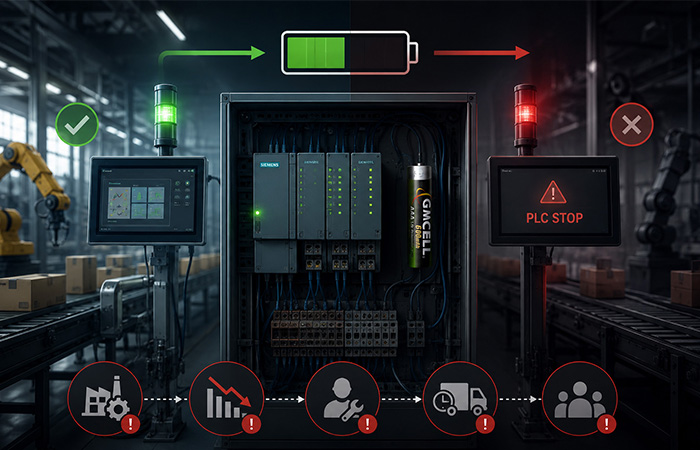
A PLC failure makes the trade-off easier to understand
Consider a PLC used in a factory automation system. The backup battery may not be powering motors, drives, or heavy loads. It may only support memory retention, configuration data, real-time clock functions, or safe recovery behavior. On paper, this may look like a small electrical requirement. In operation, however, that small requirement can protect the entire system from avoidable downtime.
If that PLC fails to recover correctly after a power interruption, the cost can quickly move from a few dollars of battery value to thousands of dollars in production loss. In larger production environments, downtime, troubleshooting, rejected output, delayed delivery, and emergency maintenance can push the real loss into tens of thousands of dollars or more.
In that moment, 10% more capacity may not matter.
If the battery cannot deliver stable, predictable support when the system needs it, the extra capacity rating becomes almost meaningless.
This is why many OEM teams prefer a battery solution that behaves consistently over one that simply looks stronger on a datasheet.
What OEM engineers really look for
When an engineer specifies a battery for an industrial product, the decision is rarely based on one number. Capacity matters, but it is only one part of the design. The battery also needs to behave predictably across temperature changes, load conditions, storage periods, and long replacement cycles.
Predictable Discharge
A stable discharge profile helps the system behave as expected instead of creating sudden drops, false alarms, or uncertain backup performance.
Consistent Behavior
Industrial systems need repeatable performance across production batches, service intervals, and real operating conditions.
Proven Chemistry
A mature chemistry gives engineers more confidence when designing products expected to remain in service for many years.
This is where NiMH battery packs for OEM applications continue to hold a practical role. They are not selected because they are the newest chemistry. They are selected because, in the right application, they can offer a familiar, stable, and serviceable power design that fits the way industrial products are actually used.
For backup power, memory retention, emergency operation, embedded electronics, and other moderate-load systems, the most valuable battery is often the one that quietly does its job without forcing the OEM to redesign the entire product around battery risk.
In industrial systems, a better battery decision is not always the one that adds more capacity. It is often the one that removes uncertainty, reduces service risk, and keeps the equipment running when failure would be expensive.
Understanding Operational Risk in Industrial Power Systems
Many people look at a battery and see a simple power source. If the voltage, capacity, and size match the requirement, the decision may look finished. But in industrial power systems, a battery rarely affects only the electrical design.
The battery can influence uptime, maintenance schedules, global logistics, replacement planning, service cost, and even how confidently an OEM can support the product years after shipment. This is why operational risk matters so much in OEM battery pack selection.
Technical Risk
A battery that behaves inconsistently can create unstable voltage, unexpected shutdowns, false alarms, memory loss, or recovery failures after power interruption.
Safety Risk
Battery choice can affect thermal behavior, protection design, enclosure planning, and how safely the product performs under real operating stress.
Supply Chain Risk
If a cell type, connector, pack format, or approved supplier becomes unavailable, an OEM may face redesign work, requalification, and delayed shipments.
Compliance Risk
Transportation, documentation, certification, and customer approval requirements can all become more complicated when the battery design is difficult to manage globally.
Service Risk
Every unexpected battery replacement can create field visits, labor cost, spare-part pressure, and customer frustration long after the original sale.
Many OEMs evaluate batteries not only by performance specifications, but also by the operational risks they introduce throughout the product lifecycle.
Why Long Product Lifecycles Favor NiMH Battery Packs
Consumer electronics often move fast. A phone, headset, camera, or portable gadget may be redesigned every two or three years. In that world, battery selection can follow the pace of product refresh cycles.
Industrial equipment works differently. A controller, meter, emergency device, medical instrument, or embedded system may remain in service for five, ten, fifteen, or even twenty years. Once the product is shipped, the OEM still needs to support it with replacement parts, compatible battery packs, documentation, and stable supply.
2–3 Years
Battery decisions often follow short product refresh cycles and rapid model replacement.
5–20 Years
Battery selection must support field service, spare parts, reorders, and long-term product reliability.
This is where NiMH battery packs can remain attractive for industrial OEMs. The value is not only in the battery chemistry itself. The value is in predictable sourcing, familiar pack formats, easier replacement planning, and proven use in applications where long-term reliability matters more than chasing the newest specification.
After equipment leaves the factory, the customer may still need compatible battery packs years later. If the original battery solution disappears, changes shape, requires a new charger, or forces a redesign, the OEM carries the burden. Future availability, replacement compatibility, and supply continuity become part of the product promise.
Future Availability
OEMs need confidence that cells, pack structures, connectors, and replacement options will remain available after the first production run.
Replacement Compatibility
A replacement battery should fit the original device, match the approved electrical behavior, and avoid unnecessary redesign work.
Supply Continuity
Stable supply helps OEMs avoid emergency substitutions, rushed testing, customer delays, and unexpected qualification costs.
For industrial OEMs, battery selection does not end when the product ships. It continues through service, maintenance, replacement, and every year the equipment remains in the field.
Common Industrial Applications Where NiMH Still Makes Sense
NiMH is not the right answer for every product. But in many industrial power applications, the battery is not expected to drive the largest load or deliver the highest possible energy density. It is expected to keep the device recoverable, stable, and serviceable when power conditions are not ideal.
This is why NiMH battery packs still appear in systems where predictable backup behavior matters more than maximum runtime on a datasheet.
Industrial Control Systems
In PLC, HMI, and controller systems, the battery often supports memory retention, real-time clock functions, system parameters, and safe restart behavior.
The value is not simply runtime. The value is making sure the machine can recover correctly after power interruption.
Medical Equipment
In portable monitors and diagnostic devices, battery stability can affect readiness, backup operation, and service confidence.
Medical device designers often care less about chasing the newest chemistry and more about repeatable, predictable behavior.
Emergency Lighting
In emergency lighting and backup systems, the battery may sit quietly for long periods before it is needed.
When the power fails, the buyer is not thinking about energy density. They are thinking about whether the system works immediately.
Utility Metering
In remote meters and utility devices, batteries may support data retention, communication backup, or low-power electronics.
Replacement planning and long-term availability are often more important than selecting the most aggressive battery specification.
Embedded Electronics
In RTC backup, memory backup, and embedded control boards, the battery is part of the system’s ability to remember, recover, and continue.
For these designs, stable behavior across years of service can matter more than adding extra capacity that the device may never fully use.
The common thread is simple: NiMH still makes sense when the application values stable backup behavior, long service life, and low operational uncertainty more than maximum energy density.
What Industrial Buyers Evaluate Before Choosing a Battery Chemistry
A serious industrial buyer does not choose a battery chemistry from one specification line. Capacity, voltage, and size matter, but they are only the starting point. The real decision comes from how the battery behaves inside the product, how it affects support work, and how much uncertainty it adds over time.
This is why OEM battery selection is usually a trade-off. A battery that works well for a compact consumer device may not be the best choice for an industrial controller. A battery that is perfect for high-energy portable equipment may be unnecessary for backup memory retention. Different applications lead to different answers.
| Factor | What Buyers Actually Ask | Why It Matters |
|---|---|---|
| Energy Density | Does the application truly need maximum energy in the smallest space? | High density is valuable, but it may not be the top priority for backup or moderate-load systems. |
| Safety | How does the chemistry behave under stress, misuse, heat, or fault conditions? | Safety influences enclosure design, approval work, service confidence, and customer risk. |
| Lifecycle | Can this battery support the product for years after launch? | Industrial products often remain in service much longer than consumer electronics. |
| Maintenance | Will replacement be simple, predictable, and easy to plan? | Difficult maintenance increases labor cost, downtime, and customer frustration. |
| Supply Stability | Can the OEM source compatible packs across future production and service cycles? | Unstable sourcing can force redesign, requalification, and delayed delivery. |
| Transportation | Will shipping, documentation, packaging, or regional compliance create extra friction? | Battery logistics can affect global delivery speed and total operating cost. |
| System Complexity | Does the battery require extra circuitry, firmware, monitoring, or redesign? | A more complex battery system can create more points of failure and more engineering work. |
| Cost of Ownership | What is the real cost after maintenance, downtime, logistics, compliance, and service are included? | The cheapest battery is not always the lowest-cost solution over the full product lifecycle. |
There is no universal “best” battery chemistry for every industrial product. The right answer depends on the application, the risk profile, the service model, and the expected life of the equipment.
When Lithium-Ion Is the Better Choice
A serious battery discussion should not pretend that one chemistry is always better than another. Lithium-ion has become dominant for a reason. In many portable devices, compact electronics, and weight-sensitive systems, lithium-ion is clearly the stronger choice.
If your product needs the highest possible energy in the smallest and lightest package, lithium-ion often makes more sense. The point is not to argue against lithium-ion. The point is to understand where it fits best — and where NiMH battery packs may still offer a more practical risk profile.
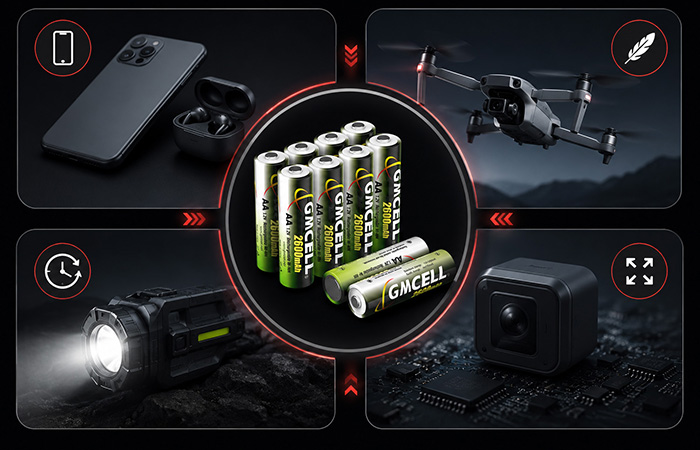
Portable Devices
Phones, tablets, drones, cameras, handheld tools, and consumer electronics often need high energy density and long runtime in a small form factor.
Weight-Sensitive Equipment
If every gram affects user experience, mobility, or installation design, lithium-ion’s high energy-to-weight ratio becomes a major advantage.
Long Runtime Requirements
For products that must run for long periods between charges under higher load, lithium-ion can provide stronger runtime advantages.
Compact Electronics
When internal space is limited and the battery must deliver more energy from a smaller volume, lithium-ion is often the practical choice.
The honest answer is not “NiMH is better” or “lithium-ion is better.” The better question is: which chemistry creates the right balance of performance, safety, serviceability, and lifecycle risk for your application?
The Future Is Not One Battery Chemistry
As AI, edge computing, industrial automation, medical devices, and smart infrastructure continue to expand, battery selection will become more application-specific — not less. More devices will need backup power. More systems will operate outside traditional consumer environments. More OEMs will need to balance performance with safety, compliance, service life, and supply continuity.
That does not mean NiMH technology will replace lithium-ion. It also does not mean lithium-ion will completely remove the need for NiMH. The future is more likely to be a mixed battery landscape where different chemistries serve different engineering priorities.
Distributed devices need stable local power.
Remote systems need uptime and recovery.
Automation values reliability over novelty.
Devices need predictable backup behavior.
In this environment, battery chemistry should not be treated as a trend statement. It should be treated as an engineering decision. The best choice for a lightweight handheld device may not be the best choice for a backup control system. The best choice for a high-drain portable tool may not be the best choice for a utility meter expected to remain in service for many years.
NiMH will not replace lithium-ion. Lithium-ion will not completely replace NiMH. What truly decides the right battery chemistry is the application itself.
GMCELL Tech Perspective
Based on recent conversations with OEM customers, GMCELL Tech has observed a clear shift in how industrial buyers evaluate battery packs. Many teams are no longer focused only on maximum capacity or energy density. They are paying closer attention to lifecycle stability, long-term availability, and system reliability.
That shift makes sense. When a battery is used inside an industrial control system, medical device, emergency backup unit, or embedded electronics platform, the battery becomes part of the product’s long-term reliability strategy. A strong specification is useful, but a stable supply model, predictable performance, and replacement compatibility can be just as important.
Lifecycle Stability
OEMs want battery solutions that remain predictable across production, storage, service, and long replacement cycles.
Long-Term Availability
Long product lifecycles require compatible battery packs, stable sourcing, and supplier support beyond the initial order.
System Reliability
The battery should support the product’s uptime, recovery behavior, maintenance planning, and real-world service expectations.
For many industrial OEMs, the future of battery selection is not about chasing the highest capacity number. It is about choosing the chemistry, pack design, and supplier model that reduce uncertainty across the full product lifecycle.
FAQ About NiMH Battery Packs for Industrial OEMs
If you are comparing NiMH battery packs, lithium-ion batteries, and other OEM battery pack options, the right choice depends on your application, risk tolerance, service model, and expected product lifecycle.
Why do some OEMs still choose NiMH instead of lithium-ion?
Some OEMs still choose NiMH battery packs because their products value reliability, predictable discharge, long-term availability, and service stability more than maximum energy density. In many industrial control systems, backup devices, and embedded electronics, the battery is not selected to chase the highest capacity number. It is selected to reduce operational uncertainty over years of use.
Are NiMH battery packs safer than lithium-ion batteries?
NiMH battery packs are often considered a lower-risk choice for certain industrial applications because they generally have a more forgiving chemistry and simpler safety requirements than many lithium-ion systems. However, this does not mean NiMH is automatically safer in every design. Proper charging, pack construction, temperature control, and application matching are still important.
What industrial applications commonly use NiMH battery packs?
NiMH battery packs are commonly used in industrial backup power, PLC and HMI systems, controllers, portable medical equipment, diagnostic devices, emergency lighting, utility meters, RTC backup, memory backup, and other embedded systems where stable operation and long-term serviceability matter.
How long do industrial NiMH battery packs typically last?
The service life of an industrial NiMH battery pack depends on the cell quality, pack design, charging method, temperature, discharge depth, storage conditions, and replacement schedule. In OEM applications, buyers usually care not only about cycle life, but also about predictable replacement planning and compatibility over the product’s full lifecycle.
Do NiMH battery packs require a battery management system?
NiMH battery packs generally require less complex battery management than lithium-ion packs, but they still need proper charging control, temperature consideration, and suitable pack engineering. The exact design depends on the voltage, capacity, load, charging environment, and safety requirements of the device.
Are NiMH batteries easier to transport internationally?
NiMH batteries are often subject to fewer transportation restrictions than many lithium-ion battery systems, which can simplify global logistics in some cases. However, shipping rules can still depend on pack size, destination, carrier policy, packaging, labeling, and documentation requirements. OEM buyers should always confirm logistics requirements before mass shipment.
What factors matter most when selecting an OEM battery pack?
Important factors include energy density, safety, lifecycle stability, maintenance planning, supply continuity, transportation requirements, system complexity, and total cost of ownership. For industrial OEMs, the best battery pack is not always the one with the highest capacity. It is the one that fits the application with the lowest long-term risk.
Will NiMH batteries disappear as lithium-ion technology advances?
NiMH batteries are unlikely to disappear from industrial use simply because lithium-ion technology continues to improve. Lithium-ion is better for many compact, high-energy, weight-sensitive products. NiMH remains useful where stability, predictable behavior, replacement compatibility, and long-term support are more important. The future is not one battery chemistry, but application-specific battery selection.
For industrial OEMs, the strongest battery decision is rarely based on chemistry alone. It comes from matching the battery to the real application, the service model, and the product lifecycle.