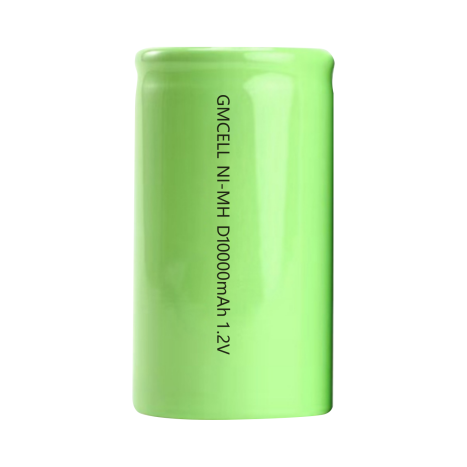
Description
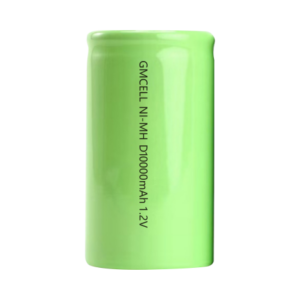
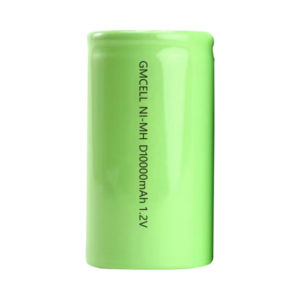
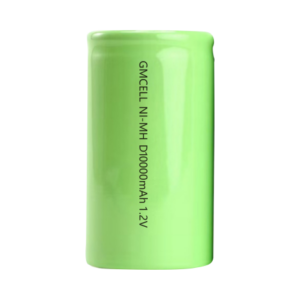
D 8000mAh NiMH Battery Product Attributes
Key Features:
1. Rechargeable nickel metal hydride cylindrical cell with 1.2V nominal voltage and 8000mAh nominal capacity.
2. Minimum capacity is 8000mAh under standard charge and discharge conditions.
3. Standard charge rate is 800mA for 16 hours at 20±5℃.
4. Quick charge rate is 4000mA for 2.4 hours with -ΔV=5mV/cell control.
5. Cell dimensions with tube are 33.0mm diameter and 60.0mm height.
6. Internal impedance is specified as no more than 18mΩ within 1 hour after standard charge.
7. Cycle life is specified as at least 500 cycles under IEC 61951-2:2017 test conditions.
| Type | Description |
|---|---|
| Category | Ni-MH Batteries |
| Battery Chemistry | Nickel Metal Hydride |
| Battery Type | Rechargeable Nickel Metal Hydride Cylindrical Cell |
| Model | GMCELL D8000mAh |
| Issued Date | 2024-06-11 |
| Voltage – Rated | 1.2 V |
| Nominal Capacity | 8000mAh |
| Minimum Capacity | 8000mAh |
| Standard Charge | 800mA (0.1C) × 16hrs at 20±5℃ |
| Quick Charge | 4000mA (0.5C) × 2.4hrs, -ΔV=5mV/cell, ambient temperature 10–40℃ |
| Trickle Charge | 0.02C–0.05C at 0–40℃ |
| Standard Discharge | 1600mA (0.2C) discharge to 1.0V/cell at 20±5℃ and 65±20% humidity |
| Maximum Discharge Current | 8000mA (1C), Ta=-20–60℃, 1.0V/cell cut-off |
| Open Circuit Voltage | ≥1.25V within 1 hour after standard charge |
| Internal Impedance | ≤18mΩ within 1 hour after standard charge |
| 0.2C Discharge | ≥300 minutes after standard charge and 1 hour rest before discharge; allow up to 3 cycles |
| 0.5C Discharge | ≥112 minutes after standard charge and 1 hour rest before discharge; allow up to 3 cycles |
| Charge Retention | ≥4800mAh (60%) after standard charge and storage for 28 days at ambient temperature or 7 days at 45℃, then standard discharge |
| Cycle Life | ≥500 cycles according to IEC 61951-2:2017 / 7.5.1.2 |
| Recommended Standard Charge Temperature | 20±5℃ |
| Recommended Fast Charge Temperature | 10–40℃ |
| Recommended Discharge Temperature | -20–60℃ |
| Recommended Storage Temperature | -20–35℃ |
| Storage Temperature Range | -20–25℃ within 1 year; -20–35℃ within 6 months; -20–45℃ within 1 month; -20–55℃ within 1 week |
| Storage Humidity | Relative humidity 65±20% |
| Dimensions with Tube | Diameter 33.0mm (+0/-1.0); height 60.0mm (+0/-1.5); top diameter 10.0mm; top height 0.6mm |
| Weight | Approx. 141.0g |
| External Appearance | Cell shall be free from cracks, scars, breakage, rust, discoloration, leakage, and deformation |
| Overcharge Test | 0.1C charge for 48 hours; no leakage nor deformation |
| Short Circuit Test | After standard charge, short circuit at 20±5℃ until the cell temperature returns to ambient temperature; inter-connecting circuitry resistance shall not exceed 0.1Ω; leakage and deformation may occur, but no explosion is allowed |
| Vibration Resistance | After 0.1C charge for 16hrs and 24hrs rest: amplitude 1.5mm, vibration 3000CPM, any direction for 60min; voltage change <0.02V/cell and internal impedance change <5mΩ/cell |
| Impact Resistance | After 0.1C charge for 16hrs and 24hrs rest, drop from 100cm onto a 30mm thick wooden board for 3 times in unspecified direction; voltage change <0.02V/cell and internal impedance change <5mΩ/cell |
| Leakage Test | No leakage nor deformation after standard charge and 14 days standing |
| Safety Test | Forced discharge at 20±5℃ with constant current 0.2ItA to 0V, then increase current to 1.0ItA and continue forced discharge for 60 minutes; no disrupt, burst, or explosion, while electrolyte leakage and deformation are acceptable |
| Delivery Charge | Normal conditions with electricity retained at 50%; special demands require confirmation after negotiation |
| Warranty | One year limited warranty against workmanship and material defects |
| Storage Note | Store at -20–35℃, low humidity, and no corrosive gases; long-term storage may require 1–3 charge/discharge cycles to reach maximum discharge capacity; after three months of storage, one charge/discharge cycle is required |
| Charging Method | Use the correct charger for Ni-MH batteries and follow the specified charging method |
| Safety Notes | Do not reverse charge, short circuit, solder directly to cells, incinerate, mutilate, remove the outer sleeve, put into water or seawater, mix new and semi-used batteries, or use under adverse conditions such as extreme temperature, deep cycling, excessive overcharge, or over-discharge |