
Why Engineers Prefer NiMH Battery Packs Over Standard Solutions
Battery selection is rarely based on capacity alone. You also need to consider operating voltage, discharge current, charging architecture, safety behavior, available installation space, maintenance frequency, environmental conditions, and the expected service life of your device.
Standard alkaline batteries and off-the-shelf lithium-ion packs may work well in many products, but they do not automatically meet the requirements of every industrial system, medical device, automotive application, or embedded platform. When predictable performance, robust safety behavior, repeatable cycling, and practical system integration matter more than maximum energy density, Nickel-Metal Hydride battery packs remain a valuable engineering option.
You may choose NiMH not because it is the newest battery chemistry, but because it is proven, configurable, and well understood. With appropriate cell matching, charging control, pack construction, and application-specific testing, a NiMH battery pack can provide a dependable alternative to a standard battery solution.
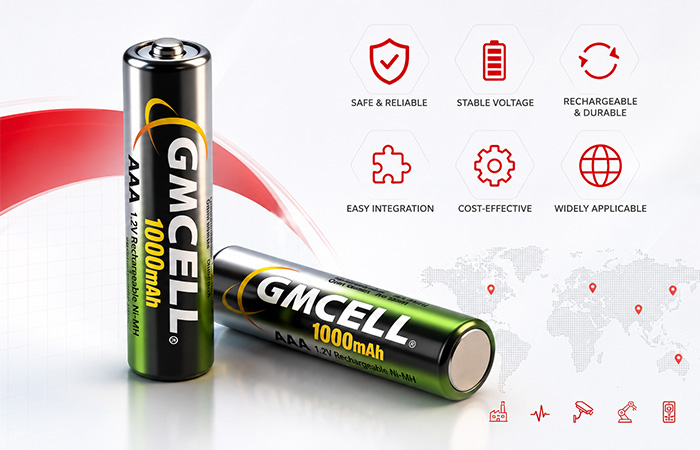
Understanding this preference requires looking beyond individual cell specifications and examining how the complete battery system behaves inside your final device.
Standard Battery Solutions Do Not Always Fit Real-World Devices
A standard battery may successfully power your prototype and still be unsuitable for long-term deployment. The difference often appears only after your device is exposed to repeated charging, peak current demands, temperature changes, vibration, long standby periods, or limited maintenance access.
Off-the-shelf batteries are designed to serve a broad range of products. Your application, however, has its own electrical, mechanical, charging, and environmental requirements. Even when the individual cells appear suitable on paper, a battery pack that does not match those conditions can create integration problems during production or after the equipment enters service.
Fixed Electrical Output
A standard pack may provide the wrong voltage, insufficient capacity, or inadequate current for your device.
Mechanical Mismatch
Fixed dimensions, battery holders, and cell arrangements may not fit the available installation space.
Connector Problems
Connector type, polarity, wire gauge, wire length, or cable exit direction may not match your assembly.
Peak-Current Limitations
A battery that supports average consumption may still struggle when motors, radios, pumps, or transmitters start.
Environmental Constraints
Standard products may not be tested for your required temperature range, vibration level, or standby period.
Limited Pack Testing
Loose or generic cells may not be matched and tested together under your actual charging and discharge conditions.
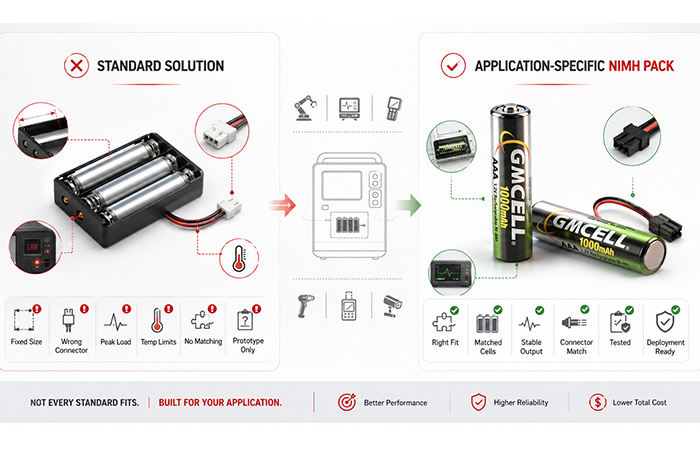
The engineering question is not simply, “Which battery has the highest capacity?” It is, “Which battery system best matches the operating conditions of your device?”
Safer Chemistry Supports More Predictable System Design
Safety is one of the strongest reasons you may continue to specify NiMH battery packs. NiMH cells use an aqueous electrolyte and generally present a lower fire and thermal-runaway risk than conventional lithium-ion cells that use flammable organic electrolytes.
This makes NiMH attractive for safety-critical equipment, medical instruments, industrial control systems, and embedded electronics where predictable behavior can be more important than achieving the highest possible energy density.
Lower risk does not mean zero risk
Excessive overcharging can still produce heat, gas, and internal pressure. Your design should include appropriate charge termination, temperature monitoring, ventilation, insulation, and pressure-relief considerations.
The advantage is therefore not the complete absence of risk. It is a more forgiving and well-established safety profile for many moderate-energy applications, provided that the complete battery system is designed and controlled correctly.
Safety alone does not determine battery suitability. You must also understand how the pack delivers voltage and current during actual operation.
Stable Voltage Under Load Benefits Electronic Devices
Voltage behavior is especially important when your equipment must operate consistently under changing loads. Alkaline batteries begin with a relatively high open-circuit voltage, but their voltage gradually decreases during discharge and can fall more quickly when your device draws a heavier current.
A properly selected NiMH Battery can provide the relatively flat discharge profile and repeatable current delivery required by industrial controllers, portable instruments, medical equipment, and embedded devices.
NiMH cells operate at a lower nominal voltage of approximately 1.2V per cell, but they usually maintain a flatter voltage level through much of their usable capacity. This can make your device performance easier to predict, particularly in high-drain electronics, motor-driven equipment, communication devices, and systems that need steady current rather than occasional low-power operation.
NiMH and Alkaline Performance at a Glance
| Engineering Factor | NiMH | Alkaline |
|---|---|---|
| Nominal cell voltage | About 1.2V | About 1.5V |
| Rechargeability | Rechargeable | Normally disposable |
| Voltage profile | Relatively flat | Gradually declining |
| High-current performance | Generally stronger | More load-dependent |
| Repeated use | Suitable | Requires replacement |
The higher nominal voltage of an alkaline cell does not automatically mean better performance. Your device electronics must be designed around the complete discharge profile, not only the initial voltage.
You must still account for the sharper voltage drop that occurs near the end of a NiMH discharge cycle. A suitable low-voltage cutoff helps prevent unstable equipment operation and reduces the risk of weaker cells being over-discharged in a multi-cell battery pack.
Simpler Battery Management Can Reduce Integration Complexity
NiMH battery packs can simplify certain aspects of your system design. Compared with multi-cell lithium-ion packs, they may require less complex protection electronics because they do not depend on the same strict cell-level overvoltage and undervoltage limits.
In a multi-cell lithium-ion battery system, your design may require individual cell monitoring, balancing, overcharge protection, deep-discharge protection, short-circuit protection, and thermal safeguards. A NiMH pack may use a more straightforward architecture, but it still requires a charger and protection strategy that match the cell capacity, charge rate, operating temperature, and pack configuration.
Simpler does not mean unmanaged
Your NiMH charging system must still prevent excessive overcharge, control current, monitor temperature where necessary, and stop charging at the correct point.
Charging Controls Your Design May Require
Thermistor
Allows your charger or controller to monitor pack temperature during charging and operation.
Fuse
Helps interrupt excessive current caused by a short circuit or abnormal equipment condition.
Thermal Switch
Disconnects the circuit when the pack reaches a defined temperature threshold.
For your engineering team, the benefit is usually a mature and well-understood charging architecture rather than the complete elimination of control electronics. The exact design still depends on your required charging time, cell count, operating environment, current demand, and maintenance strategy.
NiMH reduces certain system complexities, but reliable performance still depends on correct charger and battery-pack design.
Rechargeability Can Reduce Long-Term Maintenance Costs
Battery cost should be evaluated across the life of your equipment rather than only at the time of purchase. Disposable alkaline batteries may appear inexpensive, but repeated replacement can increase labor, downtime, inventory requirements, maintenance visits, and waste-handling costs.
A rechargeable NiMH battery pack allows you to reuse the same power source across many charge and discharge cycles. Under appropriate conditions, quality NiMH cells commonly provide several hundred cycles. Carefully controlled applications may achieve considerably more, while harsh temperatures, excessive overcharging, or repeated deep discharge can shorten the pack’s useful life.
This can be especially valuable when your battery is installed inside remote monitoring equipment, sealed enclosures, medical devices, industrial control systems, or other equipment that is difficult or expensive to access.
Look Beyond the Initial Battery Price
Purchase Cost
The initial battery price is only one part of your total ownership cost.
Labor
Every replacement may require a technician, operator, or service visit.
Downtime
Equipment may need to stop operating while the battery is inspected or replaced.
Inventory
Frequent replacement requires more spare batteries, storage, and stock management.
Disposal
Used batteries still need to be collected, handled, and disposed of correctly.
What Determines Your Actual Cycle Life?
The economic advantage of NiMH often comes from reduced maintenance and repeatable use, not simply from a lower cell price.
Deep Discharge Still Requires Careful Management
NiMH cells are sometimes described as tolerant of deep discharge, but this statement requires qualification. In a series-connected battery pack, individual cells do not always reach empty at exactly the same time.
Differences in capacity, internal resistance, temperature, and aging can cause the weakest cell to reach its discharge limit before the rest of the pack. If your device continues drawing current after that point, the depleted cell may be driven into reverse polarity.
Repeated reversal can cause permanent capacity loss, increase internal resistance, and reduce the reliability of the complete battery pack. This is particularly important in multi-cell industrial battery packs, backup power systems, portable instruments, and embedded equipment that may remain connected until the device automatically shuts down.
Deep-discharge tolerance is not unlimited
A NiMH pack may tolerate some operating abuse, but repeatedly draining a multi-cell pack beyond its intended cutoff can damage weaker cells and shorten the service life of the entire battery system.
What Happens Inside a Series-Connected Pack?
Matched cells discharge together and supply the intended pack voltage to your device.
A lower-capacity or more heavily aged cell reaches its discharge limit before the others.
The rest of the pack continues forcing current through the depleted cell.
Reverse polarity may damage the cell and reduce future pack capacity and consistency.
How You Can Control Deep Discharge
Suitable Cutoff Voltage
Stop the equipment before the weakest cell is pushed below its safe operating range.
Cell Matching
Select cells with similar capacity, voltage, and internal resistance before pack assembly.
Application Testing
Verify the pack under your real current demand, temperature range, and shutdown conditions.
Aging Allowance
Account for the increasing performance differences that can develop as cells age.
Engineers therefore use suitable discharge cutoffs, matched cells, and application-specific testing to control discharge depth. Pack reliability depends not only on the battery chemistry, but also on how consistently the individual cells behave together throughout the product’s operating life.
This is one reason custom battery-pack engineering matters more than simply purchasing a group of individual rechargeable cells.
Cell Matching Improves Pack Consistency
A battery pack is only as reliable as its weakest cell. When cells with significantly different capacity, voltage, or internal resistance are connected in series, the weakest cell may reach full charge or full discharge before the others.
This difference can reduce your usable runtime, make charge termination less predictable, and increase the risk of overcharging or over-discharging individual cells. The effect becomes more important in multi-cell NiMH battery packs, industrial backup systems, medical equipment, and embedded devices expected to operate consistently over long service periods.
Cell matching helps reduce these differences before the pack is assembled. By selecting cells with similar electrical and performance characteristics, a manufacturer can give your battery pack a more balanced starting point and improve its behavior as one complete power system.
What Should Be Evaluated Before Pack Assembly?
Matching should consider more than the capacity number printed on the cell label.
Capacity
Cells with similar usable capacity are less likely to reach the end of discharge at significantly different times.
Open-Circuit Voltage
Voltage measurement helps identify cells that begin with noticeably different electrical conditions.
Internal Resistance
Similar internal resistance supports more consistent current delivery, voltage behavior, and heat generation.
Self-Discharge Behavior
Cells that lose charge at similar rates help the pack remain more balanced during storage and standby operation.
Charge Acceptance
Consistent charging response reduces the likelihood that one cell reaches full charge substantially earlier than the others.
Discharge Performance
Cells should respond consistently under the current demand and operating conditions expected in your equipment.
Matching cannot eliminate normal aging. Temperature differences, charging history, discharge depth, and repeated use will gradually change the characteristics of each cell. However, matching gives your pack a more consistent starting point and reduces the likelihood that one cell will prematurely limit the entire system.
Engineers often prefer professionally assembled NiMH packs because the cells are selected and tested as part of one system rather than treated as unrelated components.
International Shipping Is Often More Straightforward
Shipping and regulatory requirements can influence your battery choice, especially when you manufacture equipment for customers in multiple countries. Packaging rules, transport documents, carrier acceptance, labeling, testing requirements, and destination regulations can all affect the time and cost required to deliver your products.
Lithium-ion batteries are subject to detailed transport controls related to battery testing, state of charge, watt-hour ratings, packaging, labeling, documentation, and the way batteries are shipped inside equipment or as separate components. These requirements are important, but they can add complexity to your logistics process.
NiMH batteries are often easier to transport when they are correctly packaged and protected against short circuits and accidental activation. This does not mean they are exempt from every transportation requirement. It means they are often subject to fewer transport complications than lithium-ion batteries, depending on the shipment method, pack design, carrier, and destination.
Typical Transport Considerations
| Shipping Factor | NiMH | Lithium-Ion |
|---|---|---|
| Watt-hour rating controls | Generally not the central classification factor | Frequently influences transport conditions |
| State-of-charge controls | Usually less complex | May apply to certain air shipments |
| Specialized labeling | Often more straightforward | Commonly required under applicable conditions |
| Short-circuit protection | Still required | Required |
| Overall logistics complexity | Often lower | Often more controlled |
What You Still Need to Control
A simpler process does not remove your responsibility to prepare the battery and equipment correctly.
Prevent Short Circuits
Terminals and connectors should not be able to contact conductive objects during transport.
Protect Terminals
Exposed terminals should be insulated, capped, separated, or protected by the product enclosure.
Prevent Activation
Equipment controls should not be able to switch on accidentally inside the shipment.
Use Suitable Packaging
The pack should be protected against movement, crushing, impact, moisture, and connector damage.
Confirm Local Rules
Check the current requirements of your carrier, transport mode, origin, destination, and product category.
Avoid describing NiMH as unrestricted
The applicable requirements can change according to whether batteries are shipped separately, installed in equipment, sent by air or sea, and delivered to a particular country. Your shipping plan should always be confirmed against the current carrier and regulatory requirements.
For OEMs shipping completed industrial equipment, replacement battery packs, medical devices, or service components across multiple markets, a more straightforward logistics process can reduce packaging work, documentation demands, and shipment delays.
NiMH batteries are often subject to fewer transport complications than lithium-ion batteries, but correct packaging and current shipping compliance remain essential.
NiMH and Lithium-Ion Serve Different Engineering Priorities
Lithium-ion remains the preferred choice for many portable products because it stores more energy in a smaller and lighter package. Smartphones, laptops, drones, and other weight-sensitive devices often benefit from this higher energy density.
NiMH becomes more attractive when your equipment has sufficient installation space and your design prioritizes robust safety behavior, high-current capability, established charging methods, durable cycling, and long-term serviceability.
A practical nimh battery vs lithium ion comparison should consider operating voltage, energy density, charging architecture, safety requirements, maintenance access, transport conditions, and expected service life rather than focusing on capacity alone.
Choose NiMH When You Prioritize
Choose Lithium-Ion When You Prioritize
Engineering Comparison at a Glance
| Engineering Priority | NiMH | Lithium-Ion |
|---|---|---|
| Energy density | Moderate | Higher |
| Nominal cell voltage | About 1.2V | Commonly 3.2–3.7V |
| Weight and size | Larger for equal stored energy | More compact and lighter |
| Safety architecture | Often more forgiving | Usually requires tighter protection |
| Fire risk | Generally lower | Higher if damaged or mismanaged |
| Protection complexity | Often simpler | Usually more comprehensive |
| Self-discharge | Generally higher | Generally lower |
| Typical advantage | Reliability and serviceability | Maximum energy in minimum space |
You should therefore choose between NiMH and lithium-ion according to the compromises your application can accept. There is no universal winner. The correct chemistry is the one that fits your required voltage, runtime, available space, safety architecture, maintenance strategy, and operating environment.
Lithium-ion often wins when energy density dominates. NiMH often remains competitive when robustness and practical integration matter more.
Custom Pack Design Solves Application-Specific Problems
Engineers often prefer the complete NiMH battery-pack solution, not simply the NiMH chemistry. A custom pack can be configured around the electrical, mechanical, charging, safety, and installation requirements of your final device.
The number of cells determines your pack voltage, while cell capacity and arrangement influence runtime, dimensions, current delivery, and available installation space. Connectors, wire length, wire gauge, temperature sensors, fuses, insulation, and enclosure design must also match the equipment.
This level of integration can reduce modification work during assembly and lower the risk of incorrect polarity, loose connections, unsuitable charging, excessive voltage drop, or insufficient current capability in industrial equipment, medical devices, embedded systems, and portable electronic instruments.
Electrical Configuration
Mechanical Configuration
Safety and Monitoring
What Application-Specific Pack Design Helps You Avoid
A custom battery pack allows the power system to fit your equipment instead of forcing your equipment to fit a generic battery.
Manufacturing Quality Matters as Much as Battery Chemistry
Battery chemistry alone does not guarantee reliable pack performance. Cell consistency, welding quality, wiring, insulation, connector polarity, mechanical construction, and final testing all influence how the battery behaves after it is installed in your equipment.
Poor welding can increase electrical resistance and create localized heating. Incorrect wire selection can cause voltage loss, while unmatched cells may reduce your usable runtime or cause one cell to reach its charge or discharge limit before the others. Inadequate insulation can also increase mechanical and electrical risk inside industrial equipment, medical instruments, embedded systems, and backup power applications.
Reliable battery-pack manufacturing therefore requires controlled processes, defined acceptance criteria, documented inspection, and application-specific validation rather than simply connecting individual cells together.
Cell Validation
Confirm the cells before assemblyAssembly Control
Build the pack around your designFinal Validation
Verify performance before deliveryManufacturers such as GMCELL support OEM battery projects through cell selection, pack configuration, connector customization, assembly, testing, and application-specific engineering.
For your engineering team, working with a manufacturer that can review voltage, current, dimensions, cell arrangement, connector requirements, charging conditions, temperature range, and testing expectations can reduce integration risk before mass production begins.
A reliable battery pack is the result of controlled cell selection, consistent assembly, application-specific testing, and documented quality inspection.
Where NiMH Battery Packs Commonly Excel
NiMH battery packs are especially useful when your application values predictable power delivery, rechargeable operation, established charging methods, high-current capability, and long-term serviceability more than minimum weight or maximum energy density.
Suitability still depends on the voltage, runtime, temperature range, available space, discharge current, charging system, maintenance interval, and regulatory requirements of your equipment.
Industrial Control Systems
Industrial control equipment often prioritizes predictable operation, serviceability, and long-term availability over minimum battery weight.
Medical and Laboratory Equipment
NiMH may be considered for selected medical and laboratory devices that require rechargeable power, predictable operation, and practical maintenance.
Battery selection must still follow the device-specific safety, validation, certification, and performance requirements.
Emergency and Security Systems
Emergency and security equipment often needs rechargeable standby power that remains available when the primary supply is interrupted.
Portable High-Drain Electronics
NiMH cells can support high-drain portable equipment that needs steady current and repeated charging without depending on maximum energy density.
Automotive and Hybrid Systems
NiMH has a long history in hybrid vehicle battery systems, where durability, power delivery, thermal tolerance, and established system behavior are important engineering priorities.
Embedded and IoT Equipment
A custom NiMH pack can be configured around the voltage, enclosure, connector, and maintenance requirements of embedded and connected devices.
Application fit should always be verified
The presence of NiMH in a product category does not mean every device in that category should use it. Your final selection should be based on electrical load, charging design, operating temperature, space, weight, service interval, safety requirements, and required certifications.
Across these applications, the common requirement is not maximum energy density. It is dependable power delivery under known operating and maintenance conditions.
Questions Engineers Should Ask Before Choosing a Battery Pack
Battery-pack selection should begin with the operating requirements of your device, not with a preferred chemistry or a capacity number from a product catalogue. Defining your electrical, mechanical, environmental, charging, maintenance, and compliance requirements first helps you compare NiMH, lithium-ion, alkaline, and other battery options more accurately.
The following questions can help you prepare a clearer specification for an industrial battery pack, medical-device battery, embedded power system, portable instrument, or OEM rechargeable battery project.
Electrical Requirements
Define how much voltage, current, energy, and runtime your device actually needs.
What nominal voltage does your device require?
The required voltage determines the number of cells connected in series and influences the charger, cutoff point, and pack configuration.
What operating-voltage range can your electronics accept?
Your electronics must tolerate the battery voltage immediately after charging and near the end of discharge.
What are the continuous and peak current demands?
Motors, radios, pumps, displays, heaters, and transmitters may create short peak loads far above the normal operating current.
How long must your device operate between charges?
Required runtime should be calculated from the real duty cycle rather than the maximum current alone.
What end-of-discharge voltage will your system use?
A suitable cutoff helps prevent unstable device behavior and reduces the risk of weaker cells being over-discharged.
Mechanical and Environmental Requirements
Make sure the pack can fit, connect, and operate safely inside your final equipment.
How much space is available for the battery pack?
Record maximum length, width, height, mounting orientation, cable clearance, and connector access.
What operating-temperature range will the pack experience?
Specify charging, discharging, storage, and short-term temperature extremes separately.
Does your equipment require a custom connector?
Define connector series, pin assignment, polarity, wire gauge, wire length, exit direction, and strain relief.
Charging, Safety, and Maintenance
Define how the battery will be charged, protected, stored, inspected, and replaced.
How will the battery be charged?
Define charger voltage, current, charging time, termination method, temperature sensing, and whether charging occurs inside the device.
Can your device tolerate the battery’s self-discharge rate?
This is especially important for standby equipment, seasonal products, emergency systems, and devices stored for long periods.
How often can the battery be serviced or replaced?
A battery inside a sealed, remote, or continuously operating device may justify a different design from an easily accessible consumer product.
Does your pack need a thermistor, fuse, or thermal switch?
The answer depends on charge rate, fault-current risk, pack location, enclosure, operating temperature, and equipment safety architecture.
What cycle life do you expect from the battery?
Cycle life depends on charge rate, temperature, discharge depth, storage conditions, overcharge exposure, and cell quality.
Compliance and Production Planning
Confirm the documentation, testing, market, and production requirements before finalizing the design.
What transport and certification requirements apply?
Requirements may depend on battery chemistry, pack configuration, application, destination, transport mode, customer standard, and local regulation.
What production volume is planned?
Prototype quantity, pilot production, annual demand, forecast stability, and replacement demand can influence tooling, testing, packaging, and supply planning.
Information to Prepare Before Requesting a Battery-Pack Proposal
Providing the following details allows a battery manufacturer to evaluate your application more accurately and reduces repeated design revisions.
The correct battery pack is not simply the option with the highest capacity. It is the solution that fits your electrical load, available space, charging method, operating environment, maintenance plan, and compliance requirements.
Frequently Asked Questions About Battery Pack Selection
These answers address common questions you may encounter when defining a rechargeable battery pack for an industrial, medical, embedded, or portable application.
What information is needed to design a custom battery pack?
You should provide the required voltage, capacity, continuous and peak current, maximum dimensions, connector details, wire specifications, charging method, temperature range, protection requirements, certification market, and expected production volume.
How do I calculate the required battery-pack voltage?
Start with the nominal voltage and operating-voltage range accepted by your device. The battery chemistry and number of cells connected in series must keep the pack voltage within that range from full charge to the end-of-discharge cutoff.
Why must peak current be specified separately from average current?
Motors, pumps, transmitters, heaters, displays, and other loads may briefly draw much more current during startup or operation. A pack sized only for average consumption may experience excessive voltage drop or fail to support these short peak loads.
How does operating temperature affect battery-pack selection?
Temperature can affect capacity, internal resistance, charging efficiency, self-discharge, cycle life, and safety. You should specify separate temperature ranges for charging, discharging, storage, and short-term exposure.
Does every NiMH battery pack need a thermistor or fuse?
Not every pack requires the same components. A thermistor, fuse, thermal switch, or PTC may be appropriate depending on the charging rate, current demand, fault conditions, operating temperature, enclosure, and equipment safety design.
How should battery-pack cycle life be estimated?
Cycle life should be estimated under your actual charge rate, discharge depth, operating temperature, storage conditions, load profile, and maintenance practices. A laboratory cycle rating does not automatically represent service life inside the final device.
Why is the end-of-discharge voltage important?
The cutoff voltage helps prevent unstable equipment operation and excessive discharge. In a multi-cell pack, continuing to draw current after the weakest cell is depleted can drive that cell into reverse polarity and reduce pack life.
When should a custom pack be used instead of a standard battery?
A custom pack is useful when your device requires a specific voltage, capacity, cell arrangement, connector, wire length, enclosure, temperature sensor, protection component, mechanical structure, or application-specific test that standard products cannot provide.