
Solving Power Stability Issues in Industrial Devices with GMCell NiMH Batteries
Industrial devices are designed to operate reliably for years, but unstable power delivery can create unexpected downtime, data loss, and system failures. Unlike consumer electronics, industrial equipment cannot simply be restarted or replaced when power problems occur.
For engineers and system designers, power stability is not only about battery capacity. It is about maintaining predictable performance under real operating conditions, where voltage fluctuation, battery aging, charging management, and thermal stress can directly affect equipment reliability.
This is why many industrial applications continue to evaluate reliable rechargeable solutions such as NiMH Battery technology. With stable operating characteristics and proven long-term performance, NiMH solutions can help protect critical systems including industrial controllers, embedded devices, monitoring equipment, and backup power applications.
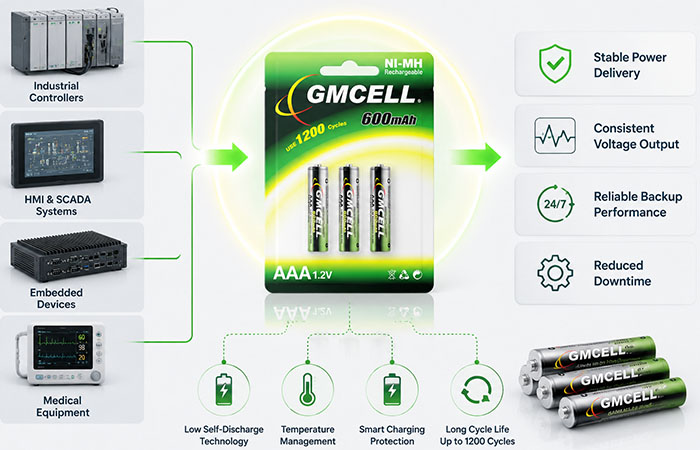
Why Power Stability Matters in Industrial Devices
When you design or maintain an industrial device, battery selection is not simply about how much energy can be stored. In real-world industrial environments, the most important requirement is often power stability — ensuring that critical systems continue operating predictably when unexpected power conditions occur.
Unlike consumer electronics, industrial equipment is usually expected to operate continuously for years. A smartphone can be restarted or replaced, but a failed industrial system may cause production delays, data loss, or expensive maintenance operations.
Industrial systems such as PLC controllers, industrial computers, smart meters, medical equipment, and IoT gateways depend on reliable backup power to protect system operation.
What Does a Reliable Industrial Battery Actually Protect?
Data Retention
During power interruptions, backup batteries help preserve configuration data, parameters, and system clock settings so equipment can recover correctly.
Controlled Shutdown
Sudden power loss may cause software errors, corrupted data, and production interruption. Stable backup power gives systems time to safely store information and complete critical operations.
Emergency Operation
Some industrial devices require short-term operation during unexpected events, including security systems and monitoring equipment.
In industrial applications, battery reliability is often measured by how predictably a system behaves during abnormal conditions.
Common Causes of Power Stability Problems
Understanding why industrial devices experience unstable power is the first step toward selecting the right battery solution. In many cases, failures are caused not by insufficient capacity, but by changes in electrical load, aging conditions, and environmental stress.
Voltage Sag During Heavy Loads
Industrial devices often experience sudden power demands during startup, communication activity, or motor operation. These events can create current spikes, motor startup loads, and communication peaks.
If the battery cannot respond quickly enough, the result may be a voltage drop that affects:
- controller reset
- sensor failure
- communication interruption
A properly designed NiMH Battery solution provides relatively stable voltage characteristics around its nominal 1.2V operating range. However, reliable performance still depends on proper cell matching, low internal resistance, and correct battery configuration.
Battery Aging and Performance Degradation
Industrial equipment is often installed for long periods. Over time, battery aging can increase internal resistance, reducing the battery’s ability to deliver stable current when needed.
This may result in:
- available current decreases
- voltage drops faster
- backup time becomes shorter
Using quality cells, proper charging control, and regular battery monitoring helps maintain long-term reliability.
Self-Discharge During Long Standby Periods
Many industrial devices do not operate continuously. Emergency systems and backup controllers may remain unused for weeks or months before they are required.
For these applications, Low Self-Discharge (LSD) NiMH technology helps maintain stored energy for longer periods and improves startup reliability when backup power is needed.
Thermal Stress and Battery Degradation
Temperature is another important factor affecting battery performance. High temperatures accelerate:
- capacity loss
- chemical degradation
- cycle life reduction
Temperature monitoring and proper charging management help reduce thermal stress and extend battery service life in demanding industrial environments.
How NiMH Batteries Improve Industrial Power Stability
When you select a battery for an industrial device, the goal is not simply to maximize stored energy. The real challenge is ensuring that your equipment receives stable and predictable power throughout its operating life.
NiMH battery technology has been widely adopted in industrial and embedded applications because it offers a balanced combination of voltage stability, recharge capability, and long-term operational reliability.
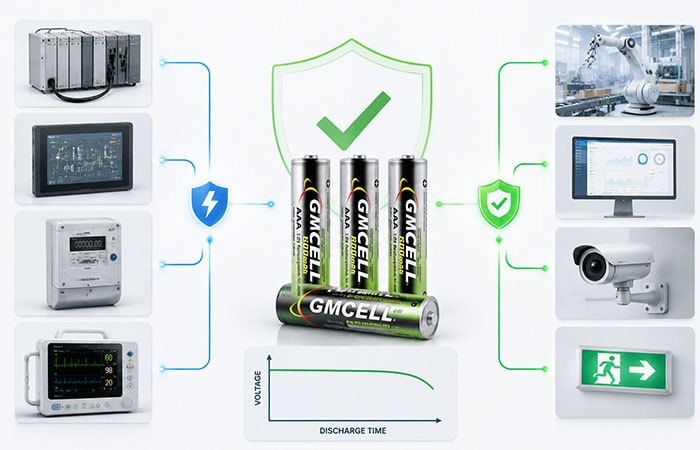
Stable Voltage Characteristics
NiMH batteries operate with a nominal voltage of 1.2V, providing a predictable voltage profile that fits many industrial electronic designs.
Unlike some battery technologies where voltage behavior may change significantly during discharge, NiMH batteries provide consistent performance across a large portion of their discharge cycle.
This predictable behavior makes NiMH suitable for applications such as:
Protecting stored parameters and system information during power interruptions.
Supporting stable operation for industrial control systems.
Providing reliable power for compact electronic systems.
Reliable Recharge Capability for Long-Term Operation
Many industrial devices are expected to operate for years with minimal maintenance. This means the battery must support repeated charging and discharging without frequent replacement.
NiMH technology is well suited for applications requiring hundreds or thousands of charge cycles, especially where predictable maintenance schedules and long service life are important.
Common applications include repeated charging systems, maintenance equipment, and industrial backup applications where reliability matters more than short-term maximum output.
Safer Chemistry for Industrial Environments
Lithium-ion batteries provide excellent energy density and are widely used in many industries. However, battery selection depends on the specific requirements of each application.
For many industrial systems, engineers often prioritize:
- safety characteristics
- predictable operation
- simplified maintenance requirements
Engineering Strategies to Maximize NiMH Battery Reliability
Choosing the right battery chemistry is only the first step. In industrial applications, battery reliability also depends on proper cell selection, charging design, thermal control, and system integration.
Selecting Low Self-Discharge NiMH Cells
Some industrial devices remain inactive for long periods before they are needed. For standby equipment, traditional batteries may lose available energy during storage.
Low Self-Discharge (LSD) NiMH technology helps maintain stored energy over extended periods, making it suitable for:
- standby equipment
- emergency devices
- backup systems
Optimizing Cell Configuration for Different Applications
Different industrial devices require different power characteristics. Selecting the correct cell format helps balance capacity, current output, and installation requirements.
| Cell Format | Application |
|---|---|
| AA | Sensors and controllers |
| AAA | Compact embedded devices |
| SC | Robotics and industrial tools |
| D | Backup power systems |
Smart Charging Control for Longer Battery Life
Charging management plays an important role in preventing premature battery failure. A well-designed charging system monitors:
- voltage change
- temperature change
Common technologies include ΔV detection, ΔT sensing, and NTC thermistors. These methods help prevent:
- overheating
- overcharging
- reduced lifespan
Thermal Management in Industrial Battery Packs
Battery pack design must consider environmental conditions to maintain stable performance over time.
Important design factors include:
- airflow management
- temperature monitoring
- charging speed control
NiMH Battery vs Lithium Ion: Choosing the Right Technology
When selecting a battery for industrial equipment, there is no universal solution that fits every application. Different devices have different requirements, and the best battery technology depends on factors such as operating environment, maintenance expectations, energy demand, and reliability goals.
Lithium-ion batteries are widely recognized for their high energy density, while NiMH Battery vs Lithium Ion comparisons often focus on the different advantages each technology provides in real-world applications.
| Factor | NiMH | Lithium Ion |
|---|---|---|
| Energy Density | Moderate | High |
| Voltage | Stable 1.2V | Higher voltage |
| Safety | Strong stability | Requires protection management |
| Maintenance | Simple | Requires BMS |
| Industrial Backup | Common | Application dependent |
When Lithium Ion Makes Sense
If your priority is maximum energy density and reducing battery size or weight, lithium-ion technology may be the preferred choice.
When NiMH Makes Sense
If your priority is stable operation, predictable performance, and long-term reliability, NiMH remains a practical choice for many industrial systems.
Industrial Applications Where NiMH Batteries Improve Reliability
The value of a battery is determined by how well it supports the equipment it powers. In many industrial environments, reliability means maintaining operation during unexpected events, reducing maintenance frequency, and ensuring predictable system recovery.
Industrial Control Systems
Industrial automation systems such as PLC controllers, HMI systems, and industrial computers depend on reliable backup power to maintain critical information.
NiMH battery solutions help support:
- memory retention
- system recovery
- stable controller operation
Medical Equipment
Medical devices often require dependable power because unexpected interruptions may affect monitoring accuracy and equipment availability.
Applications such as monitoring devices and portable instruments benefit from battery technologies that provide predictable performance and long service life.
IoT and Embedded Systems
Many IoT and embedded devices operate in remote locations where frequent maintenance is difficult.
These systems require:
- low maintenance requirements
- predictable power delivery
- long standby reliability
Security and Emergency Systems
Security equipment and emergency systems are often required to remain ready even when they are rarely activated.
In these applications, standby reliability is critical because the battery must perform when unexpected situations occur.
Why OEMs Choose GMCELL for Industrial Battery Solutions
Selecting an industrial battery supplier is not only about choosing a battery cell. For OEM customers, long-term reliability depends on whether the supplier can provide consistent quality, stable production, and solutions that match specific equipment requirements.
When evaluating battery partners, engineers and purchasing teams usually consider several important factors:
Manufacturing Consistency
Stable manufacturing processes help ensure that battery performance remains consistent across production batches.
Quality Control
Reliable industrial batteries require strict testing and quality management to support demanding applications.
Custom Battery Pack Capability
Different devices require different configurations, capacities, and connection designs.
Long-Term Supply Reliability
OEM projects often require stable supply capability throughout the product lifecycle.
GMCELL provides battery solutions for industrial and commercial applications, supporting customized requirements from battery cells to assembled packs. By combining manufacturing experience with flexible battery solutions, OEM customers can develop products that require dependable and predictable power performance.
How to Select the Right Industrial NiMH Battery Solution
Choosing the right industrial battery requires more than comparing capacity numbers. The best solution depends on how your equipment operates, where it is installed, and how frequently it requires power support.
1. Power Requirements
Start by understanding the electrical requirements of your device.
- Voltage requirement
- Current demand
- Load characteristics
2. Operating Environment
Environmental conditions directly influence battery performance and service life.
- Operating temperature
- Humidity conditions
- Installation environment
3. Charging Frequency
Consider whether the battery operates in a frequent charging cycle environment or remains in long standby conditions. This helps determine the most suitable battery configuration.
4. Required Lifetime
Industrial equipment is often expected to operate for many years. Battery selection should consider cycle life, maintenance requirements, and replacement intervals.
5. Space Limitation
The available installation space affects battery size, cell configuration, and pack design. A suitable solution balances physical dimensions with required performance.
Building Reliable Industrial Power Starts with the Right Battery Choice
Industrial battery selection is not simply a competition for higher capacity. The most suitable solution depends on whether the battery can provide stable performance throughout the equipment lifecycle.
For many industrial applications, the key factors are stable voltage, predictable performance, safety, and lifecycle reliability. NiMH remains a practical technology for applications where dependable operation matters.
Frequently Asked Questions About Industrial NiMH Battery Reliability
Choosing the right battery for industrial equipment often requires understanding how battery technology affects system reliability, maintenance requirements, and long-term performance. Below are common questions engineers and OEM customers consider when evaluating industrial NiMH battery solutions.
Why do industrial devices need stable battery power?
Industrial devices depend on stable power to maintain important system information, including data records, configuration parameters, and system status. Power fluctuations may cause equipment resets, data loss, communication problems, and increased maintenance costs.
How do NiMH batteries improve industrial power stability?
NiMH batteries provide predictable voltage characteristics, reliable recharge capability, and stable performance for many industrial applications. Their consistent operation makes them suitable for systems requiring backup power reliability, stable voltage output, and long service life.
Are NiMH batteries suitable for industrial backup applications?
Yes. NiMH batteries are commonly used in backup systems, industrial controllers, embedded devices, and equipment that requires dependable standby power. They are especially valuable where predictable performance and reliability are more important than maximum energy density.
Why is battery voltage stability important in industrial systems?
Stable voltage helps prevent problems such as controller resets, communication failures, and unexpected equipment shutdowns. Industrial electronics often require predictable voltage behavior to maintain reliable operation.
What is LSD NiMH battery technology?
Low Self-Discharge (LSD) NiMH batteries are designed to retain more stored energy during long standby periods. This makes them suitable for emergency equipment, backup systems, and applications where batteries may remain unused for extended periods.
How does temperature affect NiMH battery performance?
High temperatures can accelerate battery aging by increasing chemical stress and reducing available capacity. Proper temperature monitoring and charging control help extend NiMH battery service life and maintain reliable operation.
NiMH vs lithium ion: Which is better for industrial devices?
Neither technology is universally better. Lithium-ion batteries provide higher energy density, making them suitable for applications where size and weight are critical. NiMH batteries provide stable operation, predictable performance, and proven reliability for many industrial applications.
What NiMH battery size is commonly used in industrial applications?
Common NiMH battery formats include AA, AAA, SC, and D cells. The appropriate size depends on required current output, capacity requirements, installation space, and application conditions.