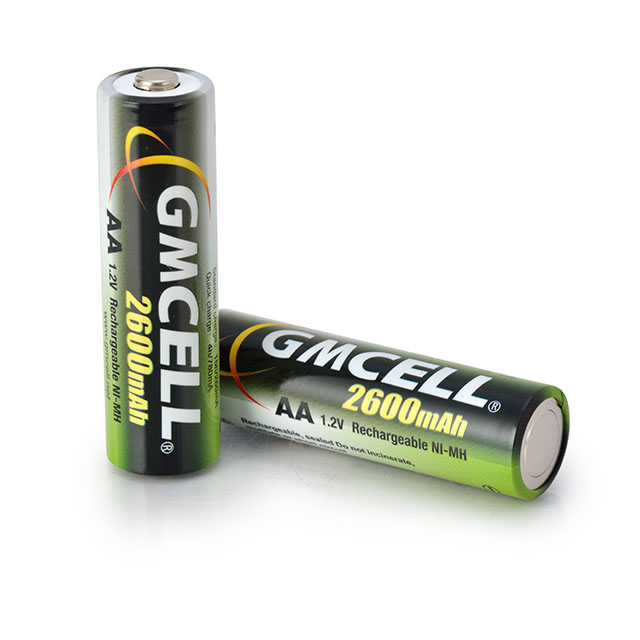
Description
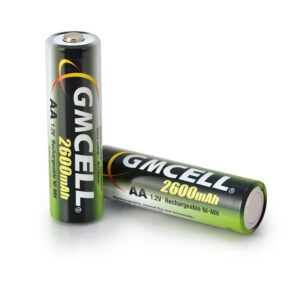
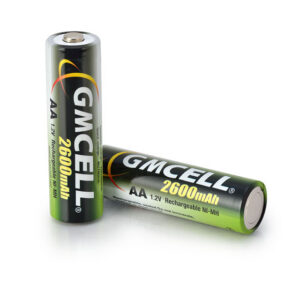
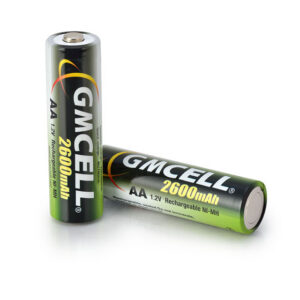
AAJ 1400mAh NiMH Battery Product Attributes
Key Features:
1. Rechargeable AAJ Ni-MH cylindrical cell with 1.2V nominal voltage and 1400mAh nominal capacity.
2. Minimum capacity is 1400mAh under standard charge and discharge conditions.
3. Standard charge rate is 140mA for 16 hours at 20±5℃.
4. Quick charge rate is 700mA for 2.4 hours at 10–40℃ with -ΔV=5mV/Cell control.
5. Internal impedance is specified at ≤40mΩ within 1 hour after standard charge.
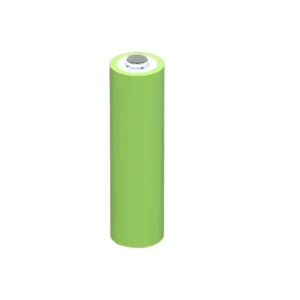
6. Cell size is 14.5(+0/-0.7)mm diameter and 50.5(+0/-1.0)mm height.
7. Maximum discharge current is 1400mA (1C), with discharge temperature from -20℃ to 60℃.
| Type | Description |
|---|---|
| Category | Ni-MH Batteries |
| Mfr | GMCELL |
| Series | GMCELL® |
| Part Status | Active |
| Battery Chemistry | Nickel Metal Hydride |
| Battery Type | Rechargeable Nickel Metal Hydride Cylindrical Cell |
| Model | GMCELL AAJ1400mAh |
| Battery Configuration | Single AAJ NiMH cell, 1 × 1.2V |
| Voltage – Rated | 1.2 V |
| Nominal Capacity | 1400mAh |
| Minimum Capacity | 1400mAh |
| Internal Impedance | ≤40mΩ within 1 hour after standard charge |
| Open Circuit Voltage | ≥1.25V within 1 hour after standard charge |
| Standard Charge | 140mA (0.1C) × 16 hours at 20±5℃ |
| Quick Charge | 700mA (0.5C) × 2.4 hours at 10–40℃, -ΔV=5mV/Cell |
| Trickle Charge | 0.02C–0.05C at 0–40℃ |
| Standard Discharge | 280mA (0.2C) discharge to 1.0V/Cell at 20±5℃ |
| Maximum Discharge Current | 1400mA (1C), -20℃ to 60℃, 1.0V/Cell cut-off |
| Low Rate Discharge | ≥300 minutes at 0.2C discharge after standard charge and 1 hour rest |
| High Rate Discharge 0.5C | ≥112 minutes at 0.5C discharge after standard charge and 1 hour rest |
| High Rate Discharge 1C | ≥51 minutes at 1C discharge after standard charge and 1 hour rest |
| Charge Retention | ≥840mAh, 60% after standard charge and 28 days ambient storage or 7 days at 45℃ |
| Overcharge | No leakage nor deformation after 0.1C charge for 48 hours |
| IEC Cycle Life Test | ≥500 cycles according to IEC 61951-2:2017 / 7.5.1.2 |
| Operating Temperature | Standard charge: 20±5℃; quick charge: 10–40℃; trickle charge: 0–40℃; discharge: -20–60℃ |
| Storage Temperature | Within 1 year: -20–25℃; within 6 months: -20–35℃; within 1 month: -20–45℃; within 1 week: -20–55℃ |
| Storage Recommendation | Store at -20℃ to 35℃, low humidity, and no corrosive gases |
| Relative Humidity | 65±20% |
| Dimensions | Diameter 14.5(+0/-0.7)mm; height 50.5(+0/-1.0)mm; top diameter 5.4mm; top height ≥1.0mm |
| Weight | Approx. 22.0g |
| External Appearance | Cell shall be free from cracks, scars, breakage, rust, discoloration, leakage, and deformation |
| Vibration Resistance | Voltage change <0.02V/cell and internal impedance change <5mΩ/cell after 1.5mm amplitude, 3000CPM vibration for 60 minutes |
| Impact Resistance | Voltage change <0.02V/cell and internal impedance change <5mΩ/cell after 100cm drop onto 30mm wooden board, 3 times |
| Leakage Test | No leakage nor deformation after standard charge and 14 days standing |
| Short Circuit Test | Leakage and deformation may occur, but no explosion is allowed |
| Safety Test | No disrupt, burst, or explosion during forced discharge test; electrolyte leakage and deformation are acceptable |
| Warranty | One year limited warranty against workmanship and material defects |
| Delivery Charge Requirement | Normal delivery electricity retain is 50%; special demands should be confirmed after negotiation |
| Long-Term Storage Note | Long-term storage may reduce capacity; 1–3 charge/discharge cycles may be needed to reach maximum discharge capacity |
| Storage Maintenance | After three months of storage, the battery needs one charge/discharge cycle |
| Charging Method | Use the correct charger for Ni-MH batteries and follow GMCELL technical charging instructions |
| Replacement Checkpoints | Confirm voltage, capacity, AAJ cell size, charge method, discharge current, storage condition, polarity, and pack assembly requirements before replacement or bulk supply |
| Shipping Info | Store and transport in a cool, dry place; avoid short circuit, reverse charge, excessive temperature, pressure, impact, water, and direct soldering to cells |